
India’s largest airline faces scrutiny after a massive flight disruption exposed deeper issues of regulatory delay, market dominance and safety lapses.
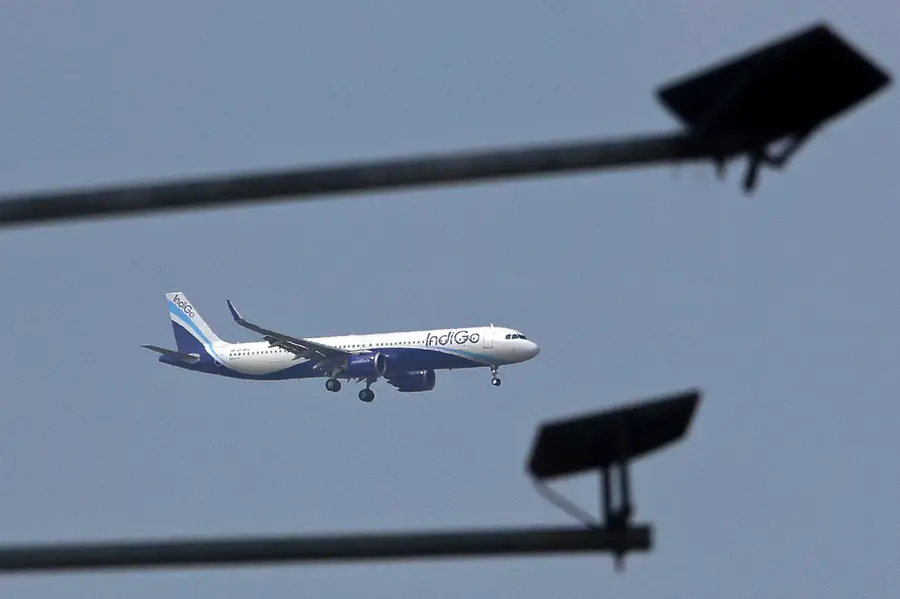
The aviation regulator, DGCA, first proposed new FDTL (Flight Duty Time Limitations) rules in January 2024. It was meant to give adequate rest to pilots in the interest of passenger safety. IndiGo ignored the implementation of new rules and, using political clout, took no action to recruit or train new pilots or even to adjust the schedules to comply with the new safety requirements. Pilot complaints were ignored, and allegations of monopoly abuse emerged. Pilots filed cases in courts. However, the DGCA continued to relax regulations to favour IndiGo.
After several postponements in favour of IndiGo, DGCA finally decided to implement new FDTL rules under the court orders, from 1 July and 1 November 2025 in two phases, two years after they were first proposed. As IndiGo was ill-prepared for the new rules, there were consequences.
The IndiGo schedules collapsed, and on 5 December 2025, over 1,000 IndiGo flights had to be cancelled. Thousands of passengers were stranded across Indian airports.
Today, IndiGo controls 64% of the Indian aviation market, while Tatas (Air India) have less than 28% market share. In 2004, there were 3.5 crore annual passengers and seven airlines. In 2025, passengers rose to 21 crore, with only two major airlines controlling over 90% market share. This represents a classic case of monopoly abuse and regulatory capture where the regulator ensures private profit instead of public interest.
What is the international experience of airline meltdown in developed markets? We do not have to look far. The December 2022 Southwest Airlines crisis in the US is a good example. The US aviation market has four big airlines, including Southwest, each with a market share of about 18%. The Southwest Airlines crisis began on December 21, 2022, when a severe winter storm hit large parts of the western and central U.S. In the next few days, many Southwest flights were cancelled. In all, Southwest ended up cancelling over 16,000 flights over the week, the largest such disruption in U.S. aviation history. Nearly 2 million passengers were stranded. While the winter storm triggered the initial disruption, deeper structural and operational weaknesses made it into a full-blown meltdown. Southwest used an old, inflexible system for rostering and managing flights. It could not handle cascading disruptions.
After the system got out of sync, the manual processes which took over could not cope up. Internal warnings by the pilots' union were ignored. The crisis was investigated by a Senate Committee. After a year of investigation in December 2023, the U.S. Department of Transportation (DoT) fined Southwest $140 million, the largest consumer-protection penalty ever levied on a U.S. airline. In addition to the fine, Southwest had to reimburse over $600 million to the passengers. The airline ended up spending, both directly and indirectly, over a billion USD. Later, Southwest upgraded its systems and, by early 2025, regained its strong on-time performance and returned to reliable service. The 2022 Southwest Airlines meltdown in the US remains a classic example of how fragile operational systems turned an ordinary weather event into an nation-wide catastrophe.
So what should be done about the IndiGo meltdown? Responsibility must be fixed. Passengers who suffered want heads to roll.
First, remove the Civil Aviation Minister Naidu for permitting the delay in the implementation of safety rules, which compromised passenger safety. He is accountable and must accept responsibility.
Second, remove the Director General of Civil Aviation and the top leadership of DGCA.
Third, terminate the services of Peter Elbers, CEO of IndiGo, who is directly responsible for operational failure. It is strange that everyone connected with IndiGo has apologised except the promoter.
A formal inquiry by DGCA should be conducted, with findings to be submitted within 15 days.
Impose financial penalties on IndiGo to create a compensation fund for passengers affected by cancellations. Section 27 of the Competition Act empowers the government to impose penalties of up to 10% of the company's average turnover. This is one of the strongest tools available to the government to prevent monopoly abuse in India.
Redistribute some of IndiGo's slots to other airlines.
Institute a Joint Parliamentary Committee (JPC) to specifically look into the possible nexus of IndiGo's (InterGlobe Aviation) political donation of ₹58 crore by electoral bonds to political parties, mainly the BJP. Did these donations embolden IndiGo to ignore DGCA's FDTL safety norms, postpone hiring new pilots and risk passenger safety?
Then there is a question of whether the air fares should be capped. On 31 August 2022, the then Civil Aviation Minister, Jyotiraditya Scindia, removed the fare cap, thereby allowing airlines to charge exorbitant fares. After the Odisha train accident, airlines reportedly charged as much as ₹1,00,000 for a Chennai-Bhubaneswar ticket. Following the IndiGo meltdown, the government reimposed the farecap on 5th December. Many developing countries cap air fares. However, the Civil Aviation Minister informed the Parliament last week that a permanent cap on air fares was not feasible. One can not accept that proposition. In a monopoly situation, there must be a fare cap or a price band. Why did the government remove the fare cap in the first place and allow the airlines to fleece the passengers? This should be investigated by the JPC.
In March 2025, Civil Aviation Minister Naidu had stated that India would require 30,000 new pilots over the next 15 years. On 25 November 2025, an Adani Group company acquired a majority stake in Flight Simulation Training Centre (FSTC), giving Adani significant control over India's pilot-training ecosystem. Just five days later, on 1 December, we witnessed the IndiGo meltdown. The JPC should examine if there is a connection.
The regulation of the Indian aviation sector needs to be completely restructured. This should be done by scrapping the current DGCA. India needs a new autonomous Civil Aviation Authority (CAA) under an act of Parliament similar to the US Federal Aviation Administration (FAA). It should include the DGCA, the Airport Authority of India, the Bureau of Civil Aviation Security, the Airport Economic Regulatory Authority and the Rajiv Gandhi Aviation University. This was proposed by the Manmohan Singh government in December 2012.
Unfortunately, while IndiGo was building and abusing its monopoly position, the Competition Commission was sleeping on the job. The Competition Commission can impose financial penalties on IndiGo to create a compensation fund for passengers affected by cancellations. Section 27 of the Competition Act empowers the government to impose penalties of up to 10% of the company's average turnover. This is one of the strongest tools available to the government to prevent monopoly abuse in India.
The government can impose drastic structural remedies to end a monopoly. Section 28 of the Competition Act empowers the government to consider breaking up IndiGo into two completely independent airlines. This was done in the US in the early 1900s under the Sherman and the Clayton Anti-Trust Acts. There would then be three equal-sized companies, each with a market share of 33%. This would act as a warning to other emerging monopolies.
(The author is a senior Congress leader and the 17th Chief Minister of Maharashtra from 2010 to 2014)
Published: 30 Dec 2025, 09:03 pm IST
Related Topics
Disclaimer: Kindly avoid objectionable, derogatory, unlawful and lewd comments, while responding to reports. Such comments are punishable under cyber laws. Please keep away from personal attacks. The opinions expressed here are the personal opinions of readers and not that of Mathrubhumi.
