
India has achieved a major feat by completing the world’s toughest high-altitude airbase at Nyoma in Ladakh — a concrete runway that withstands minus 40°C temperatures just 50 km from the China border.
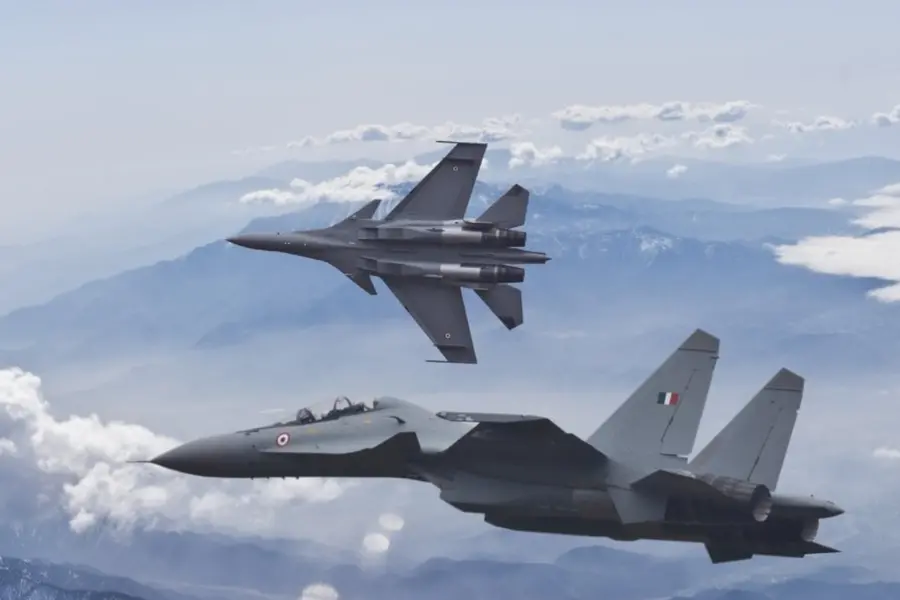
India has achieved a major milestone by operationalising one of the world’s highest airfields, turning it into the highest fully operational airbase capable of handling fighter jets, just 50 kilometres from the China border.
The newly upgraded Nyoma Airfield, perched at 13,700 feet in eastern Ladakh, can now handle MiG-29 and Sukhoi-30 MKI fighter jets, giving a massive boost to India’s air strength along the Line of Actual Control (LAC). This development not only strengthens India’s border defence but also signals the country’s growing capability to face challenges from China and Pakistan.
Also Read

The new airfield greatly improves India’s ability to watch, respond, and strike swiftly against any potential threats from China’s Xinjiang region or Pakistan’s northern areas. With Nyoma’s strategic location, the Air Force can now react faster, monitor enemy activity more effectively, and ensure stronger protection of the nation’s borders.
Earlier, India had constructed the world’s highest airstrip at Daulat Beg Oldie (DBO) at 16,600 feet, but harsh weather and operational challenges made it unsuitable for regular use. Nyoma, on the other hand, was found more reliable, acting as a strong support base for Leh and Thoise, where bad weather often disrupted operations. After a detailed study of both Nyoma and Fukche, the government found that Fukche, located in the Koyul Lungpa valley of eastern Ladakh, just 2.5 km from the LAC, had space and infrastructure issues, while Nyoma offered the right conditions for all-weather operations.
Also read: India’s ‘naval eye’ in space: CMS-03 to track every move in the Indian Ocean
Getting environmental clearance for the project wasn’t easy because Nyoma lies near the Changthang Wildlife Sanctuary, home to rare species such as the Kiang (Tibetan wild ass) and black-necked cranes. However, after agreeing to follow strict environmental rules, the Indian Air Force secured the required approval, balancing security needs with environmental care.
The Border Roads Organisation (BRO) took up the task of upgrading Nyoma, which was first opened in 2009. The old mud runway has now been transformed into a 2.7-kilometre-long concrete runway, enabling both fighter jets and heavy transport aircraft to operate easily even in difficult conditions. Following the 2020 standoff with China, the Central Government decided to turn Nyoma into a fully operational airbase, launching the project in 2021 under BRO’s Project Himank at an estimated cost of ₹220 crore.
According to the Defence Ministry, this achievement not only strengthens India’s Himalayan defence but also sends a strong message of readiness and resilience. As the world’s highest operational airbase, Nyoma enhances India’s airpower along the LAC, improving both deterrence and response capability in one of the most sensitive border regions.
The LAC, or Line of Actual Control, is the de facto border separating India and China. It is not clearly marked on the ground, which often leads to misunderstandings and clashes. During the 2020 standoff, aircraft such as the C-130J Super Hercules, AN-32, and helicopters like the MI-17, CH-47F Chinook, and AH-64E Apache had already landed at Nyoma, proving its strategic importance for high-altitude operations.
However, Nyoma’s location and altitude also bring challenges. It is the third-highest airfield in Ladakh, after Daulat Beg Oldie (16,800 ft) and Fukche (14,300 ft). The region faces temperatures as low as minus 40°C, along with heavy snow and strong winds, which can affect flights. The thin air at such heights reduces engine performance, forcing aircraft to use longer runways and carry less load. Storing fuel and lubricants is difficult in extreme cold, and electronic systems often face reliability issues.
Moreover, Nyoma’s proximity to the LAC makes it vulnerable to Chinese artillery (large long-range guns), tactical drones, and electronic warfare. Its remote location and limited road access make logistics harder, especially if supply routes come under attack. Some experts caution that Nyoma’s initial advantage could diminish in a prolonged conflict.
Yet, despite these challenges, Nyoma stands as a symbol of India’s resolve. It represents a bold step in high-altitude warfare preparedness, showing that India is willing to face nature’s toughest conditions to secure its borders. In a region where geography itself is a weapon, Nyoma shines as India’s silent sentinel in the sky — watching, ready, and unyielding.
Published: 01 Nov 2025, 11:45 am IST
Related Topics
Disclaimer: Kindly avoid objectionable, derogatory, unlawful and lewd comments, while responding to reports. Such comments are punishable under cyber laws. Please keep away from personal attacks. The opinions expressed here are the personal opinions of readers and not that of Mathrubhumi.