
India is set to take another major leap in space-based defence communication. On November 2, ISRO will launch CMS-03 (GSAT-7R) — a powerful military communication satellite — using its trusted LVM-3 rocket from Sriharikota. The mission will boost the Indian Navy’s secure communication network, strengthen maritime surveillance, and mark another milestone in India’s journey toward self-reliance in space technology.
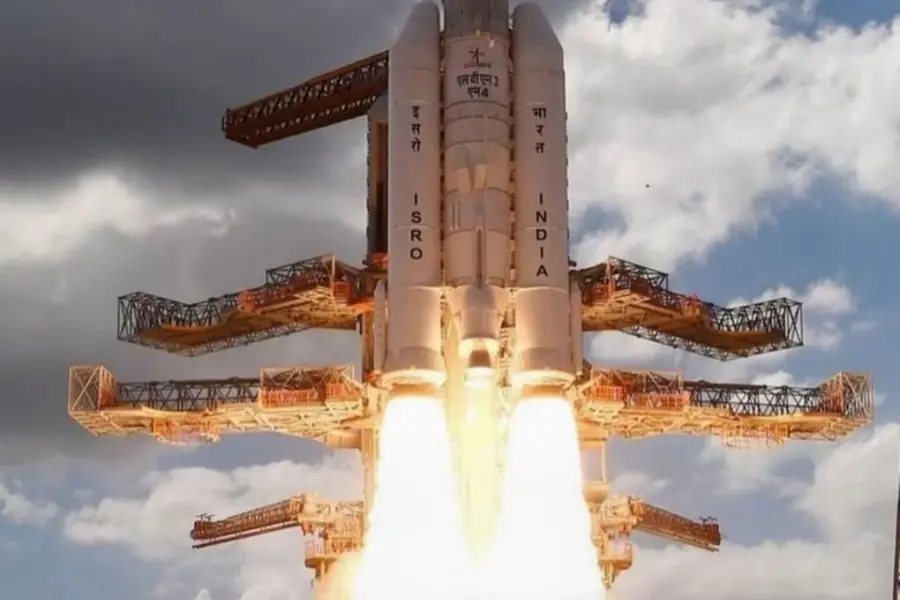
The 4,400-kilogram CMS-03 satellite will be launched by ISRO’s heavy-lift LVM-3 rocket during the LVM3-M5 mission. Once in space, it will be placed in a geostationary orbit, where it remains fixed over one point on Earth to provide continuous coverage. A Geostationary Orbit is a circular path about 35,786 km above Earth, where a satellite moves at the same speed as Earth’s rotation, appearing stationary and offering constant communication or weather coverage for that region.
The satellite will use multi-band frequencies — UHF, S, C, and Ku bands — to transmit voice, video, and data between Indian Navy ships, submarines, and aircraft. It will cover regions up to 2,000 km from India’s coastline, ensuring secure and reliable communication across the Indian Ocean region.
These — UHF, S, C, and Ku — are radio frequency bands used by satellites for efficient signal transmission:
UHF (Ultra High Frequency): Performs well even in bad weather; used for secure naval links.
S-band: Offers stable connections; used by ISRO for tracking rockets and satellites.
C-band: Ideal for long-distance communication; used in satellite TV and radar systems.
Ku-band: Provides faster data and clearer signals; used for internet and military communication.
Funded by the Ministry of Defence at a cost of ₹1,589 crore ($225.5 million), the CMS-03 is designed exclusively for the Indian Navy. It will replace the older GSAT-7 (Rukmini), which has been in service since 2013.
The LVM-3 (formerly GSLV Mk III) is India’s most powerful rocket, standing 43.5 meters tall and weighing 640 tonnes. It has three stages — two S200 solid boosters, a liquid-fueled L110 core with two Vikas engines, and a cryogenic upper stage (C25) powered by the CE20 engine.
By October 2025, LVM-3 will have completed seven successful launches, demonstrating exceptional reliability. Its eighth mission, LVM3-M5/CMS-03, is scheduled for November 2, 2025. The rocket can carry 4,000 kg to geostationary orbit and 10,000 kg to low Earth orbit. It has powered key missions like Chandrayaan-2 and Chandrayaan-3, and will also launch India’s first human space mission, Gaganyaan.
The CMS-03 satellite will greatly enhance the Indian Navy’s communication network, helping ships, submarines, and aircraft share critical information securely. It will improve coordination during missions, boost surveillance, and expand communication reach across the Indian Ocean, even in remote areas. Experts say this will make India more self-reliant and strengthen its ability to protect its maritime interests.
This launch also comes as global demand for secure communication and intelligence systems continues to grow. Major defence companies like Lockheed Martin, Northrop Grumman, Raytheon Technologies, and BAE Systems are leading innovation, while countries such as India, China, and Japan are developing their own satellites to strengthen defence and capture emerging space markets.
Currently, India holds less than 2% of the global space market, but it aims to increase it to 10% in the next decade. So far, ISRO has launched over 430 satellites for 34 countries, earning over ₹3,100 crore in revenue — proof of India’s growing influence in the global space economy.
Earlier, ISRO had launched the GSAT-7A satellite for the Indian Air Force (IAF). The GSAT-7 and GSAT-7A remain India’s only dedicated military communication satellites, while earlier earth observation and communication satellites were dual-use, serving both civilian and defence needs.
The author is a defence, aerospace & geopolitical analyst.
Published: 28 Oct 2025, 07:58 pm IST
Related Topics
Disclaimer: Kindly avoid objectionable, derogatory, unlawful and lewd comments, while responding to reports. Such comments are punishable under cyber laws. Please keep away from personal attacks. The opinions expressed here are the personal opinions of readers and not that of Mathrubhumi.
