
If India is to be taken seriously as a leading power in the Indo-Pacific rather than simply a large regional actor, it will need not just the ships, but the doctrine, the logistics, and the political will to use them the way Washington has for eight decades: Commodore (Dr) Johnson Odakkal (Retd)
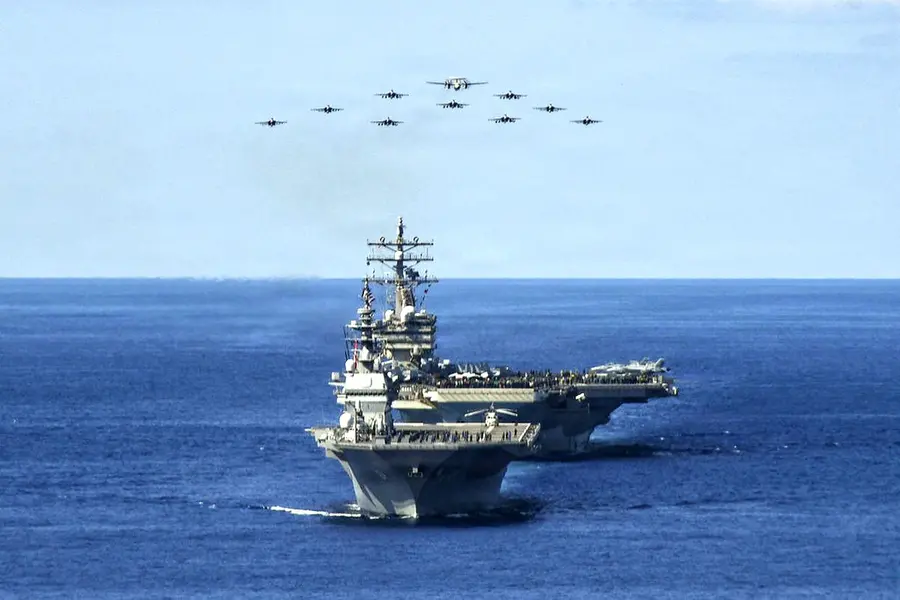
When a crisis erupts anywhere within reach of blue water, the first question asked in the White House Situation Room is rarely "should we send troops." It is, far more often, "where is the nearest carrier strike group."
That instinct -- reflexive, almost bureaucratic in its predictability -- reveals something important about how the United States has practiced foreign policy since 1945: naval airpower, concentrated in a single mobile platform, has become the default instrument of American statecraft short of war.
Carrier as a policy tool, not just a weapon
A carrier strike group -- the carrier itself, escorting cruisers and destroyers, a submarine, and a logistics train -- is often described in purely military terms: strike range, sortie generation, air wing composition. But its real value to policymakers lies elsewhere.
It is sovereign American territory that can loiter off any coastline without a basing agreement, an overflight clearance, or a host nation's permission. It can appear, linger, and depart on Washington's schedule alone. That independence from geography is precisely what makes it useful as a tool of diplomacy rather than merely of war-fighting.
Also Read: Turkey's Hurjet takes to the skies: How India's Tejas trainer stacks up
Successive administrations have used this fact deliberately. Carriers have been dispatched to the Taiwan Strait, the Eastern Mediterranean, the Persian Gulf, and the waters off the Korean Peninsula not primarily to fight, but to communicate — to allies, adversaries, and domestic audiences alike — that the United States is watching, capable, and willing to act. The ship's movement is itself the message.
Symbols of resolve in a crisis
This is the essence of what strategists call "presence diplomacy." A carrier's arrival off a contested coastline signals resolve without committing to combat. Its departure, timed carefully, can signal de-escalation just as clearly.
Because the platform is so visible and so unmistakably identified with American power, it carries symbolic weight disproportionate to what any single strike group could accomplish militarily. Adversaries read the deployment as a statement of intent; domestic audiences read it as evidence that their government is responding to a crisis; allies read it as reassurance that a security guarantee still has teeth.
This symbolism has a long pedigree. The phrase attributed to generations of American presidents — "where are the carriers?" — captures the reflex. It is not that carriers are always the best tool available. It is that no other instrument combines mobility, firepower, and visibility so effectively, at a moment when a president needs to demonstrate seriousness without asking Congress for a declaration of war.
Coercive diplomacy without trip-wire of war
The deeper logic here is what political scientists term coercive diplomacy: the use of a credible threat of force to alter an adversary's behavior without actually resorting to force.
A carrier strike group is close to an ideal instrument for this purpose because it offers escalation control. It can be reinforced. It can be pulled back. Its aircraft can fly patrols that are visible on radar and in the press without ever crossing into someone else's airspace or firing a weapon.
Also Read: Bangladesh's J-10CE gamble: Dhaka chooses China’s fighter jet over Rafale on fake claims
Few other military assets allow a government to dial coercive pressure up or down so precisely, in near real time, in response to an adversary's own behaviour.
This matters because most international crises are not actually resolved by war — they are resolved, or at least managed, by one side convincing the other that continuing on its present course carries unacceptable risk. A carrier group parked in international waters embodies that risk without requiring anyone to test it.
Why every major maritime power wants one
It is precisely this combination of flexibility and symbolism that explains why carrier capability remains so coveted among aspiring maritime powers, even in an era of long-range missiles and satellite surveillance that some analysts argue has made large surface ships vulnerable.
China's carrier program, India's indigenous carrier construction, the United Kingdom's return to fixed-wing carrier aviation, and France's continued investment in its own nuclear-powered carrier all reflect the same underlying calculation: a navy without organic airpower cannot credibly project force far from its own shores, and a nation without that capability cannot fully participate in the diplomacy of presence that carriers make possible.
A carrier is expensive, difficult to build, and vulnerable in a full peer conflict -- critics are right about all of this. But its purpose is rarely to fight a peer conflict. Its purpose is to make that conflict less likely by making the cost of miscalculation visible, and to give a nation's leadership options for signaling strength that fall well short of war. That is a capability few substitutes can replicate.
What this means for India
For India, the calculus is sharpened by geography and ambition alike. New Delhi sits astride the sea lanes connecting the Persian Gulf, East Africa, and Southeast Asia — arteries through which much of the world's energy and trade must pass.
An Indo-Pacific power that aspires to shape events in this space, rather than merely react to them, needs the ability to put airpower over these waters on short notice, independent of another country's bases or goodwill.
India's pursuit of a two, and eventually three, carrier navy — anchored by the indigenously built INS Vikrant alongside INS Vikramaditya — is best understood in this light. It is not primarily about warfighting against a specific adversary. It is about acquiring the vocabulary of presence diplomacy that great powers use routinely: the ability to reassure a partner, to signal displeasure to a rival, or to support a humanitarian or evacuation operation, all through the simple, deniable act of moving a carrier group into a given stretch of ocean.
The case for three is not sentimental. Two carriers can sustain presence on one coast at a time only by accepting gaps: a hull in refit, a second working up after deployment, and nothing held in reserve should a second contingency emerge on the other coast simultaneously. A three-carrier navy is what converts presence diplomacy from an occasional gesture into a standing capability -- one forward, one in workup, one in maintenance, on rotation, so that the Bay of Bengal and the Arabian Sea are never simultaneously uncovered. That arithmetic, not ambition, is what separates a navy that can occasionally show the flag from one that can credibly promise to always be somewhere.
If India is to be taken seriously as a leading power in the Indo-Pacific rather than simply a large regional actor, it will need not just the ships, but the doctrine, the logistics, and the political will to use them the way Washington has for eight decades: as instruments of resolve, deployed with precision, calibrated always to stop short of war.
New Delhi may not yet have an equivalent reflex — but the day may not be far when the first question in the National Command Post is not unlike Washington's: "Where is the carrier?"
The author is a maritime scholar, strategic affairs analyst, and Indian Navy veteran. He is an expert faculty and IBDP Examiner in Global Politics and Theory of Knowledge and an Adjunct Faculty of Maritime and Strategic Studies at Naval War College, Goa.
Published: 01 Sept 2026, 06:33 pm IST
Related Topics
Disclaimer: Kindly avoid objectionable, derogatory, unlawful and lewd comments, while responding to reports. Such comments are punishable under cyber laws. Please keep away from personal attacks. The opinions expressed here are the personal opinions of readers and not that of Mathrubhumi.
