

Discover the intricate art of making mridangam and tabla in Kerala. Meet Raju, a master craftsman whose passion and tradition bring percussion instruments to life.
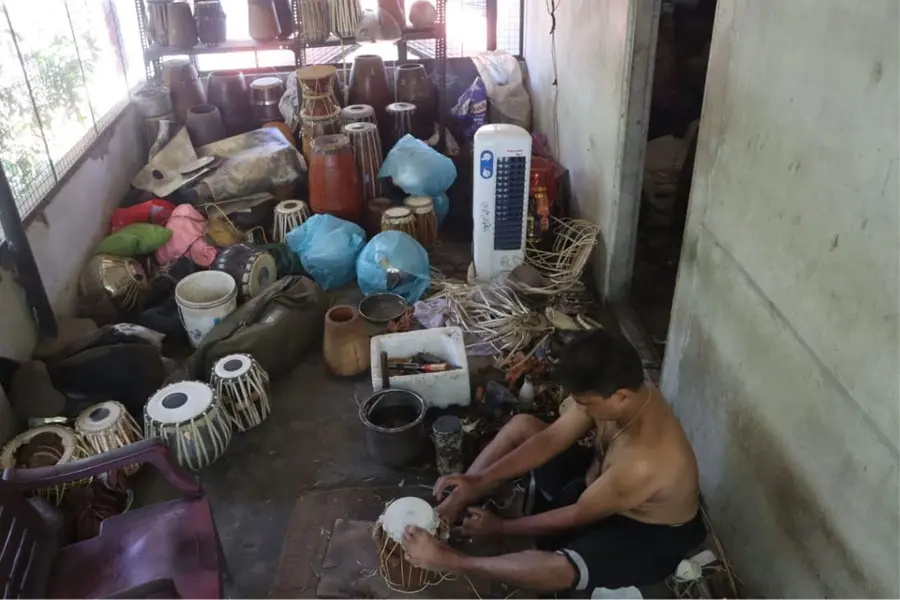
Festival season in Kerala, stretching from September to May, is a time of rhythm, travel, and devotion. Artists travel around the state, performing their traditional artforms, while percussion instruments, from mridangam and tabla to thudi, maram, and other tribal drums, undergo meticulous repair, tuning, and preparation.
Speaking to 'Mathrubhumi', Raju of Nedupuzha, Thrissur, shared insights from his 36 years of experience crafting these instruments, a journey shaped by patience, passion, and the teachings of his late guru, Johnson.
Introduction to music
“I started learning to make the mridangam and tabla when I was just 12,” Raju says. “My guru was Johnson. He is no more today, but without him, I am no one. Everything I know, every instrument I make, comes from his guidance. He taught me not just the craft, but how to respect the instrument as a living part of music.”
Raju’s introduction to music came almost by accident. “We were playing in Diwanjimoola, a colony area in Thrissur, when I heard a beat that caught my attention. At first, I didn’t know what it was,” he recalls. “When I followed it, I saw a group of men sitting together, singing with all their hearts. It was Mohanan, someone I knew, playing an instrument. Hesitant, I asked if I could sing along. He said yes. That small moment opened the door to a world of music, and eventually to my guru Johnson.”
The quest to know the art
From there, Raju was drawn to rhythm and harmony. “I would quietly watch the craftsmen working with my guru, Johnson, listening to the intricate beats. There was something magical about the way the sound seemed to grow out of the wood and skin. That’s when I knew I wanted to be part of it, not just as a performer, but as a maker.”
After completing his studies, Raju faced uncertainty. “I was wandering without a job, unsure what to do,” he says. “Then Johnson called and asked if I wanted to learn the art of making instruments. That single call changed my life.”
Johnson, Raju recalls, was a versatile craftsman. “He could make everything, mridangam, tabla, idaykka, and even other traditional and tribal instruments like thudi and maram. But he advised me to specialise in mridangam and tabla. ‘Focus deeply,’ he said. ‘That is how you leave your mark.’ I followed his advice, and it became my path.”
Peruvemba in Palakkad, a hub of skilled instrument makers, is a popular hub of mridangam making. For Thrissur, the Johnson way stands out. “It hits differently. The tone, the quality, nothing is compromised. Johnson insisted that every instrument must have its own soul. That’s what makes it special.”
The art of the mridangam
“The word ‘mridangam’ comes from the Sanskrit words ‘mrid’ meaning clay, and ‘ang’ meaning body,” Raju explains. “Early mridangams were made of hardened clay, fragile and prone to cracking. Over time, wood became the preferred material. Today, jackfruit wood is used for its hardness, durability, and resonance.”
The drumhead itself is a layered work of art. “We use buffalo skin for the outer layer, cow skin in the middle, and goat skin on top. In the early days, I would scrape the wood with a uli for just 12 rupees a day,” he recalls. “Now, with the Johnson way, each step is done with precision. Even a small mistake can ruin the sound of the instrument.”
The syahi making
A crucial element is the 'syahi' (mashi in Malayalam), the black paste that gives the mridangam or tabla its distinctive tonal character. “We use a stone called 'Puranakeedam' (usually said as lava stone), which contains iron filings. The iron energises the membrane,” he explains. “The stone is ground, mixed with rice to form a paste, and applied in layers. Each layer must dry completely before the next is added. Cracks are allowed to form naturally. Fine-tuning occurs as the syahi cures. This process can take time, but it is essential to produce the deep, resonant tones expected in performances.”
Raju emphasises the ritual-like nature of the work. “Every cut, every scraping of skin, every layer of syahi, it’s done with respect. The instrument is alive. You can hear it, feel it. The musician brings it to life, but we give it its body and soul.”
The craft of tabla making
Making a tabla follows a similar philosophy but requires its own unique techniques. “We use multiple layers of hide, usually 2 to 5 under layers, a central hide, and one top layer. Each layer is carefully stretched, pasted, and cured. Even slight differences in thickness or tension affect the pitch and tonal clarity,” Raju explains.
“The syahi on the tabla is even more sensitive,” he continues. “It’s applied in layers with precise measurements. Too thick, and the pitch is low; too thin, and the tonal quality is lost. It is a slow, painstaking process that requires patience and experience.”
Raju works with a team, Varghese, Mahesh, and Nikhil, who assist in every stage. “From peeling and drying the hides to shaping the drum shells, the team ensures every tabla and mridangam meets the highest standard. The final tuning is where the instrument truly comes alive. You listen, feel the vibration, and test how it resonates in different environments. Only then can a tabla be performance-ready.”
Changes in demand and the Art’s future
Raju reflects on how the craft has evolved. “Earlier, more work came from music schools that trained students in tabla and mridangam. But the number has decreased as students shift to newer genres rather than sticking to traditional ones,” he says. “Even so, I don’t feel regret. This is the art that gave me an identity and a livelihood. It continues to nurture me and my family and me. That, for me, is more than enough.”
“Many artists themselves come to us to repair their instruments,” he adds. “When they receive their mridangam or tabla back, perfectly restored, and see it resonate again like new, their satisfaction gives us immense joy. Knowing that we have returned their instrument’s soul to them, that feeling is elation in itself. It’s a reward beyond words.”
For Raju, making percussion instruments is about more than craftsmanship; it is a living tradition. “Every drum, every tabla carries the soul of the music it will produce. Festival season reminds us how much these instruments mean to performers and audiences alike. Every beat depends on the care we take in the workshop.”
“And for me,” he continues, “every instrument I make is a tribute to Johnson Ashan, who taught me everything I know. Even though he is no longer with us, his teachings guide every step. Without him, I would be nothing.”
As the festival season progresses, the carefully crafted instruments of Raju and his team resonate across Kerala, filling temples, auditoriums, and stages with their rich, vibrant sound. Behind each note is the story of patience, devotion, and the human touch that transforms wood, hide, and stone into living music.
Published: 17 Dec 2025, 03:30 pm IST
ABOUT THE AUTHOR
Disclaimer: Kindly avoid objectionable, derogatory, unlawful and lewd comments, while responding to reports. Such comments are punishable under cyber laws. Please keep away from personal attacks. The opinions expressed here are the personal opinions of readers and not that of Mathrubhumi.