
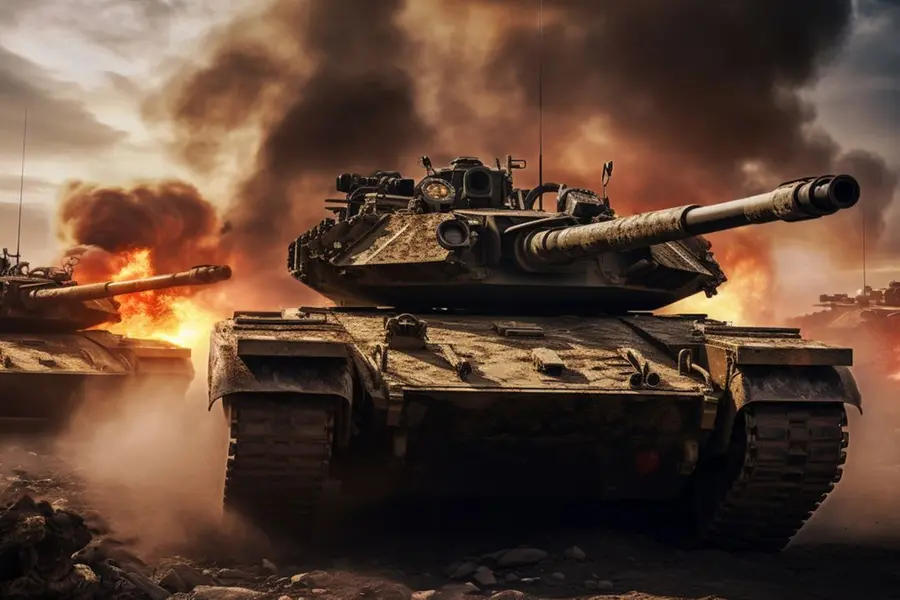
After years of planning, Ministry of Defence approved the army’s project to develop Future-Ready Combat Vehicles (FRCVs) as India’s primary battle tank by granting the Acceptance of Necessity (AoN) on September 3.
The Indian Army intends to introduce 1,770 futuristic battle tanks (FRCVs) to upgrade the armoured corps, with an estimated cost of approximately Rs 60,000 crore. Eventually, these next-generation Main Battle Tanks will take the place of the T-72M1 Ajeya tanks.
Also Read

According to officials in the defence sector, after receiving the AoN, the army will release an Expression of Interest (EoI) outlining the specific requirements and technology they are looking for. Interested firms will then submit their responses to this document. After reviewing the responses, a formal Request for Proposal (RFP) will be released.
Insiders mentioned that the army would select two development agencies, which are expected to be private sector companies. After this step, a project sanction order will be granted.
According to the Defence Acquisition Procedure (DAP), the entire process usually lasts 98 weeks (roughly 2 years). However, with the AoN approved, the process is expected to take around 6-8 months.
Following the plan, the chosen companies will create prototypes that will be tested before a final order is made. It is possible that the order may be divided between the two companies.
The army anticipates receiving the initial prototype within the next 3-4 years and commencing inductions by 2030.
Phasing Out Ageing T-72 Ajeya Tanks
The Indian Army possesses 2,414 ageing T-72 Ajeya tanks. While the T-90S tanks continue to form the core of the army’s tank fleet, India may be re-evaluating its reliance on Russian military technology.
According to a Press Information Bureau (PIB) release, the FRCVs are designed to offer superior mobility, all-terrain capabilities, multiple layers of protection, precision, lethal firepower and real-time situational awareness.
The RFI stated that the tank needs to be able to use advanced technologies, such as artificial intelligence, and function well in a network-centric and electronic warfare setting.
The FRCVs are intended to be used for the next 35-45 years. According to a project summary, the army wants it to be able to provide maximum effectiveness, protection and mobility in combat, along with a fully digital data system to support advanced capabilities and automation.
The FRCV will have a crew of four soldiers and must weigh around 55 tons. Powered with a 1500-hp engine, it needs to be transportable by existing aircraft, ships, trains and road according to the army’s specifications.
The 55-ton tank is expected to have a minimum range of 400 kilometres on rugged terrain or desert conditions and 500 kilometres on paved roads.
Main Weapons Featured by the FRCV
The tank will feature a main gun with a calibre of 120 mm or higher. It will be able to shoot three different types of rounds in both stationary and moving modes, during day or night:
* Armour-piercing, fin-stabilized discarding sabot
* High-explosive anti-tank
* High-explosive
The shells must have a minimum firing range of 2,500 metres, 1,600 metres and 5,000 metres for direct roles and 10,000 metres for indirect roles. The gun must also have the capability to launch anti-tank and anti-helicopter missiles with a minimum range of 500 metres (1,640 feet).
Two Secondary Weapons on the FRCV
The combat vehicle will have two secondary weapons:
* A coaxial machine gun that can hit targets at least 1,800 metres (5,905 feet) away, and
* An anti-aircraft machine gun that can strike air targets from a minimum distance of 1,500 metres (4,921 feet) and ground targets from up to 2,000 metres (6,561 feet)
The tank will be equipped with an AI-powered fire-control system that can switch between different modes based on the situation, such as hunter-killer, killer-killer and automatic target detection and tracking.
The fire-control system will work together with the Battlefield Management System and the Identification of Friend and Foe system to create a unified view for better control during combat.
Soft and Hard Kill Defence Systems
To counter modern anti-tank threats, the ministry has outlined the need for the tank to have an Active Protection System (APS), which includes a specialized Top Attack Protection System. The APS should have both soft and hard kill systems to detect and block such threats as laser targeting, missile launches and missile guidance, as well as to destroy, or deflect, incoming projectiles.
Additional protective features will include explosive reactive armour, adjustable non-explosive reactive armour, and belly protection against IEDs and mines with a blast force of at least 15 kg (33 pounds) of TNT.
The tank should also have protection against chemical, biological, radiological and nuclear threats, along with a quick fire detection and suppression system. It should include a missile warning system and stealth features to reduce acoustic, visual, infrared, thermal and electromagnetic signatures by 50 per cent within detection range.
Published: 05 Sept 2024, 01:55 pm IST
Related Topics
Disclaimer: Kindly avoid objectionable, derogatory, unlawful and lewd comments, while responding to reports. Such comments are punishable under cyber laws. Please keep away from personal attacks. The opinions expressed here are the personal opinions of readers and not that of Mathrubhumi.