
Spread across 13 venues at Kanakakkunnu, the festival brings together over 700 writers, thinkers, and public figures from India and abroad
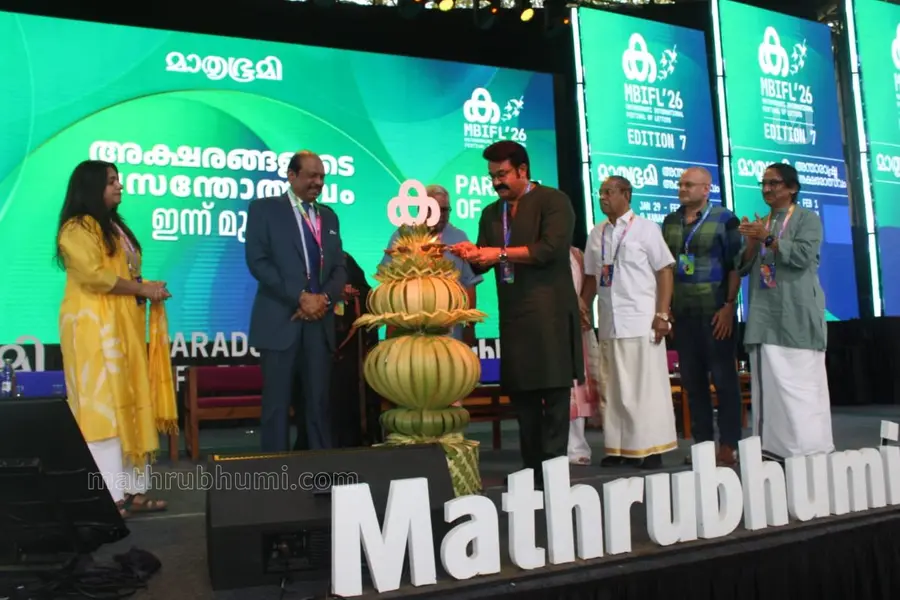
Thiruvananthapuram: The seventh edition of the Mathrubhumi International Festival of Letters (MBIFL) opened here on Thursday, with actor Mohanlal inaugurating the four-day festival, marking the start of a broad dialogue across literature, culture, and contemporary thought.
Lighting the ceremonial lamp, Mohanlal reflected on Malayalam’s century-long literary journey and his own connection with the written word. “From Indulekha to Randamoozham, Malayalam literature has completed nearly a hundred years of storytelling. From being merely an actor, it was literature that gave me these opportunities,” he said, adding that on stage he thought not of his roles, but of the writers who created them.
Calling Mathrubhumi “the word we wake up to,” he described the publication as an enduring cultural legacy. “For 103 years, Mathrubhumi has been part of our lives. It is not just a newspaper for Malayalis—it is an undying legacy. Let that journey continue,” he said.
Thanking the organisers for choosing Thiruvananthapuram as the host city, Mohanlal invoked its rich literary heritage, recalling figures such as C V Raman Pillai, P Kesavadev, O N V Kurup, Sugathakumari, and Malayattoor Ramakrishnan. Speaking nostalgically of reading handwritten screenplays by M T Vasudevan Nair, Lohithadas, Sreenivasan, and Ranjith, he noted that such manuscripts had become rare. “It will always remain an unfulfilled dream of mine to be a stranger in the crowd and enjoy this festival as one among many,” he said, before concluding his address by reciting a four-line verse from P Kunjiraman Nair’s Kaliyachan.
Chief guest M A Yusuff Ali paid tribute to M P Veerendra Kumar as a thinker and economist, recalling his books Gatt and Puppet Strings, which examined global trade and the World Trade Organisation. “What he wrote remains relevant even today. I urge people to read those works,” he said, adding that Mathrubhumi’s Naam Munnotu series, edited by K P Kesava Menon, had been formative in his understanding.
Writer K R Meera highlighted MBIFL’s emphasis on women in leadership, citing festival directors Mayura MS and Devika MS as key figures. Recalling her participation in the inaugural edition years ago, she said: “The person who attended my session then, without even a chair to sit on, was Veerendra Kumar. Big accolades are not what make life meaningful—it is moments like those.”
Tracing Mathrubhumi’s Gandhian legacy, KR Meera further noted that the newspaper’s first issue on March 18, 1923—marking one year of Mahatma Gandhi’s imprisonment—carried a Gandhi special on its seventh page, including a poem by Vallathol. “Mathrubhumi is not just a family; it is an emotion,” she said, adding that India’s freedom struggle is still ongoing and that the publication could never remain distant from it.
International keynote speaker Jonas Lüscher, the Swiss-German author of Kraft and Barbarian Spring, described MBIFL as a timely space for non-material conversations in an increasingly transactional world. On his first visit to India, he said he was struck by how long it had taken him to arrive. “Indian cinema, food and music had reached me even in the Swiss alpine pastures,” he said. Referring to recent Europe–India trade agreements and rising nationalism globally, Lüscher welcomed the festival’s focus on “non-monetary and non-materialistic things. These are as important as the trade of goods,” he said.
Literature, he added, expands intellectual horizons in a language distinct from commerce. “Our literary language is a cautious one—it allows self-doubt. Sometimes, it is more like listening,” he said, noting that stories and poems shared over the coming days would be carried home by audiences, yet remain with writers to share again and again.
Dignitaries including Festival curator Dr V Venu, Mathrubhumi Managing Director M V Shreyams Kumar, and Mathrubhumi Chairman PV Chandran were also present during the session.
Spread across 13 venues at Kanakakkunnu, the festival brings together over 700 writers, thinkers, and public figures from India and abroad. Sessions over the next four days span literature, art, history, philosophy, science, cinema, media, spirituality, and emerging fields such as artificial intelligence, alongside cultural performances and interactive engagements.
The Mathrubhumi International Festival of Letters will continue until February 1.
Published: 29 Jan 2026, 12:09 pm IST
Related Topics
Disclaimer: Kindly avoid objectionable, derogatory, unlawful and lewd comments, while responding to reports. Such comments are punishable under cyber laws. Please keep away from personal attacks. The opinions expressed here are the personal opinions of readers and not that of Mathrubhumi.
