

Award-winning playwright Ade Solanke and Indian director Deepan Sivaraman explore diaspora, visual storytelling, and theatre at MBIFL 2026, revealing how live performance shapes memory, movement, and audience experience.
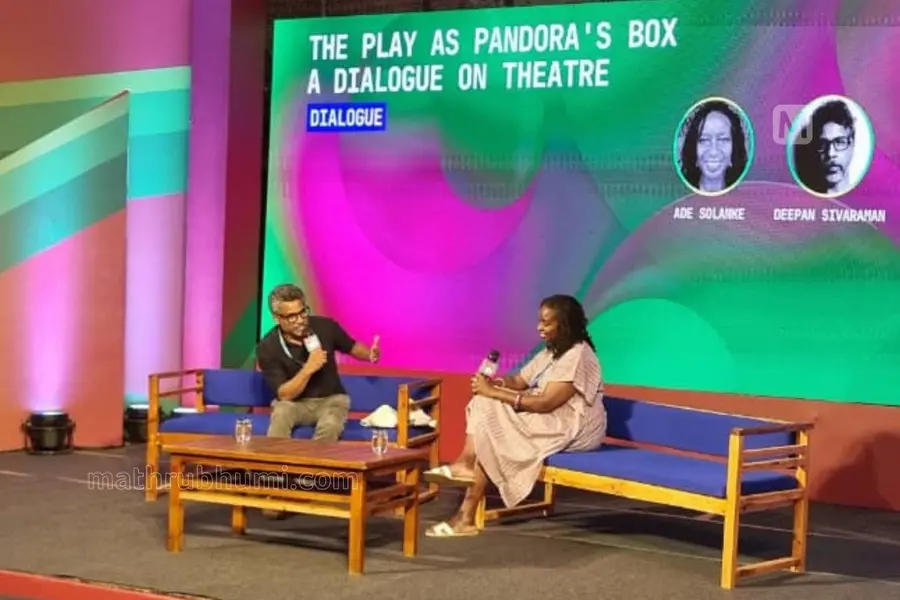
You could almost feel the stage come alive. At the Mathrubhumi International Festival of Letters 2026 (MBIFL), as the lights came up and the conversation unfolded, Ade Solanke, award-winning British-Nigerian playwright, screenwriter, and academic and Deepan Sivaraman, Indian theatre director, scenographer and academic, drew the audience into their worlds of memory, migration, and movement.
Ade Solanke, Artistic Director of Spora Stories, shared how her storytelling merges fact and imagination. “Factual writing can be imaginative and creative,” she said, reflecting on her first play, 'Pandora’s Box'. The play, described as “an exuberant and thought-provoking mix of comedy, tragedy, and family drama,” explores the dilemma of a British-Nigerian mother deciding whether to leave her son in a strict Nigerian boarding school or bring him back to London. “The diaspora is a recurring theme—migration, identity, and the constant question of how best to give to our children,” she added.
Deepan Sivaraman drew parallels with the Indian context, noting the prevalence of migration in Kerala. “Even I migrated to the UK for nearly 10 years. Like any diaspora, I sought familiar Asian faces to feel a sense of belonging,” he said, citing Benyamin’s novel 'Goat Life' to highlight struggles of displacement in general. He described his journey in Western theatre as challenging, navigating generalised notions about Indian culture, clothing, and aesthetics. “I consider myself a hybrid individual. Even when working with classical texts, I try to find a colloquial essence in every story,” he said.
The discussion emphasised the differences in storytelling techniques between the two artists. Ade focuses on family narratives and dialogue, while Deepan centres on movement and spectacle. “If you take well-known classical texts, you must place them in time and space so an interaction occurs with the audience,” he explained, referencing his production 'Khasakkinte Itihasam'. Ade added, “Theatre is visual storytelling, not just dialogue. The audience experience is carried through images and movement, not only the story.”
Both speakers reflected on challenges in theatre production. Ade highlighted the difficulty of attracting audiences to African stories in the UK, noting, “Producers often wonder who will pay to watch a play like this. Sometimes even security treats the audience differently, as they are not used to seeing diverse communities in theatre.” Her early career as a journalist, she said, helped develop essential listening skills, which she now applies to directing theatre.
Deepan noted practical challenges in India. “In Kerala, there is no concept of large production houses like in the West. Most productions rely on schools, open spaces, or limited funding. Only three theatres in Kerala have proper proscenium setups,” he said. Touring theatre, however, generates employment for 100–150 people, including technicians, stage builders, and lighting staff.
The conversation also reflected on the decline of intimate storytelling traditions in Kerala. Deepan recalled 'Kathaprasangam', a performance art where stories were narrated with songs and minimal instruments, and emphasised the need to preserve such cultural forms. Ade acknowledged European influences on her work, noting her decade-long experience abroad shaped her approach to theatre and playwriting.
Both agreed on a fundamental truth about theatre. “Theatre is an experience of time and space—you have to be in the space to experience it. It cannot be stored like a film or painting. Every conversation, every dialogue happens live, shared by performers and audience alike.” Deepan echoed the sentiment, concluding, “This is why people come to theatre—the shared, unrepeatable experience.”
Published: 30 Jan 2026, 07:53 pm IST
ABOUT THE AUTHOR
Disclaimer: Kindly avoid objectionable, derogatory, unlawful and lewd comments, while responding to reports. Such comments are punishable under cyber laws. Please keep away from personal attacks. The opinions expressed here are the personal opinions of readers and not that of Mathrubhumi.