

Translating humour demands more than linguistic skill. As Khyrunnisa A’s English works reach Malayalam readers, translators Kaikasi and K T Rajagopalan reflect on the challenges of preserving wit, culture and meaning across languages.
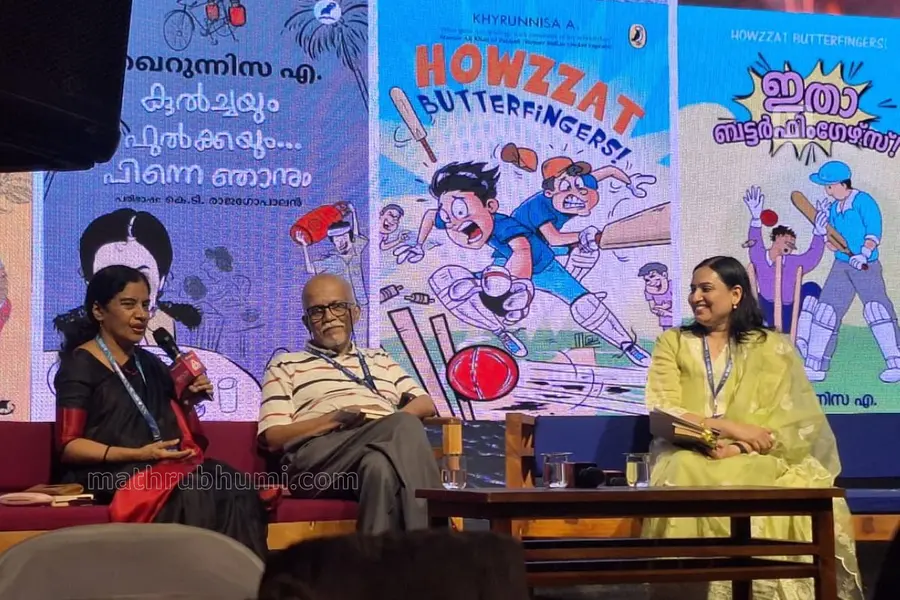
Thiruvananthapuram: Translating humour is notoriously tricky. Too literal, and the joke falls flat; too liberal, and the cultural essence disappears. This delicate balancing act confronted Kaikasi V S, bilingual poet and translator, and K T Rajagopalan, author and translator, as they worked to bring the English works of Khyrunnisa A into Malayalam.
Khyrunnisa A, the author of 18 books, has only recently seen two of her works reach Malayalam readers. 'Howzzat Butterfingers!' became 'Itha Butterfingers', translated by Kaikasi V S, while another collection was rendered by Rajagopalan as 'Kulchayum Phulkayum Pinne Njanum'. Both translators emphasise that rendering humour across languages is not merely technical—it is an art.
“Every language has its own vocabulary, grammar, and cultural nuances,” Khyrunnisa explains. “To transfer all that from English into Malayalam, retaining the humour and quirks, is a huge challenge.”
Kaikasi, who also moderated the session named 'Translating Humour: The Challenges and Joys' at Mathrubhumi International Festival of Letters (MBIFL 2026), recalls the early struggles with titles. Initial attempts to render the word 'Butterfingers' literally, as' Venna Kayyan'—roughly meaning ‘butter-handed’ in Malayalam—were quickly abandoned. The final choice, 'Itha Butterfingers', preserved the affectionate nickname and cricketing spirit. Her essay collection, 'Tongue in Cheek: The Funny Side of Life', required a different approach, relying on careful cultural adaptation rather than literal translation to retain its humour, remarked T K Rajagopalan.
Rajagopalan, whose formal education in Malayalam ended at class 10 and who studied English only as a second language at university, describes the painstaking process: translating a single word was manageable, a sentence could be tricky, a paragraph even harder, and a full article presented a complex puzzle. Humour, he notes, was the most challenging element, with jokes, idioms, and cricket commentary often lacking direct equivalents in Malayalam.
The work was highly collaborative. Rajagopalan typed translations daily, while Khyrunnisa’s husband, Professor Vijaykumar, read the English originals aloud so she could follow along and provide feedback. Mistakes were corrected, passages adjusted, and humour carefully preserved. Some jokes and cultural references had to be omitted when untranslatable, while others were creatively adapted—for instance, a pun involving a computer mouse became a reference to Ayurveda, keeping the playful intent alive for local readers.
Kaikasi said, Cultural context was another guiding principle. Words such as 'Pooram' cannot be translated literally; tied to temples and local myths, rendering them simply as “festival” would strip away their meaning. Even affectionate phrases, if translated without attention to nuance, risk losing both humour and sentiment. As Kaikasi puts it, “If you cannot translate something properly, leave it. Let the spirit of the work survive.”
Humour, widely recognised as the ultimate test for a translator, demands precision. Kaikasi likes to call it “catching a greasy pig in monsoon season,” where even a minor misstep—a pun, a cricket term, or a local idiom—can derail the joke. Yet when executed successfully, the story resonates in a new language, laughter intact and cultural flavour preserved.
Malayalam’s relative resistance to foreign borrowings further complicates translation. Iconic writers like Vaikom Muhammad Basheer took liberties with language, inventing playful terms that modern translators often cannot replicate. For Khyrunnisa’s work, translation was never a mechanical exercise, say the translators in unison. It was an act of creation, requiring bilingual skills, cultural sensitivity, and respect for the original text. The outcome is literature reborn in Malayalam, retaining the quirks, wit, and heart that made it beloved in English.
In the end, the discussion returned to a shared belief: translation is not about replacing one language with another, but about carrying meaning, memory and emotion across cultures. A successful translation does not announce itself; it allows readers to laugh, pause and reflect as though the work were originally written in their own language. For translators of humour, the task is especially unforgiving, demanding restraint as much as invention. Translation does more than bridge languages—it expands the life of a book, giving it new voices, new readers and a renewed sense of belonging.
Published: 31 Jan 2026, 06:01 pm IST
ABOUT THE AUTHOR
Disclaimer: Kindly avoid objectionable, derogatory, unlawful and lewd comments, while responding to reports. Such comments are punishable under cyber laws. Please keep away from personal attacks. The opinions expressed here are the personal opinions of readers and not that of Mathrubhumi.