
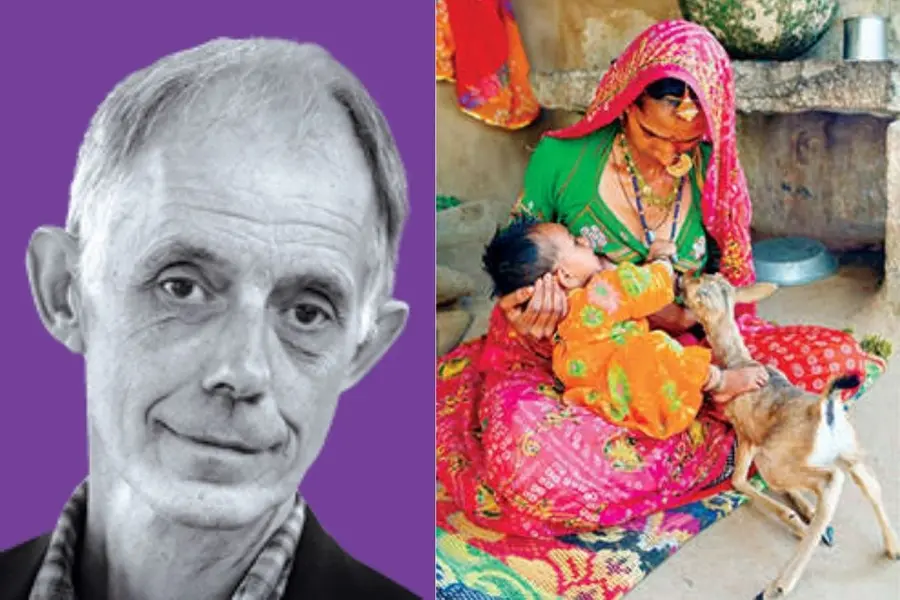
British journalist and author Martin Goodman, will discuss his book ‘My Head for a Tree: The Extraordinary Story of the Bishnoi, the World’s First Eco-Warriors’, the world’s first environmentalists living in the deserts of Rajasthan at MBIFL 2026.
When one hears the name Bishnoi, the first thought that comes to mind for many in the modern generation is the notorious gangster Lawrence Bishnoi — the leader of a gang with over a hundred sharpshooters worldwide, reportedly running operations from behind bars.
However, British journalist and author Martin Goodman, in his book ‘My Head for a Tree: The Extraordinary Story of the Bishnoi, the World’s First Eco-Warriors’, tells the story of a very different Bishnoi lineage — the world’s first environmentalists, still living in the deserts of Rajasthan. They have no connection whatsoever with Lawrence Bishnoi. In fact, they oppose his life and activities.
Martin Goodman will speak about the Bishnoi community and their remarkable way of life at the Mathrubhumi International Festival of Letters (MBIFL) 2026, which will be held from January 29 to February 1, 2026, at the Kanakakkunnu Palace in Thiruvananthapuram.
Book your tickets for MBIFL 2026 | https://store.mathrubhumi.com/mbifl/index.html
What makes the Bishnoi community unique?
The Bishnoi community, living in the heart of the Rajasthan desert, has maintained its ancient way of life since the 16th century. Bishnoi women raise their children and tend livestock together, passing down knowledge of their traditions through generations.
The guru of the Bishnoi community is Guru Jambheshwar, also called Jambhoji. He taught his followers not to fight nature, but to live in harmony with it — to worship and pray to it.
In 1780, in the desert village of Khejarli in Jodhpur, the trees known as Khejri covered the desert in greenery and were revered by all. One day, a village woman named Amrita witnessed royal soldiers arriving to cut down the Khejri trees for the construction of the king’s palace. She stood in front of the trees, holding them tightly. The soldiers attacked Amrita, and her children — Asu, Ratni, and Bhagu — who had followed their mother, were all killed.
When villagers learned of the attack, they rushed to the site. Everyone who had embraced the trees was killed. After 363 people had died, the king finally ordered his soldiers to leave. The Bishnoi community still draws strength from the sacrifice of Amrita and the 363 people who gave their lives for the trees. Amrita is revered even today as Amrita Devi.
The Bishnois not only worship trees but also respect animals. They do not hesitate to risk their lives to protect them. The Bishnoi Tiger Force (BTF), an organisation dedicated to this protection, still exists.
The community gained attention during the case involving Bollywood actor Salman Khan, who hunted blackbucks in the desert. The Bishnois gathered witnesses and worked with lawyers to file a case against Salman Khan. At the same time, they dismissed the death threats against Salman Khan too.
Once, at school, Martin Goodman asked a Bishnoi child named Chanchai, “I am a writer. If you were to write a book, what would it be about?” The child stood up and said, “We must protect birds, animals, and trees. No one should cut down trees or kill birds." ” Another child, Santosh, added, “Trees give us oxygen, and we cannot live without oxygen.” When asked about their aspirations, every child in that classroom said they wanted to strive to be good citizens.
Goodman’s book, which explores the depth and breadth of Bishnoi life, also includes striking photographs by French photographer Franck Vogel. One image shows a Bishnoi woman holding her infant on one side while cradling a blackbuck on the other — a powerful illustration of their devotion to both family and wildlife.
Published: 15 Jan 2026, 12:25 pm IST
Related Topics
Disclaimer: Kindly avoid objectionable, derogatory, unlawful and lewd comments, while responding to reports. Such comments are punishable under cyber laws. Please keep away from personal attacks. The opinions expressed here are the personal opinions of readers and not that of Mathrubhumi.
