
Many users stressed that they were not opposed to development but questioned whether adequate environmental studies had been carried out before construction began in an environmentally sensitive area.
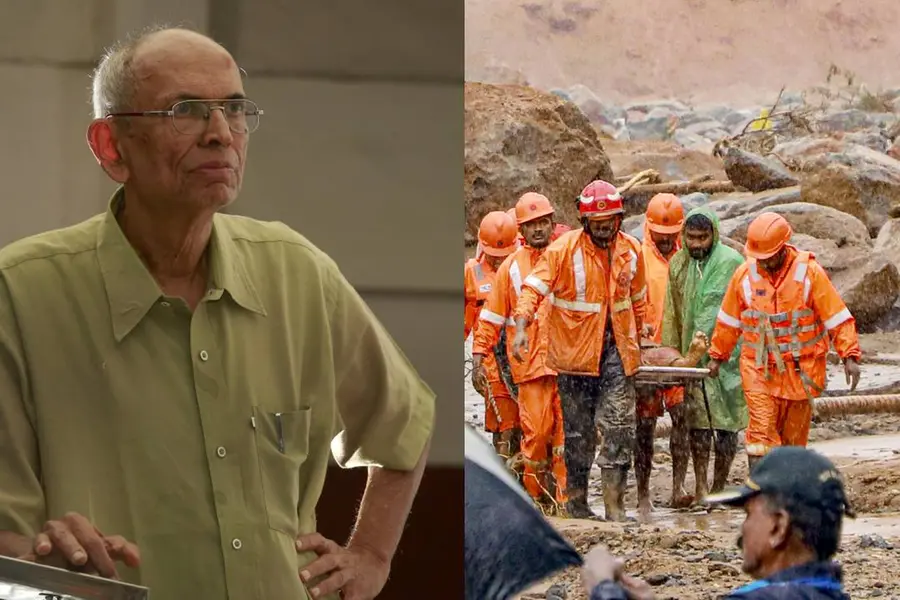
The exact scientific cause of the landslide at the Anakkampoyil–Kalladi–Meppadi twin tunnel road project in Wayanad is yet to be established. However, the incident has reignited public debate over development in the ecologically sensitive Western Ghats, with many social media users recalling the late ecologist Madhav Gadgil and his long-standing warnings on large-scale human intervention in the region.
The landslide struck the construction site at Kalladi in Meppadi Grama Panchayat on Tuesday (July 7), burying large sections of the worksite under mud and debris. Rescue operations entered a second day on Wednesday as teams from the National Disaster Response Force (NDRF), State Disaster Response Force (SDRF), Fire and Rescue Services, Civil Defence and police continued searching for five missing workers.
Also Read

Gadgil's warnings back in public focus
Gadgil, who died on January 8 at the age of 83, was one of India's foremost ecologists and chaired the Western Ghats Ecology Expert Panel (WGEEP). In Kerala, he became synonymous with a report that called for stronger environmental safeguards across the Western Ghats, triggering years of political and public debate.
Although successive governments did not implement many of the panel's recommendations, Gadgil's observations routinely return to public discussion whenever landslides or floods strike the state. Environmental experts and sections of civil society have argued that stricter implementation of the WGEEP recommendations could have reduced the vulnerability of ecologically fragile regions.
His work, based on scientific assessment and community participation, continues to shape discussions on balancing infrastructure development with environmental protection.
Earlier remarks on tunnel project resurface
As news of the Meppadi landslide spread, netizens shared Gadgil's earlier remarks on the proposed tunnel project.
Speaking to a news outlet, Gadgil had said that tunnelling would inevitably involve dynamite blasting, which could weaken rock formations and increase the possibility of landslides. At the same time, he had emphasised that disasters are also caused by natural factors such as heavy rainfall, while adding that human interventions can significantly enhance the risk.
His comments have resurfaced online even as authorities are yet to determine what caused Tuesday's landslide.
Social media revives debate over Western Ghats
Many users stressed that they were not opposed to development but questioned whether adequate environmental studies had been carried out before construction began in an environmentally sensitive area.
Several posts cited both the Gadgil and Kasturirangan reports, saying they had identified Meppadi and other parts of the Western Ghats as ecologically fragile landscapes where large-scale construction should be approached with caution.
Others recalled Gadgil's 2024 remarks alleging that a significant number of quarries in the Western Ghats were operating illegally. They argued that unchecked quarrying, large infrastructure projects and other human interventions had repeatedly raised concerns among environmental experts.
Some users said repeated warnings had been ignored, while others urged that future development be guided by scientific assessment and environmental safeguards.
Tributes and criticism
Several social media users also remembered the late Congress leader P.T. Thomas, who had backed stronger environmental protection measures alongside Gadgil's recommendations. Many posts said both men had faced criticism during their lifetime but that recurring disasters had brought renewed attention to the issues they raised.
Other posts described the Wayanad landslide as a "man-made disaster" and criticised successive governments in Kerala and at the Centre for failing to adequately protect the Western Ghats.
One widely shared post recalled Gadgil's warning against disturbing fragile hill ecosystems through activities such as extensive quarrying and large-scale construction. Another imagined the ecologist reminding people of the recommendations in the WGEEP report, reflecting how the latest landslide has once again revived debate over environmental protection and development in Kerala.
Published: 08 Jul 2026, 03:58 pm IST
Related Topics
Disclaimer: Kindly avoid objectionable, derogatory, unlawful and lewd comments, while responding to reports. Such comments are punishable under cyber laws. Please keep away from personal attacks. The opinions expressed here are the personal opinions of readers and not that of Mathrubhumi.