
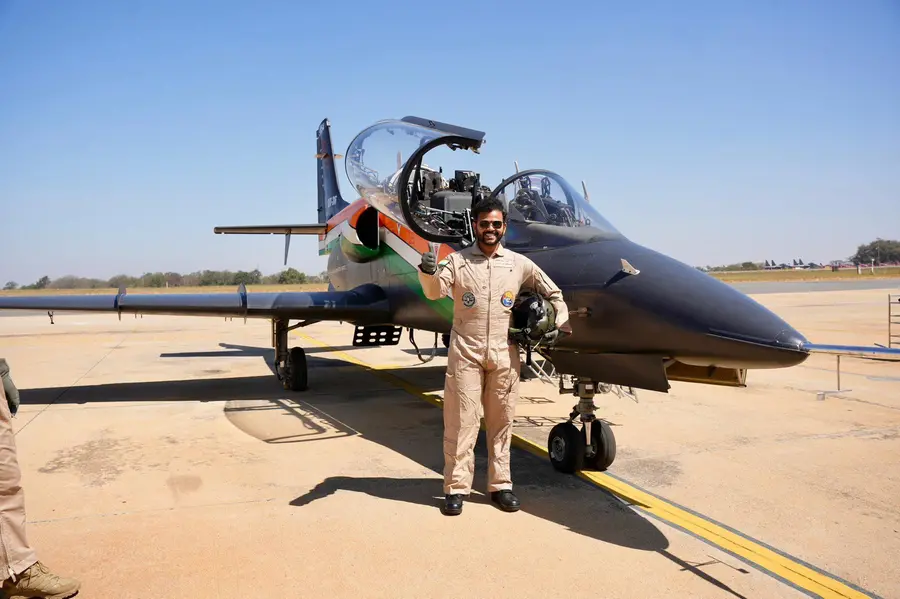
“Like a phoenix, the Yashas has risen from the ashes,” said Dr D K Sunil, Chairman of Hindustan Aeronautics Limited (HAL), at Aero India 2025. His words brought fresh hope for India’s defence preparedness. As the Indian Air Force (IAF) prepares to retire more than 100 HJT-16 Kiran jet trainers by 2027, HAL’s HJT-36 ‘Yashas’—meaning Glory—has emerged as the leading contender to fill the training gap. Previously known as ‘Sitara’ (Star in Hindi), the aircraft was renamed Yashas in February 2025 to mark its upgrades and revival. The Kiran, in service since 1968, has trained generations of IAF and Navy pilots but is now outdated and due for replacement.
Despite the buzz, only four to five Yashas aircraft have been leased for evaluation, and no firm orders have been confirmed. The question is: can HAL’s renewed effort truly lift this reborn aircraft to glory, or will delays once again ground its potential?
From Sitara to Yashas
Designed by HAL’s Aircraft Research and Design Centre (ARDC), the Yashas is a subsonic intermediate jet trainer meant to take over from the Kiran as the Stage-II trainer for the IAF and Indian Navy. The project began in 1997 to create a modern jet that could bridge the gap between basic trainers like the Pilatus PC-7 and advanced aircraft like the BAE Hawk.
The programme faced several challenges. Spin and stall issues plagued early versions, and the IAF declared it “unfit” for service in 2017. A 2011 crash and continued technical delays led to grounding for several years. By 2022, HAL resolved these problems through a redesign, including changes to the airframe. The aircraft successfully passed six-turn spin tests—a crucial safety test in pilot training aircraft.
In simple terms, a spin is an emergency condition where the aircraft, after losing lift, starts rotating steeply while descending in a corkscrew-like motion. During a spin test, engineers deliberately put the aircraft into this unstable condition and check whether it can recover safely and quickly, without losing control. A “six-turn spin test” means the aircraft completed six full spirals before the pilot successfully brought it back to stable flight. Clearing this test proves that the aircraft is aerodynamically stable, safe for training use, and can handle errors that student pilots might make in real flight scenarios.
The renaming to Yashas at Aero India 2025 symbolised a new chapter in its journey. It now features improved stability and flight safety—critical for training missions.
Technical features and capabilities
The Yashas is a well-designed training aircraft with a wingspan of 9.8 metres and a length of 10.91 metres. It features low-mounted wings that are swept back at an 18-degree angle. This means the wings are attached lower on the aircraft’s body and slant backward rather than sticking straight out. This sweepback design helps the aircraft cut through the air more smoothly, reducing drag and increasing stability—especially during high-speed manoeuvres or aerobatic training. It also makes the aircraft more efficient and easier to control, which is crucial for trainee pilots.
The aircraft has a tandem cockpit—with the instructor seated behind the trainee pilot—allowing direct supervision during flight.
Powering the Yashas is an NPO Saturn AL-55I turbofan engine, which produces 17.3 kilonewtons of thrust. The engine is controlled by a FADEC system, which stands for Full Authority Digital Engine Control. FADEC is a sophisticated onboard computer that automatically manages the engine’s key functions—like fuel supply, engine speed, and temperature—without requiring manual input from the pilot. Think of it as an advanced version of cruise control in a car, but for jet engines. This system not only improves safety and performance but also makes the aircraft more reliable and easier to fly—especially important during pilot training, where precision and consistency matter the most.
The aircraft’s digital ‘glass cockpit’ includes multi-function displays (MFDs), a heads-up display (HUD), and voice-activated controls. It can perform aerobatics and carry up to 1,000 kg of training weapons across five hardpoints—one under the fuselage and four under the wings. Its combat range is around 1,000 km, and it is capable of counter-insurgency missions as well. A drooped nose enhances visibility for trainee pilots, and the use of Indian-made Line Replaceable Units (LRUs) and AI-based systems aligns with the vision of Atmanirbhar Bharat.
The Yashas, designed as a Stage-II intermediate jet trainer, has a maximum take-off weight of 4,600 kilograms and features a retractable tricycle landing gear system operated by hydraulic controls. As a Stage-II trainer, it plays a key role in preparing pilots who have completed basic flying to advance towards more complex fighter, transport, or helicopter platforms.
The tricycle landing gear means the aircraft has three wheels—two main wheels under the wings and a single nose wheel in front—similar to the shape of a tricycle. This configuration offers better stability during taxiing, take-off, and landing. The gear is retractable, which means it can be folded into the aircraft’s body after take-off to reduce air drag and allow smoother, faster flight. Its hydraulic system uses pressurised fluid to operate the extension and retraction of the wheels, ensuring smooth and reliable movement during all phases of flight.
Reviving a stalled project
Dr Sunil’s confidence in the platform is clear. “The Yashas is a very capable aircraft,” he told ANI, citing improved spin performance and radar enhancements. At Aero India, along with Secretary (Defence Production) Sanjeev Kumar, he officially rebranded the aircraft, marking HAL’s renewed commitment.
Initial prototypes PT-1 and PT-2 had taken flight in 2003 and 2004. However, crashes in 2007, 2009, and 2011—combined with delays in the AL-55I engine’s delivery—stalled development. Today, two improved prototypes are flying, and two more are awaiting certification at HAL’s Bengaluru facility. Dr Sunil also hopes to export a weaponised version of the aircraft fitted with ASRAAM missiles, opening a low-cost combat aircraft option for international buyers. Still, HAL must deliver 85 aircraft by 2027 to meet IAF’s needs—while full-scale production is expected only by 2028.
IAF’s concerns and the urgency of delivery
The IAF has reason to be cautious. In 2010, it ordered 73 trainers worth ₹6,180 crore, but technical delays meant HAL missed the 2017 delivery deadline. This time, the IAF is leasing a few aircraft to evaluate performance before placing any bulk orders.
Yashas is essential for Stage-II training, which prepares pilots for assignment into fighters, transports, or helicopters. Any delay in induction could weaken the IAF’s goal of maintaining 30 active squadrons by 2035—a critical objective given regional threats. The 2009 grounding of HPT-32 Deepak aircraft already caused a training crisis, and the IAF cannot afford another.
Challenges ahead
Several obstacles remain. The AL-55I engine still awaits final certification, and licensed production in India has not yet begun. Producing 85 aircraft within two years will be a massive task for HAL’s Bengaluru plant. Export plans, though ambitious, could divert focus from meeting India’s urgent defence needs. Global competitors such as the Korean T-50, Italian M-346, and Czech L-39NG have already proven themselves in the international market. For the Yashas to succeed, HAL must show that it is cost-effective, reliable, and timely.
HAL will need to fast-track certification, scale up production, and work closely with the IAF to ensure the aircraft meets strict performance standards.
A symbol beyond the runway
Dr Sunil has reignited the programme—but the real test lies in execution. The Yashas is more than just a trainer jet; it stands as a symbol of India’s aerospace capabilities and the dream of self-reliance. If it succeeds, it will not only train the next generation of pilots but also strengthen India’s case as a reliable aircraft manufacturer for the world.
But time is ticking. As 2027 approaches, India watches closely. Will the Yashas soar as a symbol of national glory—or be grounded once again by missed deadlines?
- Girish Linganna is an award-winning science writer and a defence, aerospace and political analyst based in Bengaluru. He is also Director of ADD Engineering Components India Pvt. Ltd., a subsidiary of ADD Engineering GmbH, Germany.
He can be contacted at girishlinganna@gmail.com
Published: 20 Apr 2025, 12:11 pm IST
Related Topics
Disclaimer: Kindly avoid objectionable, derogatory, unlawful and lewd comments, while responding to reports. Such comments are punishable under cyber laws. Please keep away from personal attacks. The opinions expressed here are the personal opinions of readers and not that of Mathrubhumi.
