

The two incidents have triggered widespread outrage and condemnation of Kerala’s much-acclaimed but heavily stressed public health system
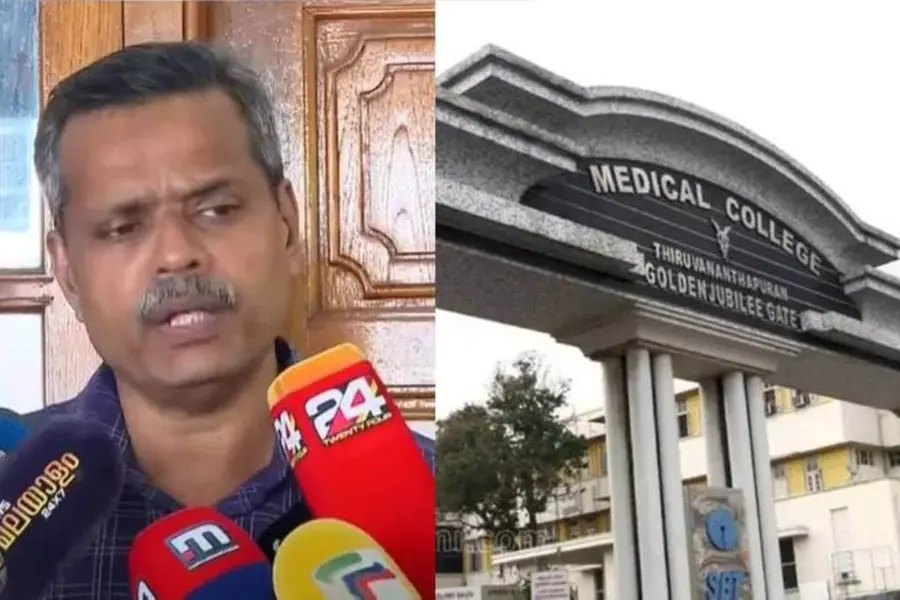
It is rare for a single individual to trigger fundamental or systemic changes, especially one without extraordinary authority, vast resources, or overwhelming popular influence. Yet Kerala has reason to hope that Dr Haris Chirakkal might prove to be one of those rare changemakers.
What sets Dr Haris, head of the Urology Department at Thiruvananthapuram Medical College, apart—and lends weight to that hope—is his professional integrity, unwavering sincerity of purpose, and remarkable courage in upholding the public good, even at great personal risk. This whistleblower appears, in every sense, to be one of those quiet instruments through whom history occasionally chooses to work. How else could a lithoclast probe—an essential surgical device—have been flown down to Thiruvananthapuram from Hyderabad within two days of Dr Chirakkal going public about its absence, which had been delaying numerous emergency surgeries in the city’s Government Medical College? However, even as Dr Haris emerged as a hero, D Bindu, a 54-year-old housewife, fell an innocent victim of the crumbling infrastructure at Kottayam Government Medical College, turning the spotlight again on the urgent need to address the growing sickness afflicting Kerala’s public health system.
The two incidents have triggered widespread outrage and condemnation of Kerala’s much-acclaimed but heavily stressed public health system. Expectedly, it also led to vociferous attacks on the state government. The narrative now demanded a villain, and Health Minister Veena George fit the role all too easily. A fierce outcry erupted—both in the media and on the streets—calling for her head. Tellingly, the demons appear to acquire bigger horns when they happen to be powerful women. Recall the earlier incidents involving PP Divya, former Kannur District Panchayat president, and Thiruvananthapuram Mayor Arya Rajendran. With the panchayat and assembly elections around the corner, the issue has already been reduced to a political football—kicked around by scheming politicians and a hyperactive media desperate for the next outrage to stay afloat in a cut throat competitive landscape. The casualty in the process is likely to be a concerted attempt to address the system's chronic problems.
The growing claims that Kerala’s public health system is merely hype and propaganda often arise from ignorance or political bias. Curiously, Kerala’s stellar record in public health continues to be loudly contested, despite decades of documentation and praise from both national and international institutions. Thanks to the sustained public investments, contributions of both the public and private health sectors, the vibrant presence of multiple medical systems and above all, a literate and health -seeking public, Kerala consistently ranks at the top in key health indicators—such as life expectancy, infant mortality, maternal mortality, and more. This has also prompted critics to often hold that Kerala led in public health even before Independence, so there’s nothing remarkable about its current standing. This, however, is only partially true. At the time of Independence, it was the princely states of Travancore and Cochin that had advanced health records—not the British-ruled Malabar region. The credit for bridging this gap and sustaining Kerala’s top position over the last seven decades goes to successive democratic governments, which have consistently allocated the highest proportion of state expenditure in India towards health.
Undeniably, all the governments under both the Left and the Congress deserve credit for this achievement to different degrees. Perhaps, more credit is due only to the people of Kerala who, as Amartya Sen said, exerted consistent pressure on their governments. The very fact that Dr Haris’s whistle-blowing and Bindu’s death stunned the state and dominated the media for so long is a testimony to both the better state of public health in Kerala and its society’s (and the media) deep engagement with such issues. Similar incidents are unlikely to trigger such a huge public outcry in most other states, where they may be routine.
Yet, recent incidents undeniably show that even what is arguably the country’s best public health system and the state's health scenario are not immune to a host of serious flaws and problems: escalating costs, rise of malnutrition, anaemia and stunting especially among women and children, obesity, the exploitative practices of the private healthcare sector, rising out-of-pocket expenses, systemic inefficiencies, bureaucratic delays, inadequate infrastructure, shortages of essential supplies, sluggish adoption of new technologies, corruption, the emergence of new diseases, and the state’s chronic shortage of resources.
Structural inequities within the system mean that these problems disproportionately affect the marginalised: the poor more than the rich, rural populations more than urban, women more than men, and the Backward castes more than others.
A comprehensive 2024 study published in the International Journal for Equity in Health offers detailed statistics on the recent rise in public trust in Kerala’s government health facilities, describing them as the best in the country. At the same time, the study highlights several contemporary and critical shortcomings in the state’s health sector—issues that, if unaddressed, could erode key health indicators, deepen inequities, and disproportionately harm disadvantaged communities. “Kerala currently faces a high burden of preventable, premature mortality due to non-communicable diseases including mental health and due to injuries. Though Kerala built a robust healthcare system, its primary care system was utilised more for delivering a selective package of services. The increasing burden of chronic illness was left to the care of the private sector. The proportion of people going to the public sector for outpatient care is more in Kerala than the all-India average- both in 2014 and in 2017. Whereas when it comes to in-patient care, the proportion of population going to the public sector in Kerala is less than the Indian average. The State has a long history of investments in public services including healthcare. But, over the course of time, the public health systems were not re-designed or expanded as required to address the new epidemiological and demographic situation in the State. The dependence on various insurance mechanisms for increasing access to secondary care as compared to expanding and strengthening public hospital capacity resulted in an acceleration of growth of an unregulated private health sector, where health outcomes are uncertain- but there is a high incidence of financial hardship and impoverishment due to healthcare expenditure.”.
What the latest incidents should have triggered is a fundamental, far-reaching overhaul of the system—one that would help Kerala retain its position as the country’s leading state in public health. Unfortunately, the current discourse, mired in political one-upmanship and mutual blame, offers little hope for such a meaningful transformation.
Published: 08 Jul 2025, 02:16 pm IST
ABOUT THE AUTHOR
Related Topics
Disclaimer: Kindly avoid objectionable, derogatory, unlawful and lewd comments, while responding to reports. Such comments are punishable under cyber laws. Please keep away from personal attacks. The opinions expressed here are the personal opinions of readers and not that of Mathrubhumi.