

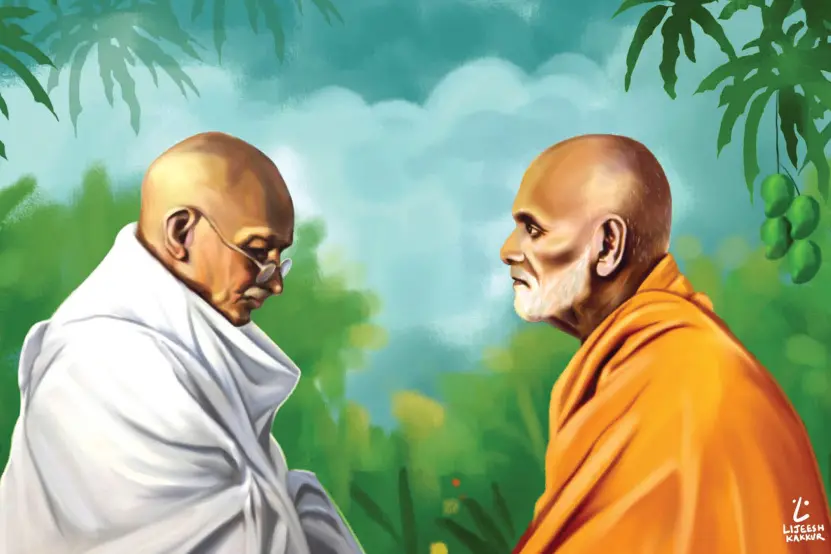
This year marks the centenary of Mahatma Gandhi's visit to Kerala in 1925, a significant chapter in his journey of social reform and India's freedom struggle. Mahatma Gandhi came to Kerala not as a politician, not as a leader seeking power, but as a pilgrim of truth and justice. He did so five times, in 1920, 1925, 1927, 1934, and 1937, seeking to support social reform, raise funds, and protest against untouchability. But the 1925 visit is particularly memorable for a special set of reasons.
Gandhiji's primary purpose in 1925 was to support the Vaikom Satyagraha, the great social movement aimed at securing the rights of lower-caste individuals to use public roads around the Vaikom temple. His presence energized the movement and brought national attention to the issue of untouchability, but did not entirely resolve the situation caused by the obduracy of the upper castes. Still, the visit facilitated a number of major episodes that are worth recalling.
Also Read
One of the most historic moments of this visit was Gandhi's meeting with Sree Narayana Guru at the Sivagiri Mutt on March 12, 1925. The two giants of India’s early 20th century transformation were reported to have discussed caste discrimination, education, and the empowerment of marginalized communities. Gandhiji sought the Guru’s thoughts on casteism, untouchability, and social reform; the Guru was already known as a revered spiritual leader advocating strongly for equality and education. But given Gandhiji’s lack of Sanskrit, Malayalam or Tamil, and Sree Narayana Guru’s lack of English, dialogue was not easy. Advocate N. Kumaran acted as their interpreter, facilitating a meaningful conversation. Still, much of their exchange is said to have passed in silence – a profound silence that conveyed depths of meaning to the Mahatma.
This encounter was a historic moment in India's socio-political and spiritual history that became a cornerstone in the fight for social justice. The meeting of the Guru and the Mahatma symbolized the unity of two great minds working towards a caste-free and inclusive society. Their conversation also touched on the importance of education and economic empowerment for marginalized communities. It also reinforced the momentum of the Vaikom Satyagraha and inspired many to join the cause. Gandhi asked Sree Narayana Guru if Hindu scriptures justified untouchability, to which the Guru categorically replied, "No." The meeting left a profound impact on Gandhi, who later described it as a privilege to have met such a visionary leader.
The other halt of great symbolic significance during Mahatma Gandhi's visit to Kerala was his remarkable sojourn in Kottayam in 1925, as it included his only known visit to the residence of a Bishop. On March 15, 1925, when Gandhiji stepped into Kottayam, he was welcomed not only by its people but by a spirit of unity that transcended caste, creed, and community. During this visit, Gandhi called on Bishop Mar Alexander Choolaparambil of the Knanaya Catholic Church at the Bishop's House in Kottayam. It was a meeting of two great souls—one, the Mahatma who dreamed of an India free from oppression, and the other, a spiritual shepherd who worked tirelessly for social upliftment. They spoke not in the language of politics, nor of mere ideals, but in the language of justice, of human dignity, of a world where faith did not divide, but united Indians.
Their meeting was significant for its emphasis on interfaith dialogue and social harmony. Gandhiji and the Bishop discussed the importance of unity among different religious communities in India. Gandhi's philosophy of non-violence and inclusivity resonated with the Bishop's vision of social equality. The meeting also touched upon the ongoing Vaikom Satyagraha, with the Bishop expressing his support for Gandhiji's efforts to eradicate untouchability and promote social justice. At a time when untouchability cast dark shadows over society, when social barriers were stronger than stone walls, Gandhi stood firm. "Untouchability is a crime against God and humanity," he declared, a truth that still echoes in our consciences today. And the Bishop, guided by the very essence of the Gospel, knew that faith without justice is empty. Did not the Bible proclaim, “There is neither Jew nor Greek, slave nor free, male nor female, for you are all one in Christ Jesus”? And in that moment, standing together, the two men showed us what that unity could look like.
Gandhiji's visit to the Bishop's residence was a powerful symbol of his commitment to fostering unity across religious and social divides. It highlighted his belief in the shared moral responsibility of all communities to address societal issues. This visit left a lasting impression on the people of Kottayam and underscored Gandhi's dedication to building bridges between diverse groups. It was a spark that ignited Kerala’s social awakening. It inspired movements that shattered the walls of caste discrimination. It called upon religious and social leaders to stand together for justice, for truth, for humanity itself.
While in Kerala, Mahatma Gandhi delivered speeches emphasizing the need for unity, non-violence, and the eradication of untouchability. His public addresses served as the voice of a crusader for both political freedom and human emancipation. His words inspired many to join the cause of social reform and independence. Gandhiji interacted with local leaders, activists, and the public, fostering a sense of collective responsibility for societal change. An account survives in the newspaper Rashtra Deepika of what Gandhiji told the people of Kottayam. He said he understood they were largely Christian, more than elsewhere in Travancore, adding that there was nothing in his movement for national awakening that a Christian could not support – in fact if they did not support him, they would be doing Christianity a disservice! He sought their support for his efforts in Vaikom, added words about his campaign against alcohol of which Kerala’s Christians were fond, advocated khaddar (and pointed out he did not see many khadi wearers in his audience), stressing that patronising handloom would help the lower castes make a decent livelihood, and underscored the importance of religious co-existence. If we were to update the alcohol campaign to one against drugs, the Mahatma could easily be speaking to the people of Kerala in 2025, not just in 1925.
When we recall Gandhiji’s visit to Kerala, we are not merely remembering an event; we are rekindling a flame -- a flame that burned in the heart of a man who walked this very land a hundred years ago, a flame that still has the power to guide us today. Yet today, we must ask ourselves—have we truly answered that call? Have we torn down all the walls that divide us, or have we built new ones in their place? Have we embraced each other as one people, or have we let hatred and prejudice slip back into our hearts?
The answers are not what the Mahatma would have hoped for. So let this centenary not be just a celebration. Let it be a renewal, a promise, a fire rekindled in our hearts. Let us not merely admire Gandhi’s ideals from a distance but carry them forward in our actions. Let us not honour his memory with words alone, but with courage, with kindness, with justice in our minds and love in our hearts. Gandhi did not walk this land for us to build new chains where the old ones were broken. He did not speak of unity for us to utter words of hate. He did not fight for justice so that we could remain silent in its absence. His journey is not over. It lives on in every act of courage, in every voice that rises against division, in every heart that dares to love beyond boundaries.
So today, a hundred years later, let that heart, his heart, be ours.
Published: 27 Mar 2025, 10:21 am IST
ABOUT THE AUTHOR
Related Topics
Disclaimer: Kindly avoid objectionable, derogatory, unlawful and lewd comments, while responding to reports. Such comments are punishable under cyber laws. Please keep away from personal attacks. The opinions expressed here are the personal opinions of readers and not that of Mathrubhumi.