

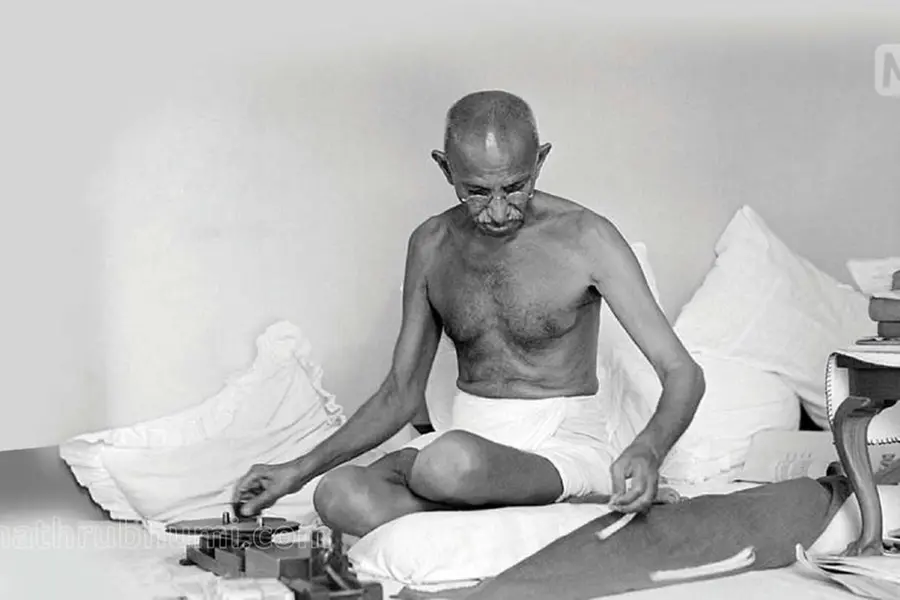
This December 26, the Indian National Congress marks the centenary of Mahatma Gandhi’s ascent to the Presidency of the party with a special session of the Congress Working Committee in Belgaum. It was in this town on the edges of Karnataka and Maharashtra that Mahatma Gandhi presided over the Congress session in December 1924. This was the only time Gandhiji held the position of Congress President. He stepped down the following year and was succeeded by Sarojini Naidu in April 1925. Gandhiji's decision to relinquish office after just five months was influenced by his desire to focus more on grassroots activism and social reforms rather than the administrative responsibilities of the Congress presidency.
Nonetheless, Mahatma Gandhi's tenure as the Congress President was brief but significant. His leadership and vision during this period were instrumental in galvanizing the Indian masses towards the struggle for independence. When he entered the Indian nationalist movement after his return from South Africa in 1916, the Mahatma began to have a transformative impact almost immediately on the freedom struggle. Where sporadic terrorism and moderate constitutionalism had both proved ineffective, Gandhiji took the issue of freedom to the masses as one of simple right and wrong and gave them a technique to which the British had no response. By abstaining from violence the Mahatma wrested the moral advantage. By breaking the law non-violently, he showed up the injustice of the law. By accepting the punishments imposed on him, he confronted his captors with their own brutalisation. By voluntarily imposing suffering upon himself in his hunger-strikes, he demonstrated the lengths to which he was prepared to go in defence of what he considered to be right.
Also Read
Mahatma Gandhi's brief tenure as the President of the Indian National Congress in 1924-25 was marked by several significant hallmarks and left an enduring legacy on the party. His emphasis on Khadi and self-reliance was a major theme of his Presidency. Gandhiji strongly advocated for the use of hand-spun cloth (Khadi) and promoted self-reliance. He believed that economic independence was crucial for political independence, and his push for Khadi became a symbol of the Swadeshi movement.
Linked to this approach was his initiation of the Non-Cooperation Movement. Although the official Non-Cooperation Movement had been suspended in 1922, following the violence in Chauri Chaura that led the Mahatma to declare that Indians were not ready for Independence, Gandhiji's presidency reinforced the principles of non-violent resistance and civil disobedience. His leadership during this period helped to keep the spirit of non-cooperation alive within the Congress.
Gandhiji's approach to leadership was deeply rooted in his spiritual and ethical beliefs. He led by example, demonstrating the power of simplicity, humility, and moral integrity. This had a lasting impact on the ethos of the Congress and inspired future leaders to adopt similar values. Inevitably, the promotion of social reforms was always high on his agenda. Gandhiji's presidency highlighted the need for social reforms, including the eradication of untouchability and the upliftment of marginalized communities. His efforts in this direction laid the groundwork for future social justice initiatives within the Congress.
At the same time, Gandhiji was not indifferent to the organisational responsibilities that came with his position as the party’s leader. He used his presidency to focus on unity and inclusivity within the party. Gandhiji worked towards bridging the gaps between different factions within the Congress. He emphasized the importance of unity and accommodation of diverse interests, striving to bring together various social, religious, and political groups under the common goal of achieving independence.
In sum, Gandhi's presidency, though brief, left a profound legacy on the Indian National Congress. His emphasis on self-reliance, non-violence, unity, and social reform became integral to the party's identity and strategy in the struggle for independence. The brief Presidency was a mini-capsule of Gandhiji's greatness, only hinting at the extraordinary resonance of his life and his message. While the world was disintegrating into fascism, violence and war, the Mahatma taught the virtues of truth, non-violence and peace. He destroyed the credibility of colonialism by opposing principle to force. And he set and attained personal standards of conviction and courage which few will ever match. He was that rare kind of leader who was not confined by the inadequacies of his followers.
Still, he did not wish to remain as President. Gandhi believed that true change came from the ground up, and he wanted to dedicate his efforts to mobilizing the masses and promoting self-reliance through initiatives like the Khadi movement and the eradication of untouchability. His departure from the presidency allowed him to concentrate on these broader social and political goals, which he felt were essential for India's path to independence.
This was the approach Gandhi brought to the movement for India's freedom -- and it worked. In the end he made the perpetuation of British rule an impossibility. His brief stint at the head of the Congress crystallised the essence of his leadership and bore the stamp of the themes that would mark the inspiring legacy he would leave to the nation.
Published: 26 Dec 2024, 09:38 am IST
ABOUT THE AUTHOR
Disclaimer: Kindly avoid objectionable, derogatory, unlawful and lewd comments, while responding to reports. Such comments are punishable under cyber laws. Please keep away from personal attacks. The opinions expressed here are the personal opinions of readers and not that of Mathrubhumi.