
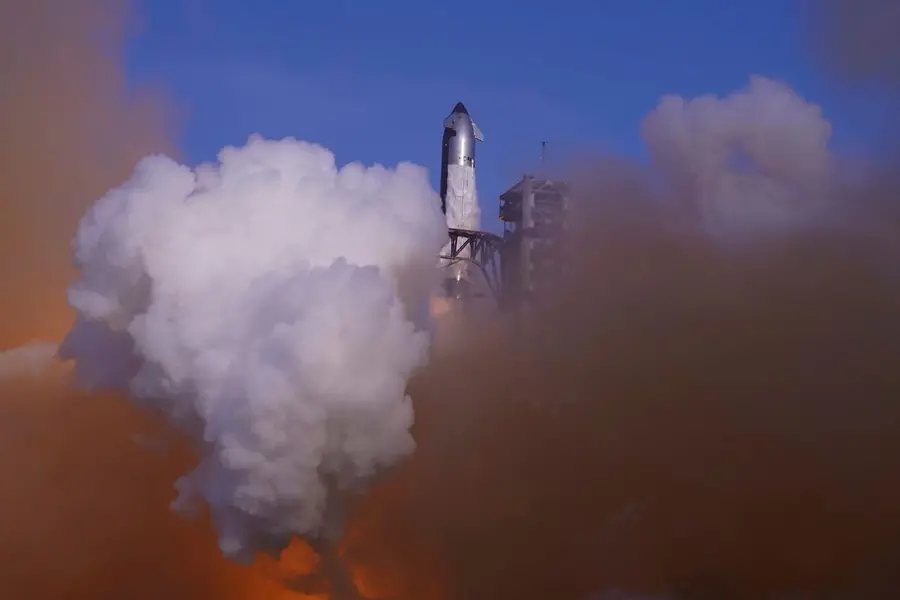
Texas: SpaceX launched its towering Starship rocket once again on Tuesday evening, marking the spacecraft’s ninth demonstration flight — but the mission fell short of its key objectives after the vehicle spun out of control and broke apart over the Indian Ocean.
The 123-metre rocket blasted off from Starbase, SpaceX’s launch facility at the southern tip of Texas, where local residents recently voted to organise as an official city. The latest test flight featured a reused booster for the first time, a milestone in the development of the ambitious rocket system, which is designed to carry humans to the Moon and Mars.
However, the mission was plagued by issues almost from the start. A planned deployment of mock satellites was scrapped when the payload door failed to fully open. The spacecraft then began to spin during its journey through space, ultimately leading to what SpaceX later described as a “rapid unscheduled disassembly” — its term for a mid-flight breakup.
“Teams will continue to review data and work toward our next flight test,” SpaceX said in a statement posted online.
There were no attempts to recover the booster using the towering “chopsticks” mounted at the launch tower, as seen in earlier tests. Instead, the booster broke up and crashed into the Gulf of Mexico. The upper stage, meanwhile, lost control and disintegrated as it headed towards the Indian Ocean, reportedly due to fuel leaks.
“Not looking great with a lot of our on-orbit objectives for today,” admitted SpaceX commentator Dan Huot during the live stream.
The company had hoped to test the spacecraft’s heat shield during a controlled re-entry, but communications were lost before re-entry, and the webcast was abruptly ended. Previous test flights had also failed to achieve key milestones, with wreckage falling into the Caribbean Sea during earlier missions.
In preparation for this flight, SpaceX had upgraded thermal tiles and installed new fittings designed to eventually help recover the upper stage. While the plan was always for this Starship to splash down in the Indian Ocean, the test was meant to pave the way for future mid-air captures and reuse.
The Federal Aviation Administration had cleared the launch last week, expanding the safety zone and moving liftoff outside peak flight times to minimise air traffic disruption, which had been an issue in earlier tests.
NASA is closely monitoring SpaceX’s progress, with Starship central to its Artemis programme. While the first crewed Starship mission around the Moon is slated for next year, the actual lunar landing is not expected before 2027. That mission will require a Starship to carry two astronauts from lunar orbit to the surface and back.
Published: 28 May 2025, 07:23 am IST
Related Topics
Disclaimer: Kindly avoid objectionable, derogatory, unlawful and lewd comments, while responding to reports. Such comments are punishable under cyber laws. Please keep away from personal attacks. The opinions expressed here are the personal opinions of readers and not that of Mathrubhumi.
