
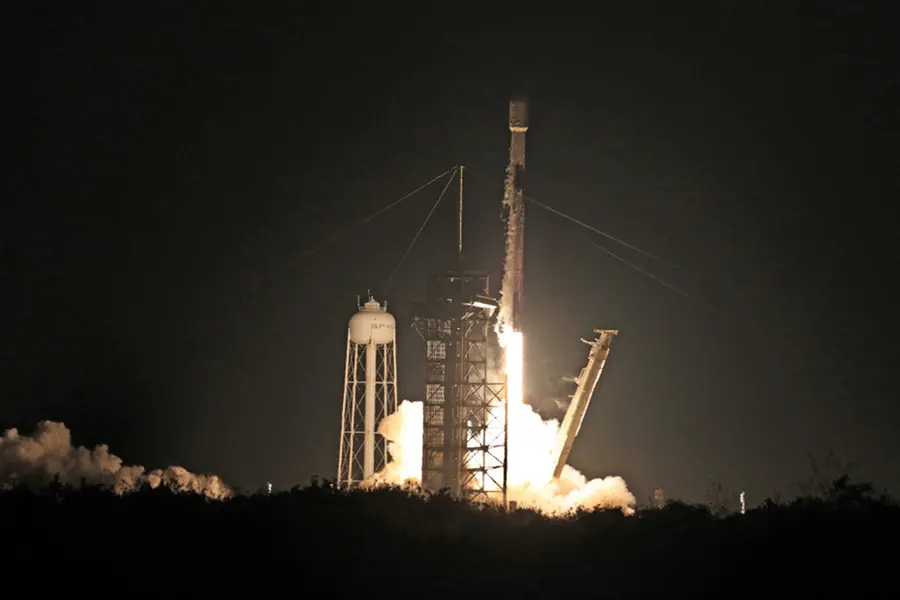
A US-based company is setting its sights on a second lunar touchdown after a successful launch aboard a SpaceX rocket on Wednesday.
Intuitive Machines, which made history last year as the first private company to send a robot to the Moon, is hoping for a more successful landing this time around.
The Houston-based company’s hexagonal-shaped lander, Athena, launched at 7:16 pm ET (0016 GMT Thursday) from NASA’s Kennedy Space Center in Florida. If successful, Athena will land on the Moon around March 6 at the Mons Mouton plateau, a location closer to the lunar south pole than any previous mission targets.
Athena is carrying a variety of scientific instruments, including a drill designed to search for ice beneath the surface, and a pioneering hopping drone named Grace. The drone is named after famed computer scientist Grace Hopper and is capable of navigating the Moon’s rugged terrain, including its inclines, craters, and boulders. This technology could play a crucial role in future crewed lunar missions.
Additionally, the lander carries a small rover equipped to test a lunar cellular network developed by Nokia Bell Labs. The network will be used to relay commands, images, and video between the lander, rover, and hopper, with long-term plans to integrate it into astronauts' suits.
Intuitive Machines CEO Trent Martin expressed excitement about the potential of the Grace drone, noting that such drones could complement future lunar rovers by reaching areas where driving is not possible, such as lunar pits and underground lava tubes.
Soft lunar landings were once the domain of a few well-funded national space agencies, but the US is now leading the charge to make private lunar missions more routine through the Commercial Lunar Payload Services (CLPS) program. This public-private partnership is aimed at delivering NASA payloads to the Moon at a significantly lower cost than traditional space missions.
"I'm very excited to see the science that our tech demonstrations deliver as we prepare for humanity's return to the Moon and the journey to Mars," said Nicky Fox of NASA, referring to the Artemis program, which aims to send astronauts back to the lunar surface later this decade.
However, before those ambitious missions, Intuitive Machines must first prove they can achieve a successful, upright landing. The company’s previous lander, Odysseus, launched in February 2024 but failed to land upright, tipping over at a 30-degree angle after descending too quickly. This mishap prevented it from completing NASA experiments under a $118 million contract. This time, the company has reduced the mission's cost to $62.5 million.
Landing on the Moon presents unique challenges, primarily due to the absence of an atmosphere, which eliminates the option of using parachutes. As a result, spacecraft must rely on precisely controlled thrusters to slow their descent and navigate the Moon’s treacherous surface.
Martin noted that the company had made significant improvements, such as enhanced cabling for the laser altimeter, which provides critical altitude and velocity data and helps identify safe landing sites.
Athena’s landing will be preceded on March 2 by another private US lander, Firefly Aerospace’s Blue Ghost, which launched in January and is sharing a ride with the ispace Resilience lander from Tokyo. NASA’s Lunar Trailblazer probe, also aboard this rocket, will enter orbit after a four-month journey and embark on a two-year mission to study water distribution on the Moon.
These missions come at a pivotal moment for NASA, as speculation grows about potential cuts or a shift away from its astronaut program for the Moon in favour of Mars exploration—a key goal for both President Trump and his advisor Elon Musk, the SpaceX tycoon.
Published: 27 Feb 2025, 06:17 am IST
Related Topics
Disclaimer: Kindly avoid objectionable, derogatory, unlawful and lewd comments, while responding to reports. Such comments are punishable under cyber laws. Please keep away from personal attacks. The opinions expressed here are the personal opinions of readers and not that of Mathrubhumi.
