
Chandrayaan-2 observes Sun’s coronal mass ejection effect on Moon’s exosphere for first time.
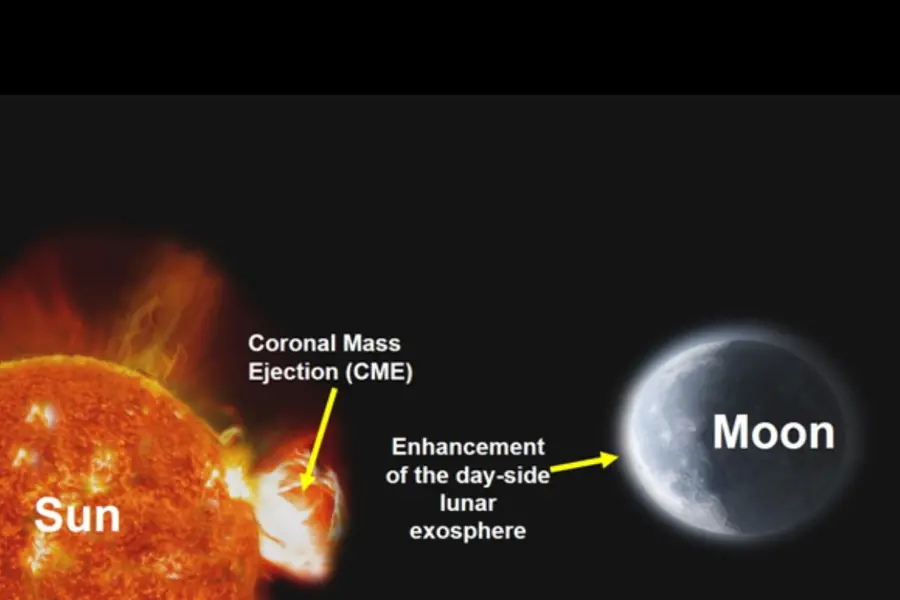
India’s Chandrayaan-2 lunar orbiter has captured a historic observation of the Sun’s impact on the Moon, ISRO reported on Saturday.
The orbiter’s Chandra’s Atmospheric Composition Explorer-2 (CHACE-2) instrument detected an increase in the total pressure of the dayside lunar exosphere when a Coronal Mass Ejection (CME) struck the Moon. The number density of neutral atoms and molecules rose by more than an order of magnitude, confirming earlier theoretical predictions.
What is the lunar exosphere?
The Moon has a very thin atmosphere, known as an exosphere, where gas atoms and molecules rarely interact. The exosphere extends from the Moon’s surface, making it a surface boundary exosphere. It forms through interactions of solar radiation, solar wind, and meteorite impacts, which release atoms and molecules from the lunar surface.
Why the Sun’s CME matters
CMEs are events when the Sun ejects large quantities of material, mainly helium and hydrogen ions. On the Moon, which lacks an atmosphere and a global magnetic field, such solar emissions directly affect the surface, temporarily increasing the exosphere’s density.
The observation was made on May 10, 2024, when the Sun hurled multiple CMEs. The impact increased the process of releasing atoms from the lunar surface, enhancing the total pressure in the sunlit exosphere.
Implications for science and lunar bases
This first direct observation will deepen understanding of the lunar exosphere and space weather effects. It also highlights challenges for future lunar bases, which must account for extreme solar events that temporarily alter the Moon’s environment.
Published: 18 Oct 2025, 09:00 pm IST
Related Topics
Disclaimer: Kindly avoid objectionable, derogatory, unlawful and lewd comments, while responding to reports. Such comments are punishable under cyber laws. Please keep away from personal attacks. The opinions expressed here are the personal opinions of readers and not that of Mathrubhumi.
