
The Proba-3 Mission by the European Space Agency (ESA) and India's Aditya L1 Mission by ISRO are both solar observation missions, but they differ significantly in their objectives, instruments, and approaches.
While both missions aim to study the Sun, Proba-3 emphasizes technology demonstration and extended corona observation, while Aditya L1 focuses on a broad spectrum of solar research and space weather studies, showcasing ISRO’s growing capabilities in space science.
Also Read

Here's a comparison
* Mission Objective
- The Proba-3 mission focuses on creating artificial solar eclipses to study the Sun's corona in greater detail. It aims to develop precision formation flying technology, using two satellites working as a single instrument.
- The Aditya L1 mission aims to study various aspects of the Sun, including the corona, solar winds, magnetic field dynamics, and solar flares. It is designed for broader solar research, including space weather impacts on Earth.
* Mission Configuration
- The Proba-3 mission uses two separate satellites flying in precise formation. While the Occulter satellite blocks the Sun's light with a 1.4-meter-wide disk, the Coronagraph satellite observes the corona from the shadow created by the occulter, positioned 150 meters apart. The primary goal is to simulate a solar eclipse for extended observation.
- The Aditya L1 mission is single spacecraft equipped with multiple payloads (seven instruments) to observe the Sun and space weather. It is positioned at the Lagrange Point 1 (L1), about 1.5 million kilometers from Earth, to maintain a continuous view of the Sun.
* Key Instruments
- The Proba-3 mission carries a high-precision coronagraph to observe the Sun's corona. It focuses on technology demonstration, specifically precision formation flying.
- The Aditya L1 mission payloads include a Visible Emission Line Coronagraph (VELC) for studying the corona, a Solar Ultraviolet Imaging Telescope (SUIT) for observing the Sun's photosphere and chromosphere and other instruments for solar wind, particles, and magnetic field analysis.
* Duration and Observation
- The Proba-3 mission has been planned for two years. It simulates about 50 artificial eclipses annually, with each eclipse providing six hours of continuous observation.
- The Aditya L1's mission life is expected to last five years. It provides continuous data due to its strategic position at L1, enabling uninterrupted solar observation.
* Launch and Orbit
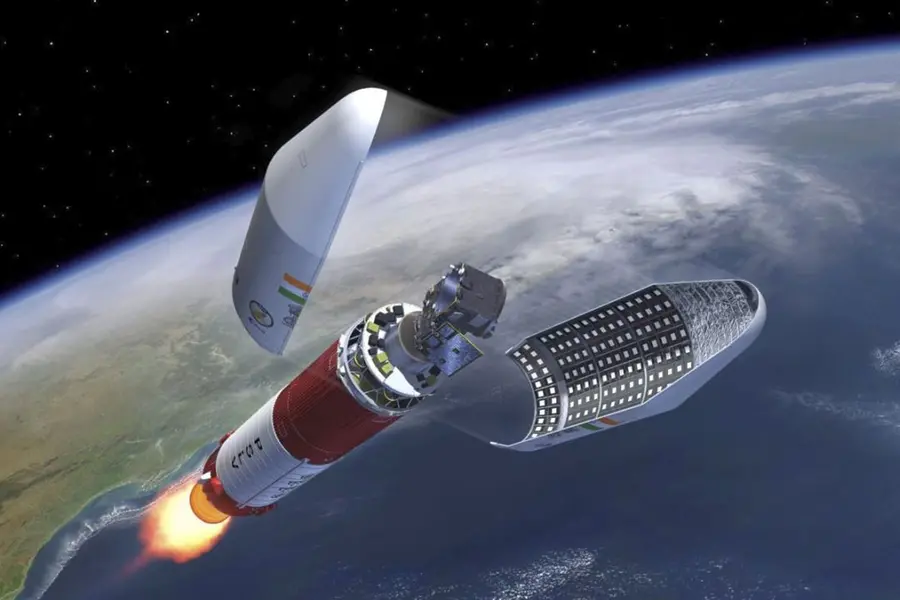
- The Proba-3 mission's launch vehicle is ISRO's PSLV-C59 rocket which will place it at the highly elliptical Earth orbit (600 km to 60,530 km). It will focus on testing new technologies alongside solar research.
- The Aditya L1 mission launch vehicle was the ISRO's PSLV-C57 rocket, which positioned it at the Sun-Earth L1 point for stable and continuous solar observation.
* Scientific Collaboration
- The Proba-3 mission has been developed by the European Space Agency in collaboration with multiple European countries. India is contributing through launch services and scientific collaboration.
- The Aditya L1 mission is an entirely Indian mission developed by the ISRO with inputs from Indian solar physicists and research institutions.
* Purpose and Outcome
- The Proba-3 mission focuses on high-precision technology testing and detailed corona study during artificial eclipses. It is aimed at advancing satellite formation flying technology for future missions.
- The Aditya L1 mission is designed to provide comprehensive insights into the Sun's behaviour and its influence on space weather. It supports broader scientific understanding with diverse observations.
Published: 03 Dec 2024, 02:50 pm IST
Disclaimer: Kindly avoid objectionable, derogatory, unlawful and lewd comments, while responding to reports. Such comments are punishable under cyber laws. Please keep away from personal attacks. The opinions expressed here are the personal opinions of readers and not that of Mathrubhumi.