
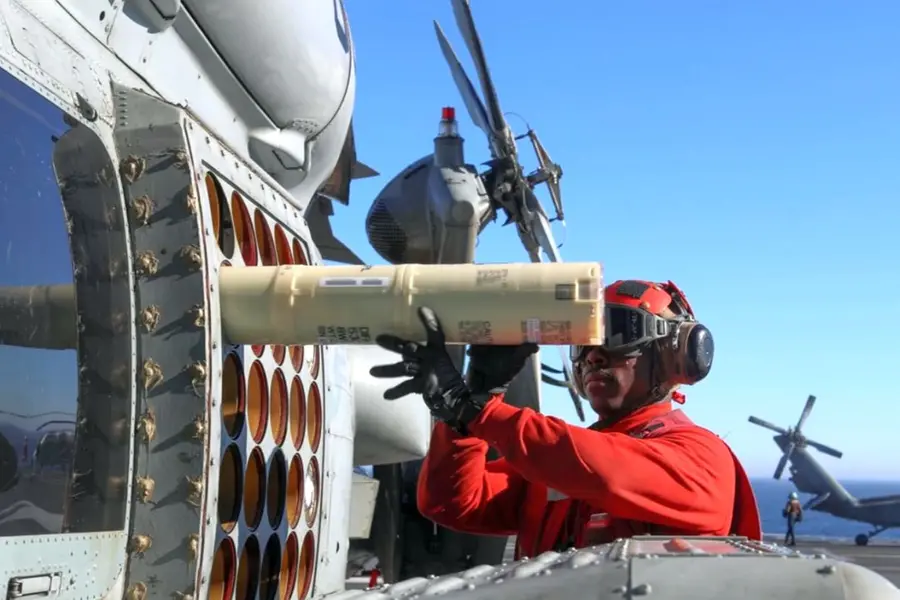
The Indian Navy has bought 500 anti-submarine warfare sonobuoys for $52.8 million (approx Rs 436 Crore) to use with their Sikorsky MH-60R helicopters. The Navy has received six helicopters so far.
During Defence Minister Rajnath Singh's recent visit to Washington DC, US Secretary of State Antony Blinken approved a potential Foreign Military Sale to India. The acquisition of these sonobuoys, is a strategic move by the Indian Navy to enhance its ASW (Anti-Submarine War) capabilities in the Indian Ocean region. This purchase is a direct response to the growing naval presence of China, particularly their submarine activity in the region.
Also Read

Sonobuoys and Their Features
The Indian government had requested the purchase of three types of sonobuoys:
* AN/SSQ-53G: This versatile sonobuoy utilizes DIFAR (Directional Frequency Analysis and Recording) technology for accurate sound detection. It operates in passive directional listening mode, meaning it detects underwater sounds without emitting signals, making it stealthy.
The sonobuoy offers both EFS (Electronic Function Selection) and CFS (Command Function Select) capabilities, allowing for pre-launch and remote control of its settings. It can function at depths up to 300 meters and be launched from altitudes as high as 9,144 meters.
Using passive directional listening the sonobuoy listens to underwater sounds without actively sending out signals and can determine the direction of those sounds (it detects noise like submarines or ships without giving away its position by emitting signals).
The Electronic Function Selection (EFS) allows users to set the sonobuoy's sensor modes and functions before it's launched. The Command Function Select (CFS) lets operators adjust the sonobuoy's settings remotely after it's already deployed in the water.
* AN/SSQ-62F: This modern, 5th generation sonobuoy features DICASS (Directional, Coherent, Active Sonar System) for active directional sonar capabilities. It sends out sound waves (pings) and analyzes the echoes to detect objects, including submarines.
The sonobuoy also incorporates GPS for precise location reporting and can operate at depths up to 460 meters, with a launch altitude exceeding 9,000 meters.
Active directional sonar means the sonobuoy sends out sound waves (pings) and listens for the echoes to detect objects, like submarines, underwater. It can also determine the direction from which the echoes are coming.
* AN/SSQ-36: This sonobuoy plays a crucial role in ASW operations by providing water temperature data. This information is vital for analyzing signals from other sonobuoys and predicting sound propagation underwater, ultimately enhancing submarine detection accuracy.
The SSQ-36 can also directly measure sound speed in water, further improving detection results.
Significance of the Purchase
This acquisition of sonobuoys from the US strengthens the Indian Navy's ASW capabilities, allowing them to effectively counter the growing submarine threat in the Indian Ocean.
The sonobuoys' advanced features, including passive and active sonar capabilities, GPS integration, and water temperature data collection, provide the Indian Navy with a significant technological advantage in ASW operations.
The Navy's purchase of these US-made sonobuoys is a strategic move to enhance its ASW capabilities in the Indian Ocean region. The advanced features of these sonobuoys, combined with the force's existing capabilities, will enable them to effectively counter the growing submarine threat from China and other potential adversaries.
This acquisition further strengthens the strategic partnership between India and the United States in the Indo-Pacific region.
Published: 09 Sept 2024, 04:51 pm IST
Related Topics
Disclaimer: Kindly avoid objectionable, derogatory, unlawful and lewd comments, while responding to reports. Such comments are punishable under cyber laws. Please keep away from personal attacks. The opinions expressed here are the personal opinions of readers and not that of Mathrubhumi.