
Skygazers worldwide are preparing for two rare solar eclipses in 2026, including February’s spectacular “Ring of Fire” annular eclipse
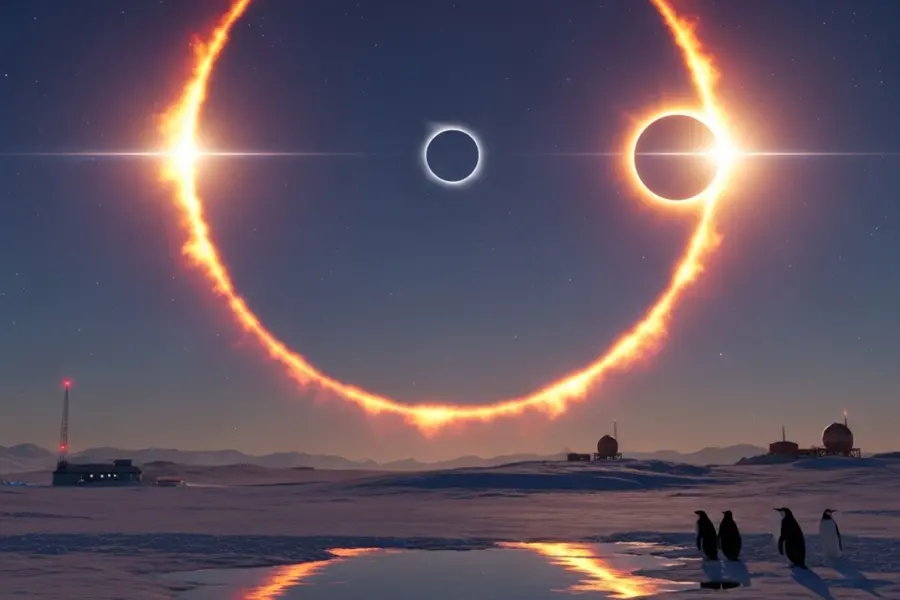
Astronomy enthusiasts have two celestial events to look forward to in 2026. The first, an annular solar eclipse, will occur on February 17, followed by a total solar eclipse on August 12.
Understanding the annular eclipse
Also Read

An annular solar eclipse happens when the Sun, Moon, and Earth align while the Moon is at its farthest point from Earth, called apogee. Because the Moon appears smaller, it cannot fully cover the Sun, leaving a bright outer ring visible—known as the “Ring of Fire.” This differs from a total solar eclipse, where the Moon completely blocks the Sun’s light.
Timing and visibility
The February 17 annular eclipse is scheduled to begin at 3:26 p.m. IST and reach its peak around 5:42 p.m. IST. However, the path of annularity passes only over Antarctica, making it invisible from India. Partial phases will be visible in parts of Africa, South America, and over sections of the Pacific, Atlantic, and Indian Oceans.
How to watch from India
Indian skywatchers can follow live coverage via digital platforms. Space agencies such as NASA and the Virtual Space Telescope will broadcast the event on YouTube and official websites.
Total solar eclipse in August
The total solar eclipse on August 12 will also be invisible from India. Its path of totality will traverse Greenland, Iceland, Spain, Russia, and a small section of Portugal. Observers in Europe, Africa, and North America may see partial phases of this eclipse.
Additional facts
- The “Ring of Fire” phase of the February eclipse will last around 1 minute and 52 seconds at peak visibility.
- Only a few Antarctic research stations lie along the eclipse’s path, where scientists may observe the phenomenon firsthand.
- Partial eclipses will create the impression of the Moon taking a “bite” out of the Sun in regions outside the main path.
While Indian observers will miss the direct view, both eclipses offer exciting opportunities for astronomy enthusiasts worldwide to witness rare solar phenomena. Digital streams ensure that the spectacular events can be safely enjoyed from anywhere.
Published: 13 Feb 2026, 01:28 pm IST
Related Topics
Disclaimer: Kindly avoid objectionable, derogatory, unlawful and lewd comments, while responding to reports. Such comments are punishable under cyber laws. Please keep away from personal attacks. The opinions expressed here are the personal opinions of readers and not that of Mathrubhumi.