
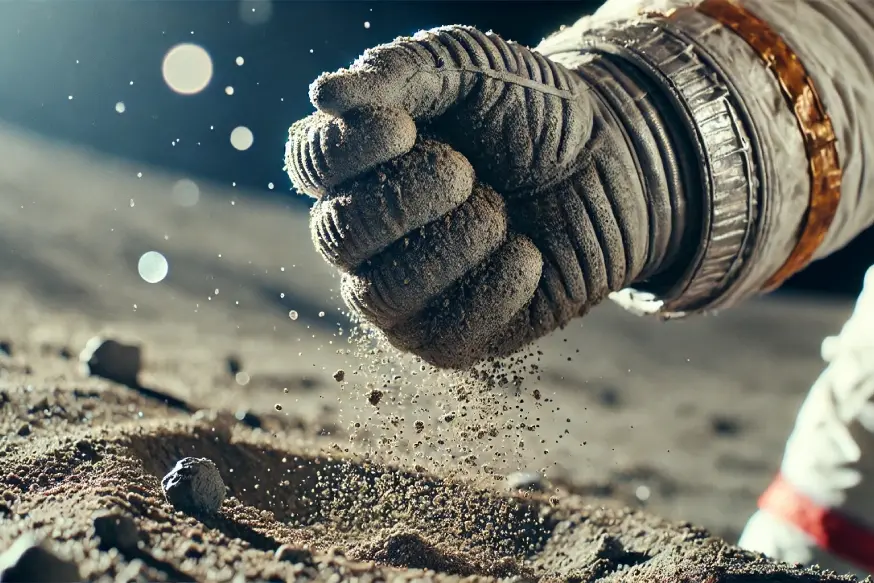
Beijing: Chinese researchers have uncovered a groundbreaking technique for generating large amounts of water using lunar soil samples brought back during a 2020 space mission, according to state broadcaster CCTV.
In 2020, China’s Chang’e-5 mission made history by retrieving lunar samples—the first time this had been done in 44 years. Scientists from the Chinese Academy of Sciences discovered that the minerals in these samples, often called 'moon soil,' are rich in hydrogen. When this hydrogen reacts with other elements at extremely high temperatures, it creates water vapor.
After three years of extensive research and repeated tests, scientists have developed a new method to extract significant quantities of water from lunar soil. This discovery is expected to be crucial in designing future lunar research stations and space stations, as per CCTV.
The implications of this discovery are significant for China’s long-term plans to establish a permanent presence on the moon, particularly in the ongoing competition with the U.S. to exploit lunar resources.
According to the state broadcaster, using this new technique, one tonne of lunar soil can produce between 51 to 76 kilograms of water. This is roughly equivalent to more than 100 bottles of water, or enough to meet the daily drinking needs of 50 people.
China aims to use recent and upcoming lunar missions as a foundation for building the International Lunar Research Station (ILRS), a project it is co-leading with Russia. The Chinese space agency has set a goal to have a basic station on the moon’s south pole by 2035, with a lunar-orbiting space station to follow by 2045.
This breakthrough comes as Chinese scientists are also examining new lunar samples brought back by the Chang’e-6 mission in June. Unlike the Chang’e-5 mission, which collected samples from the near side of the moon, Chang’e-6 gathered soil from the moon’s far side, which is always facing away from Earth.
The importance of finding water on the moon extends beyond supporting human habitation. NASA Administrator Bill Nelson told NPR in May that lunar water could potentially be converted into hydrogen rocket fuel, which would be critical for future space exploration missions to Mars and beyond.
Published: 23 Aug 2024, 03:05 pm IST
Related Topics
Disclaimer: Kindly avoid objectionable, derogatory, unlawful and lewd comments, while responding to reports. Such comments are punishable under cyber laws. Please keep away from personal attacks. The opinions expressed here are the personal opinions of readers and not that of Mathrubhumi.
