
Excitement built up across Kerala as people awaited the blood moon to emerge later in the night.
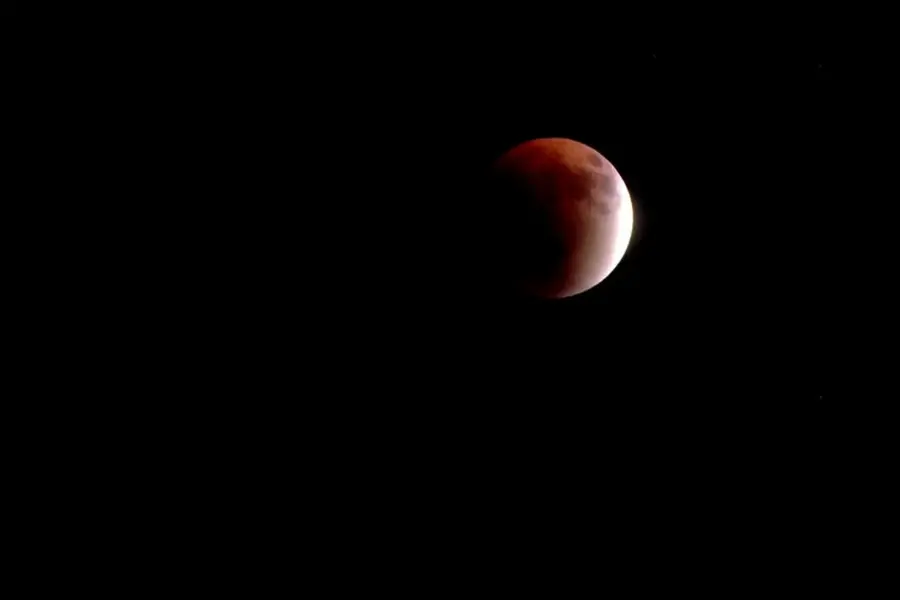
The much-awaited blood moon spectacle has begun on Sunday night, with netizens across Kerala sharing striking images as the lunar eclipse unfolded. The night sky turned into a show even before the event began, when visuals of the glowing moon were shared by news agency PTI around 8.50 pm.
By 11 pm, the moon gradually began turning red as the lunar eclipse shifted from its partial phase to the total phase. News agency ANI shared a video capturing this dramatic transformation, highlighting the peak of the celestial display over Thiruvananthapuram.
As excitement built up, people in different parts of the state took to social media platforms to share photos and videos of the rare sight.
Why the moon turns red
The transformation of the moon into red during a total lunar eclipse is popularly called the blood moon. A lunar eclipse occurs when the Earth comes between the Sun and the Moon. Although Earth’s shadow completely covers the Moon, sunlight sneaks through the planet’s atmosphere.
Shorter wavelengths like violet, blue and green are scattered away by fine particles, while longer wavelengths such as orange and red survive the journey. These reach the Moon’s surface and reflect back, giving it a dim crimson glow instead of vanishing.
Longest eclipse of the year
The eclipse, visible across most of India, will be the year’s longest. According to Nehru Centre Planetarium (Mumbai) Director Arvind Paranjpye, the total lunar eclipse will begin around 8.58 p.m.
The totality, when the Moon will be completely covered by Earth’s shadow, is expected to start close to 11 p.m. and peak at 11.42 p.m. The eclipse will last until 1.26 a.m., making it a long-duration celestial event.
Safe to watch with the naked eye
Paranjpye explained that at its peak, the Moon could appear dark or even brick-red, as Earth’s atmosphere scatters blue light while allowing red light to reach the lunar surface.
He noted that, unlike solar eclipses, lunar eclipses are perfectly safe to view with the naked eye. “There is no need for fear or superstition,” he said, adding that science regards the event as purely natural.
Memories of past eclipses
Recalling his experiences, Paranjpye mentioned extraordinary eclipses he had witnessed, including one in the 1970s when volcanic ash made the Moon vanish from sight for a few minutes. “Such sights remind us that eclipses are among the most beautiful celestial events one can witness,” he said.
He encouraged people to enjoy the spectacle, take photographs and cherish the moment. “If the skies are clear, it will be a wonderful opportunity for everyone in India to witness one of nature’s finest spectacles,” he added.
The September 7 lunar eclipse will be the last of the year and, according to astronomers, one of the most significant celestial events of 2025.
Published: 07 Sept 2025, 09:55 pm IST
Related Topics
Disclaimer: Kindly avoid objectionable, derogatory, unlawful and lewd comments, while responding to reports. Such comments are punishable under cyber laws. Please keep away from personal attacks. The opinions expressed here are the personal opinions of readers and not that of Mathrubhumi.
