
The 1868 eclipse is sometimes described as the discovery of helium, but the history is more complicated.
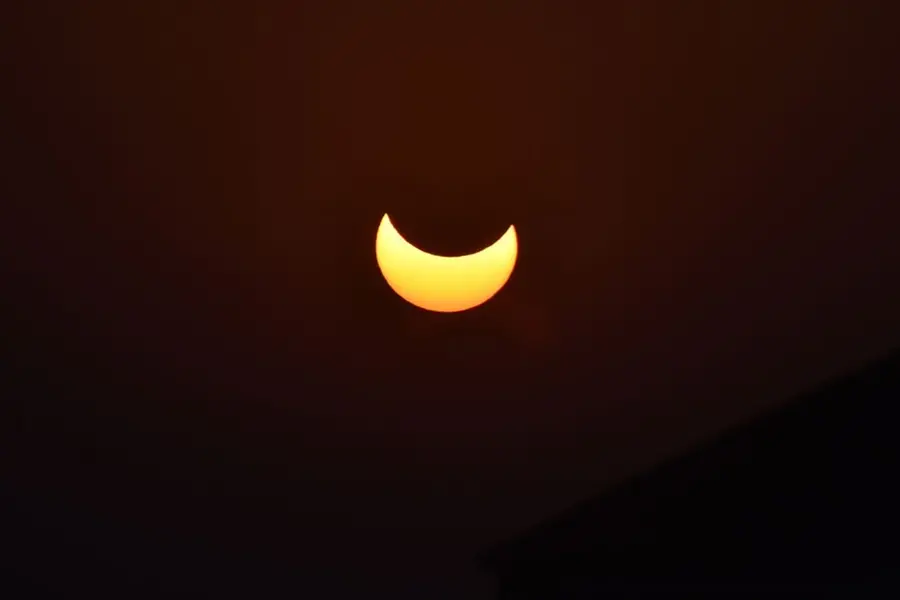
Paris: More than 150 years before a total solar eclipse sweeps across northern Spain, another eclipse observed from India helped open a new chapter in astronomy by revealing a mysterious yellow line in the Sun's spectrum that eventually led scientists to helium.
On August 18, 1868, French astronomer Pierre Jules Janssen travelled to Guntoor, India, to observe a total solar eclipse. As the Moon covered the Sun, Janssen turned his spectroscope towards the bright prominences around the eclipsed solar disc.
The light from those prominences contained a yellow spectral line close to the familiar sodium lines, but it did not quite match them. At the time, its origin was unknown.
The observation would eventually become associated with helium, an element that had not yet been identified on Earth. But contrary to the often-repeated version of the story, Janssen did not discover or identify helium during the eclipse.
The 1868 eclipse and the mysterious yellow line
The total solar eclipse gave astronomers a rare chance to study the Sun's prominences using spectroscopy. By splitting their light into different wavelengths, researchers could look for characteristic spectral lines that might reveal the substances present in the glowing solar structures.
Janssen's observations were particularly significant because they helped demonstrate a new way of studying prominences. He developed what later became known as the prominence method, allowing astronomers to observe these structures without necessarily waiting for another total solar eclipse.
The mysterious yellow feature was initially difficult to distinguish precisely because it appeared close to sodium's well-known D1 and D2 lines.
After the eclipse, English astronomer Norman Lockyer examined the evidence more closely and determined that the unidentified feature did not correspond to sodium. He designated it D3, noting that its wavelength was slightly shorter.
Janssen subsequently confirmed that the line was very close to the sodium lines but slightly more refrangible.
Janssen did not discover helium
The 1868 eclipse is sometimes described as the discovery of helium, but the history is more complicated.
Janssen's contribution was his observation of the unexplained spectral feature and his work on techniques for studying solar prominences. He did not identify the element responsible for the D3 line.
Lockyer continued investigating the mystery and worked with chemist Edward Frankland to determine whether the line could be produced by hydrogen. Their laboratory experiments failed to reproduce it under the conditions they tested.
That failure raised the possibility that the Sun was revealing the signature of an element unknown to terrestrial chemistry.
Lockyer eventually named the proposed solar element helium, after Helios, the Greek personification of the Sun. At that point, helium existed only as a spectral clue; scientists had not isolated it from any material on Earth.
The episode became an early demonstration of the power of spectroscopy: astronomy had detected the signature of a substance before chemistry had physically identified it.
How helium was finally found on Earth
The mystery was resolved nearly three decades later.
In 1895, Scottish chemist William Ramsay extracted helium from the mineral cleveite. His work provided the terrestrial confirmation that the element whose spectral signature had first been detected in sunlight also existed on Earth.
The discovery changed the historical meaning of the 1868 observation. Rather than being a single-person discovery by Janssen, helium's identification emerged through a chain of observations, interpretation and laboratory experiments stretching from the eclipse in India to Ramsay's work.
Janssen's more lasting contribution was his prominence method, which opened new possibilities for observing the solar atmosphere. The D3 line was one part of that larger scientific story.
The historical episode is particularly relevant as another total solar eclipse approaches Europe.
On August 12, 2026, the Moon will pass directly between the Sun and Earth, casting its shadow across a narrow path of totality. The eclipse will be visible in northern Russia, Greenland, Iceland, Spain and the northeastern tip of Portugal.
In Spain, the path will cross parts of the country's north before moving towards Mallorca. The eclipse will also pass over areas affected by devastating wildfires, which scientists have linked to increased fire risk associated with human-driven climate change.
For observers in Spain, totality will occur shortly before sunset and last less than two minutes in many locations. In Burgos, for example, totality is expected to last one minute and 48 seconds.
The event will last somewhat longer in parts of Russia and Greenland, although still for less than two-and-a-half minutes. Partial phases will last much longer and will be visible across much of Europe, Canada, the northern United States and northwest Africa.
NASA describes the geometry behind a total solar eclipse as a "cosmic coincidence".
"Even though the Sun is about 400 times bigger than the Moon, it is also about 400 times farther away," the US space agency says.
That unusual alignment allows the Moon to cover the Sun almost completely from the perspective of observers in the path of totality, exposing the Sun's outer atmosphere, or corona.
How rare is a total solar eclipse?
Solar eclipses occur roughly once or twice every year, but totality is visible only along a relatively narrow path. As a result, a particular location can wait centuries before experiencing another total solar eclipse.
The next major total eclipse visible in parts of southern Europe will arrive on August 2, 2027, when the path of totality crosses southern Spain, northern Africa and the Arabian Peninsula.
Totality during that eclipse will last up to six minutes and 23 seconds. A longer total eclipse will not occur until 2114.
Spain will see another notable event on January 26, 2028, when an annular eclipse, sometimes called a "ring of fire" eclipse, crosses southern parts of the country.
How to safely watch the eclipse
Unlike the 1868 astronomers, modern eclipse observers have access to specially designed eye protection, and experts warn against looking directly at the Sun without it.
Eclipse glasses should meet the ISO 12312-2:2015 standard and provide appropriate protection from ultraviolet radiation.
Looking directly at the Sun can cause serious retinal damage. The eyes do not have pain receptors capable of warning a person that injury is occurring, meaning damage may only become apparent later.
Research following the 2024 total solar eclipse in the United States found a surge in online searches for "my eyes hurt", highlighting the risks of viewing the Sun without proper protection.
More than a century and a half after Janssen looked towards the eclipsed Sun from India and encountered an unexplained yellow line, total eclipses continue to offer scientists and observers an extraordinary view of the solar atmosphere, and a reminder of how much astronomy has learned from the brief moments when the Moon blocks the Sun.
Published: 12 Aug 2026, 07:58 am IST
ABOUT THE AUTHOR

Related Topics
Disclaimer: Kindly avoid objectionable, derogatory, unlawful and lewd comments, while responding to reports. Such comments are punishable under cyber laws. Please keep away from personal attacks. The opinions expressed here are the personal opinions of readers and not that of Mathrubhumi.