
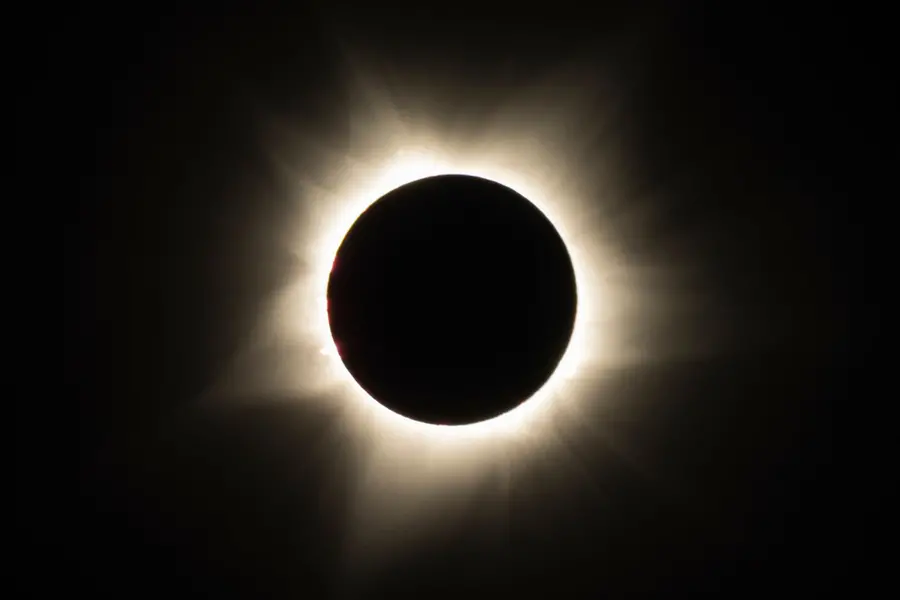
Eclipse mania is sweeping across North America as a breathtaking celestial event on Monday promises a rare blend of commerce, science -- and celebration.
The Moon's shadow will land on Mexico's Pacific coast, then speed northeast across a 15-state swath of the United States and on to Canada, exiting the continent over Newfoundland just under an hour and a half later.
Festivals, viewing parties, and even a mass wedding are planned along the eclipse "path of totality".
"Eclipses have a special power," NASA administrator Bill Nelson said recently. "They move people to feel a kind of reverence for the beauty of our universe."
This year's path of totality is 115 miles (185 kilometres) wide and home to nearly 32 million Americans, with an additional 150 million living less than 200 miles from the strip. Those further away can still enjoy a partial eclipse, or follow a webcast provided by US space agency NASA.
Several airlines have advertised flights scheduled to pass under the eclipse, while Delta has even planned two special trips along the path of totality.
NASA plans to launch a trio of sounding rockets before, during and just after the eclipse to measure changes caused by the sudden darkness of the ionosphere, an upper layer of the atmosphere important for long-distance radio communication.
The eclipse also offers a golden opportunity to study the Sun's corona, the outer layer of our star's atmosphere which is normally hidden by the blinding light of the surface.
Researchers are particularly thrilled about the Sun being near the peak of its 11-year cycle.
Startling animal behaviour has been noted during past eclipses: giraffes have been seen galloping, while roosters and crickets can start crowing and chirping.
NASA has invited the public to contribute to research through its citizen-science project Eclipse Soundscapes, by recording the sounds of nature and submitting their multisensory observations.
In humans, eclipses trigger feelings of awe and "prosocial" tendencies towards others, research has found.
Safety is paramount, with authorities stressing people must use certified eclipse glasses to prevent retinal injury.
Past eclipses have been followed by increases in hospital visits by people with complaints of blurry vision, changes in colour perception, and blind spots, with the outlook for recovery far from certain.
Only those within the path of totality can safely remove their eye protection and admire the corona peeking out from behind the silhouette of the Moon for a few precious moments.
But they must be certain of when it begins and ends and don their glasses in time, say health professionals.
AFP
Published: 08 Apr 2024, 09:35 am IST
Related Topics
Disclaimer: Kindly avoid objectionable, derogatory, unlawful and lewd comments, while responding to reports. Such comments are punishable under cyber laws. Please keep away from personal attacks. The opinions expressed here are the personal opinions of readers and not that of Mathrubhumi.
