
During the test flight, the Matrix circled the heliport twice before landing smoothly roughly ten minutes later, offering a glimpse of how electric air taxis might operate in the future.
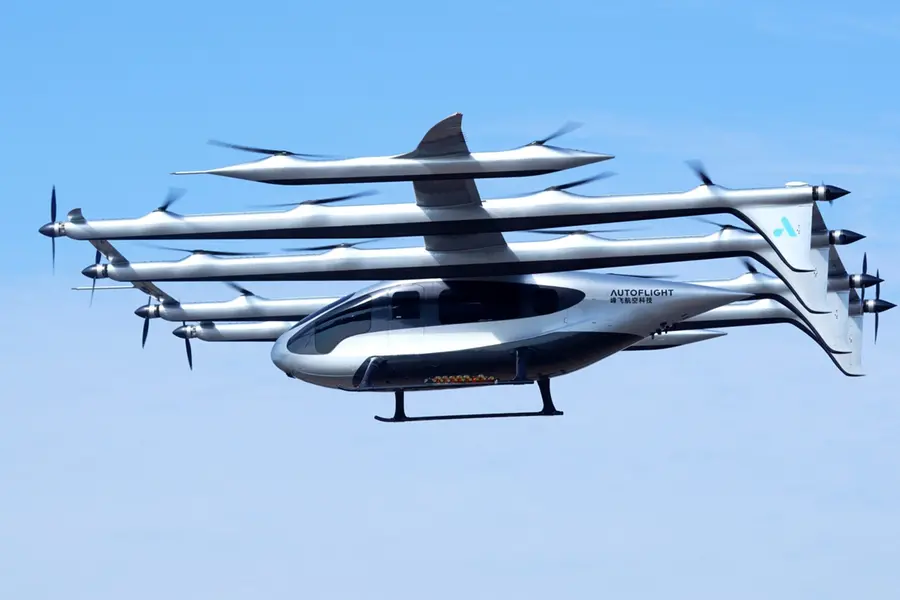
Inside a hangar in this southeastern Chinese city, engineers are testing what could be a preview of future urban transport, a massive electric aircraft designed to function as a flying taxi.
The aircraft, called Matrix, looks somewhat like an oversized drone but is built to carry people. Developed by the Chinese company AutoFlight, it is a five-ton electric vertical takeoff and landing vehicle (eVTOL) that can accommodate up to 10 passengers. With a wingspan of around 20 meters (66 feet), the aircraft measures about 17.1 meters long and stands 3.3 meters tall. On a full charge, it can remain airborne for roughly an hour.
AutoFlight recently showcased the prototype during a demonstration flight at its low-altitude test facility in Kunshan, about 60 kilometres west of Shanghai. Engineers rolled the aircraft from its hangar onto a helipad before powering up its propellers. After routine checks, the vehicle slowly lifted into the air. The sound was noticeable, though quieter than a conventional helicopter.
Also read | Nothing Phone 4a, Phone 4a Pro launched today: Check price in India, full specs here
During the test flight, the Matrix circled the heliport twice before landing smoothly roughly ten minutes later, offering a glimpse of how electric air taxis might operate in the future.
Still, widespread passenger flights remain some distance away. “This is a good question, but this is a very tough question for me to answer,” said Steven Yang, senior vice president of AutoFlight, when asked when flying taxis could become a reality.
Founded in 2017, the company is already developing a smaller two-ton passenger eVTOL model, though it is still awaiting regulatory certification. Yang said the company hopes to obtain a type certificate, confirmation that the aircraft meets safety standards, by 2027. Even after that, operators would still require additional approvals to carry passengers commercially.
Also read | AI and drones in Tamil Nadu: Inside ambitious plan to map ‘Blue Carbon’ ecosystems
For now, the Matrix remains a prototype.
China’s interest in the sector is growing. Several other companies are also developing eVTOL aircraft as part of the country’s emerging “low-altitude economy.” In Guangdong province, drone manufacturer EHang has already secured certification to offer commercial passenger services, though operations have yet to begin.
Experts say technological capability alone will not determine the pace of adoption. Infrastructure, safety regulations and traffic management systems will also need to evolve before flying taxis become common.
Gary Ng, senior economist at Natixis Corporate and Investment Banking, says the ecosystem around the technology is still developing. “All of this ecosystem surrounding the technology itself is also still underdeveloped at this point,” he said. “I would say it would take at least another three years to see something more viable.”
While drones are already being used for deliveries in some Chinese cities such as Shenzhen, passenger air taxis remain largely experimental. Yet watching the Matrix rise into the sky makes the concept feel less like science fiction and more like a possible next step in urban mobility.
Published: 06 Mar 2026, 08:01 am IST
Related Topics
Disclaimer: Kindly avoid objectionable, derogatory, unlawful and lewd comments, while responding to reports. Such comments are punishable under cyber laws. Please keep away from personal attacks. The opinions expressed here are the personal opinions of readers and not that of Mathrubhumi.
