
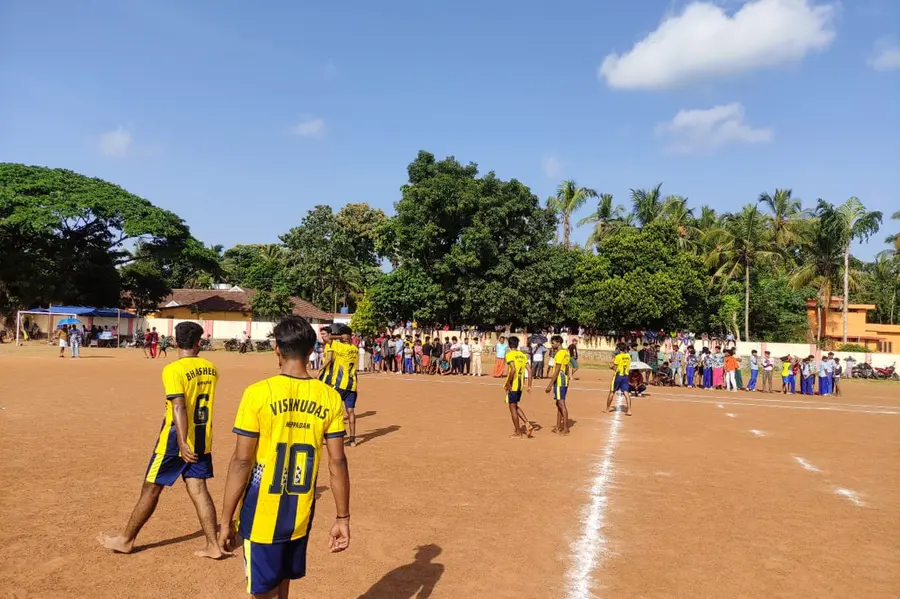
Thrissur: For natives of Chelakkara here, Onam is incomplete without the Thalama Panthu Kali (ball game), or just Panthukali, as they call it. The Onam festival starts here with the beginning of the almost 20-day-long Panthukali season. This has been the tradition for Chelakkara natives as long as their memory goes. Don't get it confused with the Thalappanthu Kali, a game often linked to the Onam festival. This is a different league, altogether.
The game
Nehru Club, an organisation formed with the sole purpose of conducting the Thalama Panthu competition, organises the major tournament at Mukarikunnu ground in Chelakkara. A team consists of seven members with the option for two substitutes. This year there are 53 teams, which is the biggest in the history of the game, the organisers say. One game has seven steps, each played thrice. The steps are called 'Thalama', Otta', 'Erada', 'Thudama', 'Pidichan', 'Kakkudi', and 'Oodi'. They represent each round, played differently. Sometimes, the ball is served using the leg, like in football, otherwise, it will be served by hand, like in volleyball.

For example, in the 'Thalama' round, one team will hit the ball with their hand (like serving in volleyball), while the opponents have to return it on the first attempt itself and they are allowed to use their legs. 'Pattam Vekkal' is the scoring moment, when one team finishes all seven steps thrice, without getting into the hands of the opponents. The opponents will try to beat the team by returning the ball. The teams also try to bring down the members of the opposing team, like in Kabaddi. As a result, teams may lose their co-players for the rest of the match.
Whichever team completes the 'Pattam Vekkal' twice consecutively wins the game. The game will end only if a team wins. There have been times when the match prolonged for more than one day. The final winner would get Rs 15,000, sponsored by Chelakkara grama panchayat. The runner-up would get Rs 12,000. Understanding the rules of the game is not easy. Even people in neighbouring villages don't know how the game is played. 'I started playing the sport back in 2005. I have been an organising committee member since 2008. This game is also played in some places in Palakkad, Kottayam and even Pathanamthitta districts. But we have updated the rules to make it simpler,' said Anas Pathukudy, an organiser.
Festival sans religion
The tournament of this year began on Sunday (August 13). It is held in the afternoon. It usually starts at 2 pm and goes till 7 pm, for almost 20 days. For the whole season, many would ditch work. ‘It is a startling revelation that we have so many unemployed people (laughs),’ says Anas. People of Chelakkara, sans religion, caste, gender and age, would throng the grounds to watch the game. 'One time, I was not able to enter the match area. It didn't matter that I was an organiser,' said Anas, who says the popularity is only growing. Minister K Radhakrishnan, who represents Chelakkara in the state Assembly, is said to be a Thalama Panthu player in his youth. ‘Local television cable channels are airing the final matches live. There are YouTube streams as well,' Anas said.
When asked what was the connection of Thalama Panthu with Onam, Anas asked back, 'How is 'Vadam Vali' connected to Onam?' There is no concrete answer to why Thalama Panthu is played during Onam days. It didn't matter to the people of Chelakkara either. For them, Onam is incomplete without the Panthukali. Due to Covid-19 restrictions, the game did not happen in 2020 and 2021. People were seen weeping in front of TV cameras for missing the season.
Physical fitness is a must to play the whole tournament. 'Often the players' legs and hands will swell after the match. Nowadays, young people are coming forward. They are already into football. This game is more suitable for them. Earlier, there were many players aged 40 or 45. Not anymore. Now,most players are in their 20s,' said Anas.
The ball
The ball, made of coir and leather, is bigger than a cricket ball, but smaller than a football. It weighs around 300 gram. One ball costs Rs 1,000. A coir ball, covered with coir twines, protected by an outer layer of leather, forms the ball.The Chakkottil family in Mangalamkunnu here has been making the ball for the past several decades. Babu and his relative Rameshan are the present members who are engaged in ball-making. One season would require around 10 balls for the Nehru club. Anas says this season may require 15. There are also other local matches in the Chelakkara area. They also buy the balls from the Chakkottil family. Anas said people from Pathanamthitta and Kottayam also come here in search of the ball makers. 'Rameshan is the youngest member of the family, who is an expert in ball making. However, there is no one else after him. It is a matter of concern. This requires special skill,' said Anas.
Published: 18 Aug 2023, 08:14 pm IST
Related Topics
Disclaimer: Kindly avoid objectionable, derogatory, unlawful and lewd comments, while responding to reports. Such comments are punishable under cyber laws. Please keep away from personal attacks. The opinions expressed here are the personal opinions of readers and not that of Mathrubhumi.