
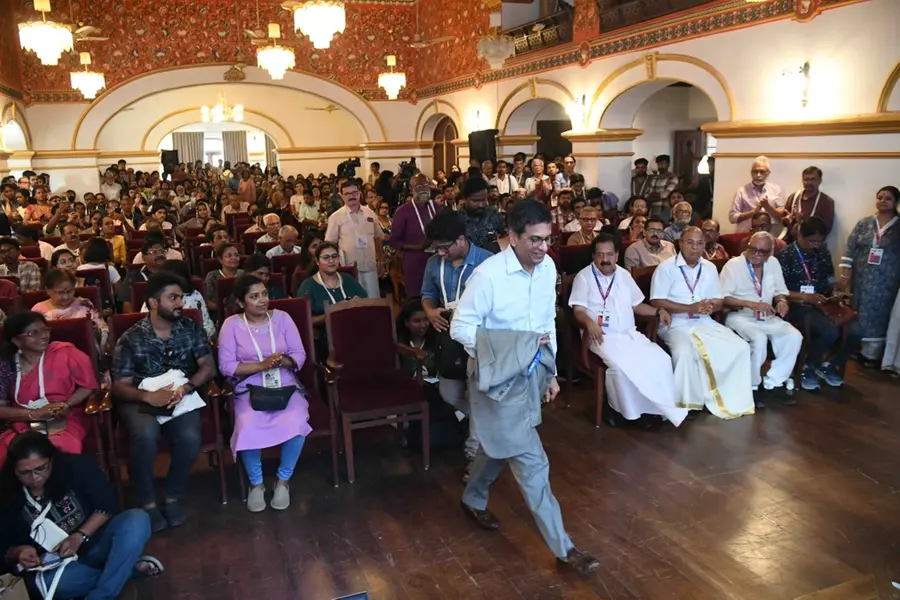
Justice D Y Chandrachud’s solo session—Fraternity As The Constitutional Soul at The Mathrubhumi International Festival of Letters (MBIFL) at Kanakakkunnu Palace in Thiruvananthapuram—saw him addressing pressing concerns raised by members of the audience around case backlogs, the collegium system, and the role of public opinion in judicial decisions.
A concerned audience member highlighted the issue of judicial backlogs, citing staggering numbers—thousands of pending cases in the Supreme Court and lakhs in High Courts.
Also Read

"Even if people have faith in the Supreme Court, it's just an indicator," the audience member noted.
"Because this law is not just about a sovereign function, but it is also an essential service."
Acknowledging the gravity of the situation, Justice Chandrachud responded with an example.
"If a marital dispute begins and remains unresolved until the couple turns 40, they have already built an entirely new life by then. Justice delayed, in such cases, is justice denied," he said.
He also pointed out the dire consequences of delayed criminal appeals, especially in states like Uttar Pradesh, where cases from the 1980s still await resolution.
However, he emphasised that courts alone cannot resolve this crisis.
"Last year, 61,000 cases were filed in the Supreme Court, and 34 judges disposed of 59,700 cases—almost at par with new filings," he explained.
"But courts cannot expand their own infrastructure. The judge-to-population ratio in India is abysmally low."
He stressed the need for additional courts, better infrastructure, and well-trained judges, rather than just filling vacancies.
Technology, he argued, could play a pivotal role.
"Artificial intelligence—though not for deciding cases—can assist in knowledge management and grouping similar cases to streamline hearings," he said.
Several initiatives, including live streaming of Supreme Court proceedings and AI-assisted translation of judgements into multiple Indian languages, were highlighted as efforts to bring judicial work closer to the people. However, he firmly asserted that "governments must allocate proper budgetary resources" to address the backlog effectively.
Another audience member questioned the often-debated collegium system of judicial appointments, asking whether it merely maintained a power balance or actively safeguarded judicial independence.
In response, Justice Chandrachud clarified a common misconception:
"The collegium system is not a case of judges appointing judges. There are multiple levels of scrutiny—recommendations originate at high courts, are vetted by state governments, and are further examined by the Union government before reaching the Supreme Court."
He also noted a significant shift in the judiciary at the district level.
"In many states, over 50 percent, sometimes even 60-70 percent, of new judges in the district judiciary are women," he said.
This, he explained, was a direct result of dismantling the "old boys' network" that once controlled judicial appointments.
"When you create a level playing field, access to the judiciary becomes democratised. These young judges will rise through the ranks in the next decade," he added.
A particularly thought-provoking question came from an audience member referencing Mexico’s judicial reform, where public elections reportedly determine certain judicial charges. They asked whether judicial decisions should reflect public sentiment and where the line should be drawn between public perception and constitutional justice.
“I would be very fearful of a system in which judges are elected by the people,” Justice Chandrachud said.
“We have seen what happens in countries like the United States, where judicial elections lead to influence from self-interest groups, corporate funding, and political pressure," he cautioned.
However, he clarified that this did not mean judges were disconnected from public concerns.
"When a law passed by Parliament is challenged, courts presume it is constitutionally valid, meaning elected representatives’ decisions are given due weight," he explained.
Yet, he underscored that judges must remain guided by constitutional values rather than fluctuating public moods.
"Some of our judgements may go against popular sentiment," he admitted, "but they uphold democracy, equality, liberty, and freedom. This is why we have appointed judges and elected legislators—to maintain a system of checks and balances as envisioned by the Constitution."
Published: 08 Feb 2025, 04:46 pm IST
Related Topics
Disclaimer: Kindly avoid objectionable, derogatory, unlawful and lewd comments, while responding to reports. Such comments are punishable under cyber laws. Please keep away from personal attacks. The opinions expressed here are the personal opinions of readers and not that of Mathrubhumi.