
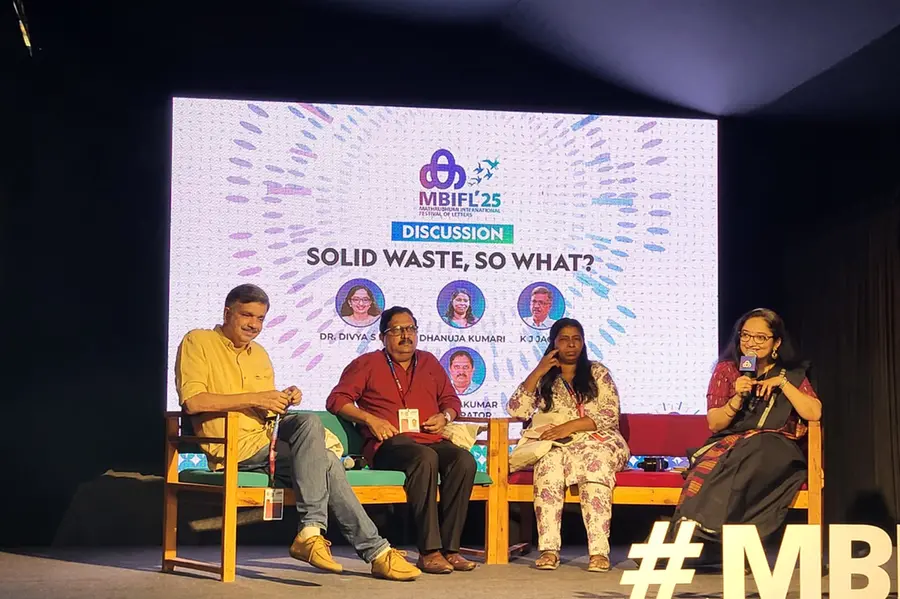
Waste management is one of the most discussed issues of the 21st century. This topic was also a major highlight at MBIFL 2025, where three to four sessions were solely dedicated to waste collection, treatment, and management.
One such session, 'Solid Waste, So What?', was moderated by Dr Divya S Iyer, the Managing Director of Vizhinjam International Seaport and the Director of the Solid Waste Management Project. The panel included Dhanuja Kumari, a member of Haritha Karma Sena and the author of the autobiography 'Chengachoolayile Ente Jeevitham', which was also discussed in the session. Other panelists included KJ Jacob and JS Jayakumar, both experts in solid, liquid, and biomedical waste management.
Dr Divya, as a bureaucratic head overseeing waste management, has developed a habit of seeking Green Protocol compliance wherever she goes something that wasn’t common a decade ago. She stated, "I look for the Green Protocol system at each place and identify whether it’s a plastic flower or a plastic cup used in this program." While preparing for the Civil Services Examination, she had already identified waste management as a priority area if she became a District Collector.
She also discussed large-scale projects under KSWMP (Kerala Solid Waste Management Project), funded by the World Bank, which includes cleaning up 59 dumping sites covering 126 acres. Of these, work on 20 sites has already begun, with an investment of Rs 100 crores. These sites contain "legacy waste"-waste that has been dumped for years, consisting of both biodegradable and non-biodegradable materials.

Identifying waste management as one of Kerala’s biggest challenges, she highlighted how pollution has compromised water purity, making it undrinkable directly from water bodies-something once common in Kerala.
KJ Jacob emphasized the success of Kerala’s waste collection system, which now collects 80% of waste directly from households. He shared his personal experience of living near the Brahmapuram Waste Treatment Plant, which initially only processed food waste. However, the establishment of a compost plant in his apartment complex has been a significant step forward.
He also noted an interesting contrast between India and the United States: While India consumes only 10% of packaged food items, in the US, the figure is 80%. He posed the question, "If we struggle with waste management, how do they handle it?" The 360-degree waste management process being implemented in Kerala, he argued, could serve as a model for the entire country.
JS Jayakumar stated, "The process of clearing waste is not just about dumping-it’s about proper disposal." He stressed that waste management is not just a regional problem but an international issue. Citing Dubai as an example, he criticized the practice of outsourcing waste treatment to desert areas, arguing that deserts are also ecosystems with biodiversity and should not be treated as dumping grounds.
He highlighted waste-to-energy initiatives, such as the BPCL plant at Brahmapuram, which converts waste into CNG. He confidently stated, "Clearing these sites will make Kerala the cleanest state."
The highlight of the session was Dhanuja Kumari, who shared her heartfelt personal experiences as a Haritha Karma Sena worker in the outskirts of Chengachoolayil. She spoke about the disgust and avoidance she faces-especially from the educated upper-middle class, who are well aware of waste management issues yet often disrespect sanitation workers.
She described how being a Haritha Karma Sena worker made her financially independent and gave her immense strength. However, she also shared an incident that deeply affected her:
"Once, I went to a house to collect waste. The owner, a school principal, told me that she sends her household waste to the school as part of the school’s waste to save money. I replied, ‘The government collects waste from schools to keep the school clean-not your home!’"
Such incidents, especially from educated individuals, deeply disappoint her. She emphasized the physical and mental exhaustion that sanitation workers endure and urged the government to provide them with basic amenities, including sanitary and healthcare facilities.
One of the biggest challenges in waste management is public resistance to setting up waste treatment plants in their neighborhoods. The "Not in My Backyard" attitude remains a major hurdle. The panel agreed that scientific awareness programs and educational sessions are essential to address this issue.
Moving from centralized to decentralized waste management, they argued, is crucial. Waste treatment plants should not exist only on paper but should function as a continuous process.
A promising step is the inclusion of waste management in school curriculums through stories and games, which was widely supported by the panelists.
The session successfully bridged the scientific and humanistic aspects of waste management. While policies, projects, and technology play a crucial role, the attitudes of individuals and communities determine the success of waste management efforts.
Published: 09 Feb 2025, 11:02 pm IST
Related Topics
Disclaimer: Kindly avoid objectionable, derogatory, unlawful and lewd comments, while responding to reports. Such comments are punishable under cyber laws. Please keep away from personal attacks. The opinions expressed here are the personal opinions of readers and not that of Mathrubhumi.