
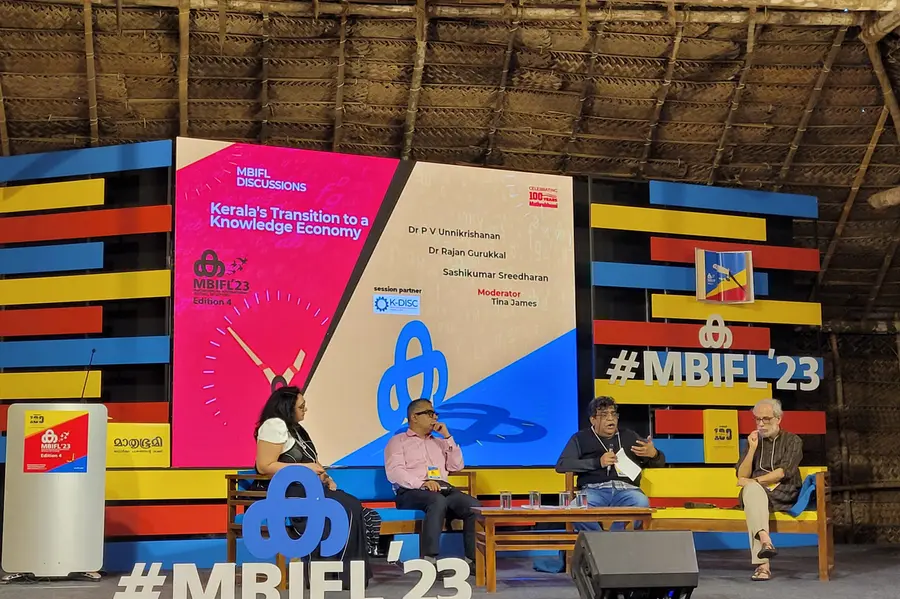
Thiruvananthapuram: Mathrubhumi International Festival of Letters on Saturday held a discussion on Kerala's gradual transition into a knowledge economy.
Dr P V Unnikrishnan, Member Secretary of the Kerala Development and Innovation Strategic Council, talked about the local economic context and the outcomes achieved by this model of economy. "The transition into a knowledge-based economy was boosted by the 2020-21 budget as Thomas Issac made some crucial changes in the economy. The central foundation for Kerala's economy is agriculture. Still, we can see some evident challenges in production as many crops faced a decline in production. Climatic change and fertiliser use played an essential role in this crisis," said Unnikrishnan.
Dr Rajan Gurukkal, Vice-Chairman of the Kerala State Higher Education Council, discussed the importance of the higher education sector in a knowledge economy. The higher education system influences the knowledge producers, exchangers and consumers. Dr Rajan argued, "Teachers, skilled craftsmen and theoreticians have a crucial role in developing the education system. A significant problem we face is outsourcing and the migration of our human resources, which creates stagnation in our knowledge production. There should be a focus on personalised self-learning because it is very successful in foreign countries". He also touched upon the development of technology and education as they can be used to control human minds in the future.
Sashikumar Sreedharan, Managing director of Microsoft India, spoke on the role of corporates in a knowledge economy and analysed the quality and competitive capabilities of students from Kerala. "Indeed, students don't get enough exposure, but they are great learners. From a corporate view, the key element is participation in the economy and to study about the opportunities in the economy. Our economy is getting into a mix of both technical and knowledge-driven methods. The corporates should learn how to transpose the technology and use it to benefit our community", according to Sashikumar.
"With the two million job opportunities in the five-year plan by the government, we could see women's rise and participation, which will reduce the gender disparity in employment." Dr Rajan said.
"The employability problem can be tackled in a knowledge economy, and it helps solve national issues. Long-term planning and lifelong learning are essential factors for a knowledge economy", Sashikumar concluded the session.
The session was moderated by Tina James, CEO of Reverie Global.
Published: 04 Feb 2023, 09:09 pm IST
Related Topics
Disclaimer: Kindly avoid objectionable, derogatory, unlawful and lewd comments, while responding to reports. Such comments are punishable under cyber laws. Please keep away from personal attacks. The opinions expressed here are the personal opinions of readers and not that of Mathrubhumi.
