
Expected to enter service in 2027, the aircraft is set to redefine global air travel with extended range, improved passenger comfort, and a new era of stop-free intercontinental journeys.
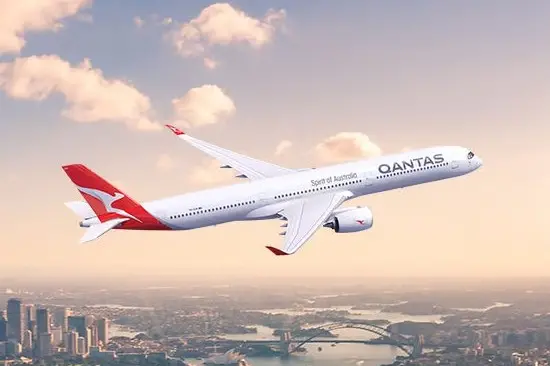
In today’s fast-paced world, taking a flight across two cities or continents is normalised; however, no one talks of the discomfort, the cramped-up feeling and feeling of being cooped up for too long…Now imagine if you have to fly 22 hours non-stop, on one of the world’s longest flights…but in ultra-luxury!
Think of boarding a flight in Sydney, settling into your seat, watching a movie, having dinner, getting some sleep, enjoying breakfast the next morning and landing in London or New York without ever changing planes.
What sounds like something from the future is now moving closer to reality.
The dream of flying halfway across the world without a single stop is moving closer to reality as Qantas' ambitious Project Sunrise programme has reached a major milestone with the successful first flight of its specially designed Airbus A350-1000ULR, an aircraft that will eventually operate the world's longest non-stop commercial passenger services between Sydney and cities such as London and New York.
The aircraft recently took off from Airbus' facilities in Toulouse, France, beginning a crucial testing and certification phase before entering commercial service.
When the aircraft eventually begins carrying passengers in 2027, it is expected to operate the world's longest non-stop commercial flights, connecting Australia's east coast directly with destinations such as London and New York in journeys lasting up to 22 hours. The aircraft is not only pushing the boundaries of aviation range but also redefining passenger comfort, featuring a spacious, premium-focused cabin, dedicated wellness areas and design elements specifically developed to make ultra-long-haul travel more comfortable and enjoyable than ever before.
For aviation enthusiasts, it is a technological achievement. For travellers, it could redefine long-distance travel.
Why is project Sunrise so important?
Australia has always faced one major challenge: geography. The country is one of the world's most isolated major aviation markets. Travelling from Australia to Europe or the eastern United States usually requires at least one stopover, often adding several hours to an already long journey.
For decades, airlines and aircraft manufacturers dreamed of eliminating those stopovers, but the technology simply wasn't available.
That changed in 2017 when Qantas formally launched Project Sunrise. The airline challenged aircraft manufacturers to design an aircraft capable of flying from Sydney directly to London or New York while carrying enough passengers and cargo to make the route commercially viable.
After evaluating proposals from both Airbus and Boeing, Qantas selected Airbus and placed an order for 12 specially modified Airbus A350-1000 aircraft.
Nearly a decade later, that vision is finally taking shape.
A name inspired by history
The name "Project Sunrise" carries a fascinating historical connection. During World War II, Qantas operated extraordinary "Double Sunrise" flights between Australia and Sri Lanka. These flights lasted more than 30 hours, and passengers often witnessed two sunrises during a single journey.
At the time, they were among the longest flights ever attempted.
Today's Project Sunrise aims to create a modern version of that achievement, using cutting-edge technology to connect Australia with the world in ways that were previously impossible.
What makes this ‘Aircraft’ special?
At first glance, the Airbus A350-1000ULR looks similar to a standard Airbus A350. However, beneath the surface, it has been redesigned for one specific purpose: flying farther than any commercial passenger aircraft before it.
The aircraft incorporates an additional fuel tank capable of carrying around 20,000 litres of extra fuel. Airbus engineers have also strengthened parts of the structure and increased the aircraft's maximum take-off weight to support these ultra-long missions.
These modifications extend the aircraft's range by approximately 1,000 nautical miles beyond a standard A350-1000.
The result is an aircraft capable of flying almost 10,000 nautical miles or more than 17,000 kilometres without stopping. That range makes direct Sydney-London and Sydney-New York services possible for the first time in aviation history.
Breaking records is part of story…
Flying for 20 to 22 hours presents unique challenges for passengers and crew. Spending nearly an entire day inside an aircraft requires a very different approach compared with traditional long-haul travel. Recognising this, Qantas has spent years studying how ultra-long-haul flying affects the human body.
In 2019, the airline conducted a series of research flights between Sydney, London and New York using Boeing 787 aircraft. Researchers monitored passenger sleep patterns, eating habits, movement, hydration levels and overall wellbeing.
The findings helped shape every aspect of the new aircraft's interior design.
Passenger comfort takes priority
Interestingly, Qantas is not using the aircraft's extra capability to squeeze more seats onboard. Instead, the airline has chosen to prioritise comfort.
While a standard Airbus A350-1000 can accommodate well over 300 passengers depending on configuration, the Project Sunrise aircraft will carry just 238 passengers. The cabin will feature six First Class suites, 52 Business Class suites, 40 Premium Economy seats and 140 Economy Class seats.
Even Economy Class passengers will benefit from a generous 33-inch seat pitch, offering more personal space than many long-haul aircraft currently provide.
Perhaps the most innovative feature is the dedicated Wellbeing Zone.
This area will allow passengers to stand, stretch, move around and stay hydrated during the journey. The concept reflects a growing understanding that maintaining physical movement is important on flights lasting nearly an entire day.
Why passengers will love it…
At first glance, spending 22 hours on an aircraft may sound exhausting. However, many travellers already spend nearly that amount of time travelling between Australia and Europe when airport transfers, layovers, security checks and missed connection risks are taken into account.
A non-stop flight removes many of those complications. Passengers avoid changing terminals, passing through multiple immigration checkpoints, collecting and rechecking baggage, and worrying about delayed connections.
For business travellers, the time savings can be particularly valuable. Eliminating a stopover could save several hours and provide a more predictable travel experience.
The success of Qantas' Perth-London non-stop service, which began in 2018, has already demonstrated that many passengers are willing to pay a premium for the convenience of direct travel.
Project Sunrise takes that concept to an entirely new level.
A new chapter in aviation history
Commercial aviation has always pushed boundaries. From the first transatlantic flights to the introduction of wide-body aircraft and the rise of low-cost airlines, every major advancement has changed the way people travel.
Project Sunrise represents another such moment.
When Sydney-London begins operating, it will become the world's longest scheduled passenger flight at approximately 17,000 kilometres, surpassing the current record held by Singapore Airlines' Singapore-New York service.
In an industry where distance records are usually broken by a few hundred kilometres at a time, the leap achieved by Project Sunrise is remarkable.
What Happens Next?
The aircraft's successful maiden flight marks only the beginning of the final phase of development. Over the next two months, Airbus engineers will conduct an extensive testing programme to certify the aircraft's new fuel system, structural modifications and onboard systems.
A second aircraft is already progressing through final assembly and is currently receiving Qantas livery before cabin installation and final preparations.
The first aircraft is expected to be delivered to Qantas in April 2027, with commercial operations planned to begin later that year. The airline is expected to announce its first Project Sunrise route and inaugural flight schedule in the coming months.
The future is non-stop
For decades, aviation experts debated whether direct flights between Australia and Europe or North America were truly possible. Today, that question is no longer about possibility—it is about timing.
With the Airbus A350-1000ULR now airborne, one of the most ambitious projects in commercial aviation is entering its final stretch. For travellers, it promises shorter journeys, greater convenience and a completely new way of connecting distant parts of the world.
And for aviation itself, Project Sunrise may prove that even in an age when the world already feels connected, there are still new frontiers left to explore.
Published: 04 Jun 2026, 09:46 pm IST
Related Topics
Disclaimer: Kindly avoid objectionable, derogatory, unlawful and lewd comments, while responding to reports. Such comments are punishable under cyber laws. Please keep away from personal attacks. The opinions expressed here are the personal opinions of readers and not that of Mathrubhumi.
