
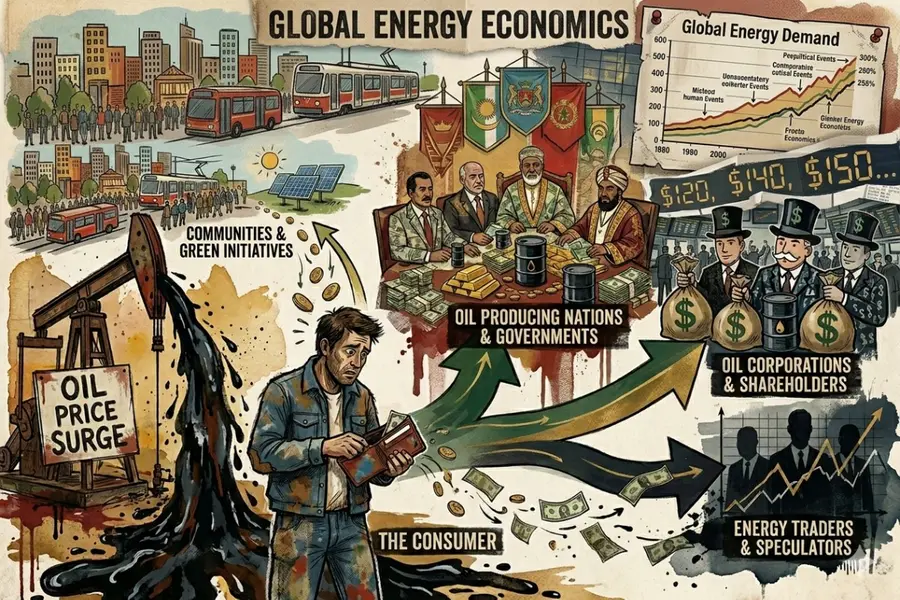
Ever wondered where your money goes when fuel prices shoot up? It is not just petrol pumps. From governments to oil giants, here is who really benefits when oil prices rise
The oil market operates on a global scale, which means conflicts such as the war involving Iran have far-reaching effects on prices across countries. When supply is disrupted in one region, the impact is felt worldwide, including in the cost of products made using oil.
Federal data shows that crude oil prices at the main US hub rose from about $66 per barrel in late February 2026, before the United States and Israel launched attacks on Iran, to $101 per barrel by April 13. Similar increases have been seen across global markets.
Read more: Will India have to pay $2 million to cross the Strait of Hormuz
As energy and international trade economists often point out, such price rises affect everyone. When oil becomes more expensive, manufacturers, businesses and ultimately consumers end up paying more.
Why oil is central to the global economy
Crude oil remains one of the most critical commodities in the modern economic system. It fuels transport, supports road construction and serves as a base material for plastics used in manufacturing and packaging.
Oil is also embedded in supply chains, playing a role at various stages of production. Even fertilisers that support food production are derived from it. In simple terms, modern life depends heavily on oil and its by-products.
Because of this, any change in supply directly affects prices. Economists explain this through the supply and demand model. When availability drops, competition increases among buyers, pushing prices higher.
How sudden disruptions drive sharp price rises
Sometimes price changes happen gradually, giving people and businesses time to adjust. However, when a major supply route is disrupted without warning, the effect can be immediate.
Read more: From baby subs to sea mines; How Iran is preparing against Trump’s threat
For example, when the Strait of Hormuz was effectively closed following US and Israeli attacks on Iran, a key oil supply route was blocked. This led to a rapid rise in prices within a short period.
Who gains when prices increase
A common question during such periods is where the extra money spent by consumers ends up. While the flow of money can be complex, most of it ultimately goes to oil producers and companies involved in extraction and supply.
What happens to this money depends on ownership structures and regulations in different countries. The legal and business environment plays a key role in determining how profits are distributed.
Middle East producers face risk but earn more
Oil-producing nations in the Middle East face increased risks during conflict, including threats to production facilities and transport routes. These risks raise costs related to insurance, security and logistics.
However, production costs in the region remain relatively low. As a result, higher global prices often still translate into significant profits.
In countries such as Saudi Arabia, where the government controls most oil production, higher prices strengthen public finances. Oil revenue has long been used there to support government spending and investment.
Windfall gains in the United States
In the United States, the Permian Basin in West Texas stands as the largest oil-producing region. Its distance from the Persian Gulf means it is not directly affected by regional conflict.
When global oil prices rise, companies operating in this region benefit quickly. Prices increase faster than costs in the short term, creating a windfall effect.
Read more: Gold SIP investment for beginners: benefits, returns and risks
These gains are usually distributed to shareholders through dividends, debt reduction, share buybacks and reinvestment into drilling and production. Over time, companies may also invest in expanding infrastructure such as pipelines.
North Sea revenues and government benefits
Oil production in the North Sea, located between Great Britain and Scandinavia, involves both multinational corporations and state-backed companies.
In the United Kingdom, higher oil prices primarily benefit private shareholders. However, additional taxes on oil and gas profits allow the government to claim a substantial portion, which is used to fund public services.
In Norway, oil income is channelled into the Government Pension Fund Global, the largest sovereign wealth fund in the world, valued at more than $2 trillion. Strict rules govern how this money is spent, ensuring support for public services while preserving wealth for future generations.
Read more: PNG explained: Where it comes from and how it reaches your kitchen
A similar approach exists in Alaska, where oil revenues fund government programmes and provide annual payments to residents.
Russia’s oil profits and power structures
Russia’s oil sector operates under strict international sanctions imposed after its invasion of parts of Ukraine. While countries such as the United States cannot directly control Russia’s pricing, they can regulate services like shipping, insurance and financing.
Current sanctions allow these services only if Russian oil is sold below $60 per barrel.
The industry is dominated by state-controlled companies with close ties to President Vladimir Putin. Although details remain opaque, it is widely believed that the main financial benefits flow to powerful elites and the military-industrial sector rather than the general population.
What it means for consumers
For everyday consumers, especially in the United States, rising oil prices mean higher costs for fuel and goods. While it may be frustrating to see money flowing to large corporations or governments, there are limited short-term options to avoid these costs.
In the longer term, however, there is growing interest worldwide in shifting towards alternative energy sources that reduce reliance on fossil fuels.
Published: 21 Apr 2026, 12:05 pm IST
Disclaimer: Kindly avoid objectionable, derogatory, unlawful and lewd comments, while responding to reports. Such comments are punishable under cyber laws. Please keep away from personal attacks. The opinions expressed here are the personal opinions of readers and not that of Mathrubhumi.
