
After a century, the remarkably preserved body of Saint Teresa of Avila is on public display.
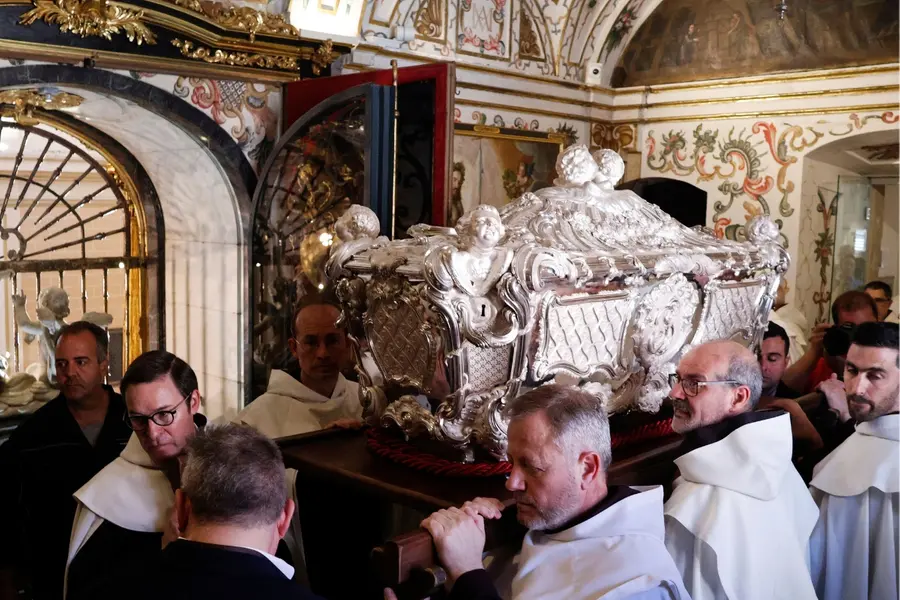
More than 440 years after her death, the body of Saint Teresa of Ávila has been revealed to the public in a rare display, astonishing Catholic faithful and researchers with its remarkable preservation. Devotees and experts alike gathered in the western Spanish town of Alba de Tormes this month to witness the exhibition of the 16th-century mystic’s remains — a spectacle not seen in over a century.
Who was she?
Saint Teresa of Ávila, a prominent Spanish saint, religious reformer and mystic, was a towering figure of Spain’s Golden Age and a key voice during the Catholic Church’s Counter-Reformation. Her introspective writings on divine experiences and inner spiritual life were once deemed controversial, but they have come to be regarded as one of the most profound contributions to Catholic spirituality.
According to José Calvo, a professor of theology at the Pontifical University of Salamanca, Teresa’s works are “a profound treatise on spirituality.” She remains an influential figure not only in the religious world but also in Spanish history and literature.
Veneration of her legacy is widespread. General Francisco Franco, Spain’s former dictator, was even said to have kept a relic of Teresa’s hand at his bedside. In September of last year, newly elected Pope Leo XIV paid a visit to her birthplace in Ávila, situated about an hour’s drive from Alba de Tormes.
The opening of the casket
This month, the saint’s body was made visible inside an open silver casket in Alba de Tormes, drawing close to 100,000 people over a two-week period. The event marked a significant occasion in the Catholic calendar, as the body had not been displayed publicly since 1914, when it was shown for just one day.
On Sunday, the final full day of the exhibit, pilgrims continued to line up, silent and awe-struck. Among them was Guiomar Sánchez, who had travelled from Madrid with her two daughters. Recalling her late mother’s devotion to the Carmelite nun, Sánchez said, “It gave me a feeling of fulfillment, of joy, and of sadness.” She described the experience as “inexplicable,” adding that she came partly to honour her mother’s faith in the saint.
The following morning, the casket — only about 1.3 metres (4 feet) in length — was resealed and carried through the town in a religious procession. Pilgrims walked behind it as organ music played inside the church. The Church has not indicated when the relics will next be shown to the public; it may be years, even decades, before they are revealed again.
Condition of the body
Saint Teresa died in 1582 at the age of 67. Her remains are said to have stayed largely incorrupt, according to the Diocese of Ávila. The current condition of the saint’s body was assessed last summer when the tomb was officially opened. Discalced Carmelite monks, priests and nuns took part in the process to examine the relics — including her heart, hand and arm — and to compare her condition with photographic documentation from the 1914 exposition.
Experts confirmed that many of her body parts were intact. Visible inside the casket is the saint’s skull, dressed in a religious habit and vestments. The heart is preserved separately within the church, while other parts — such as a jaw, a hand and fingers — are held as relics in various churches across Europe.
Visible signs of preservation
Father Marco Chiesa stated that the saint’s face and foot had not changed noticeably since their last known recording in 1914. According to ET, a thorough anthropological study released in March 2025 corroborated these claims. The 53-page report noted that the right foot, left hand, heart and left arm all remained preserved. These parts still retained distinguishable features such as skin, tissue and muscle — an extraordinary finding for remains that have been exposed to environmental conditions over such a lengthy period.
The scalp was found to still have brown hair, while the right eye had preserved features including darkened eyelids and a discernible iris. X-ray scans conducted during the recent study revealed that Saint Teresa had suffered from several chronic illnesses during her lifetime — conditions that likely restricted her movement.
In the church, the impact on worshippers was visibly emotional. A group of nuns from India were seen wiping away tears as they stood near the glass-encased remains. One visitor, 75-year-old Gregoria Martín López, climbed to an elevated section behind the altar for a clearer view of the saint’s skull. “The saint for me is a thing of great strength. If they close her, I can say that I saw her,” she said, and blew a kiss toward the relic.
What has preserved the body?
While some believers consider the state of the body to be miraculous, experts have pointed to natural explanations. Professor Luigi Capasso, a leading anthropologist, attributed the exceptional preservation to the dryness within the tomb. According to him, this “unique natural occurrence” created an environment unsuitable for the growth of bacteria and fungi, significantly slowing down the decomposition process.
High-resolution imaging has been used to thoroughly document the remains for scientific and ecclesiastical archival purposes. Church officials have indicated that the preservation of Saint Teresa’s body will continue, serving both as an object of religious veneration and academic study.
(With inputs from AP)
Published: 27 May 2025, 09:37 am IST
Related Topics
Disclaimer: Kindly avoid objectionable, derogatory, unlawful and lewd comments, while responding to reports. Such comments are punishable under cyber laws. Please keep away from personal attacks. The opinions expressed here are the personal opinions of readers and not that of Mathrubhumi.
