
RAF Fairford, located on the border of Gloucestershire and Wiltshire, has previously been used by the US military for long-range heavy bombing missions
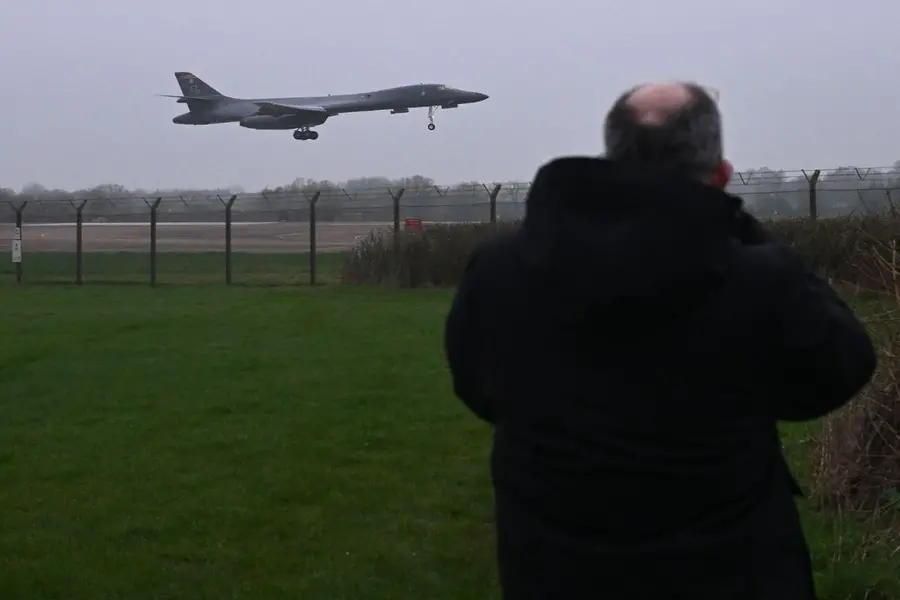
A United States bomber capable of carrying 24 cruise missiles has landed in the United Kingdom after Prime Minister Sir Keir Starmer approved what he described as “defensive” US action against Iranian missile sites from British bases.
The 146ft (44.5m) B-1 Lancer arrived at RAF Fairford in Gloucestershire on Friday evening. Its arrival follows comments by US Defence Secretary Pete Hegseth, who said on Thursday that strikes on Iran were “about to surge dramatically”.
Sir Keir had initially refused to grant permission for the US to use UK bases in its joint offensive with Israel against Iran, a move that reportedly caused a disagreement with US President Donald Trump.
Trump told journalists in the Oval Office earlier this week that he was “not happy with the UK” over the decision, saying it had forced US aircraft to fly “many extra hours” to carry out strikes last weekend.
ALSO READ | ‘We are waiting’: Iran warns US against escorting ships through Strait of Hormuz
After subsequently granting the US permission to use RAF Fairford in Gloucestershire and Diego Garcia in the Indian Ocean, the prime minister told MPs that the government “does not believe in regime change from the skies”.
RAF Fairford, located on the border of Gloucestershire and Wiltshire, has previously been used by the US military for long-range heavy bombing missions.
The B-1 Lancer, built by Boeing, weighs around 86 tonnes and is the fastest bomber in the US Air Force, capable of reaching speeds of more than 900mph (1,448km/h). Nicknamed “the Bone”, the aircraft is equipped with advanced radar and GPS targeting systems, as well as electronic jammers, radar warning receivers and a decoy system designed to protect it from enemy defences.
ALSO READ | Israel’s massive airstrikes: 80 fighter jets drop 230 bombs on Iranian military sites
Military analyst and former British Army officer Justin Crump described the B-1 Lancer as “one of the most significant bombers in the world”, noting that it can carry large bomb loads over long distances at high speed if required.
RAF Fairford’s role and history
RAF Fairford, on the Gloucestershire–Wiltshire border, has long been a key site for US and UK operations. Managed by the US Air Force’s 501st Combat Support Wing, it routinely supports heavy bombers such as the B-1B Lancer, B-2A Spirit and B-52H Stratofortress, and plays a central role in Bomber Task Force operations.
The airfield has a long history of military use. During World War Two, No. 620 Squadron operated from Fairford for airborne operations, including parachute drops and glider towing for the Normandy landings on 6 June 1944 and Operation Market Garden in September 1944. During the Cold War, Strategic Air Command units were deployed there as part of NATO’s deterrent against the Soviet Union. RAF Fairford also supported US operations during the Gulf War in 1991 and the Iraq War in 2003.
The base was previously used as a test centre for Concorde aircraft until 1977, thanks to its long runway. Its current deployment of B-1 bombers highlights its ongoing strategic importance.
The B-1 Lancer
Built by Boeing, the B-1 weighs around 86 tonnes and is the fastest bomber in the US Air Force, capable of speeds exceeding 900mph (1,448km/h). Nicknamed “the Bone”, it carries advanced radar and GPS targeting systems, electronic jammers, radar warning receivers and decoys to protect it from enemy defences. Military analyst and former British Army officer Justin Crump described it as “one of the most significant bombers in the world”, able to carry large bomb loads over long distances at high speed.
The deployment comes amid heightened tensions in the Indian Ocean region, following reports that the United States sank Iranian warship IRIS Dena near Sri Lanka, and after another Iranian vessel, IRIS Bushehr, docked in Sri Lanka after requesting assistance outside the country’s waters.
Published: 07 Mar 2026, 06:10 pm IST
Related Topics
Disclaimer: Kindly avoid objectionable, derogatory, unlawful and lewd comments, while responding to reports. Such comments are punishable under cyber laws. Please keep away from personal attacks. The opinions expressed here are the personal opinions of readers and not that of Mathrubhumi.
