
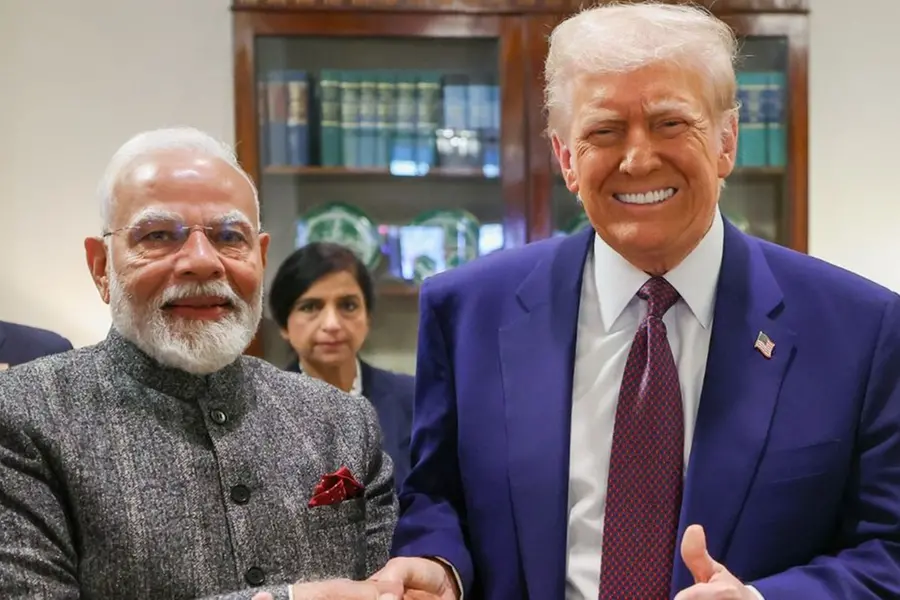
Washington: In a high-profile meeting on Thursday, US President Donald Trump and PM Modi focused on strengthening their countries' economic relationship. Trump vowed to bring "fairness and reciprocity" to the trade dynamic between the US and India, which has been marked by a significant trade deficit in India's favour. This move is part of Trump's broader effort to tackle global trade imbalances.
Trump highlighted his intent to reduce the US trade deficit, mentioning the possibility of raising tariffs on Indian goods. He explained, "Whatever India charges, we charge them. So frankly, it no longer matters to us that much what they charge." Trump emphasised, “Really, we want a certain level playing field.”
Also Read

In line with previous visits, Modi praised Trump, saying he is determined to "Make India Great Again" (MIGA) like Trump does with the US, a playful variation on Trump's own slogan, "Make America Great Again" (MAGA).
Extradition of Mumbai attack plotter
Another topic discussed was the extradition of a key figure in the 2008 Mumbai attacks. Trump confirmed that one of the plotters, likely Tahawwur Hussain Rana, would be extradited to India. "He's going to be going back to India to face justice," Trump stated. "We’re giving him back to India immediately." Trump also hinted at further extraditions to come.
The US President also announced a significant increase in military sales to India, expected to reach "many millions of dollars." This move could pave the way for India to acquire F-35 stealth fighter planes, a long-awaited goal for the country.
The trade deficit between the US and India stands at USD 50 billion in India's favour. In 2023, the Indo-US trade in goods and services reached USD 190.1 billion. The US exported nearly USD 70 billion to India, while imports from India totalled USD 120 billion.
Warm reception despite trade disagreements
Before the news conference, the two leaders shared a warm hug in the lobby of the White House's West Wing. However, the US has recently implemented tariffs that affect American trading partners, including India, and this has created tension. Modi is eager to avoid further U.S. tariffs while improving relations with the West, especially given recent political strains, including Modi’s refusal to condemn Russia’s actions in Ukraine.
Prime Minister Modi remarked, "The world had this thinking that India somehow is a neutral country in this whole process. But this is not true. India has a side, and that side is of peace."
Trump’s global tariff strategy
Trump's administration has been focused on addressing trade deficits globally, recently imposing tariffs on China and signalling further actions against the European Union, Canada, and Mexico. The White House maintains that these "reciprocal" tariffs are aimed at creating a level playing field between US manufacturers and their international competitors.
Despite this, Modi expressed concern over the US tariffs. India had already made concessions, reducing tariffs on some US products, including Harley-Davidson motorcycles, and dropped retaliatory tariffs on items like US almonds and apples in 2023. These steps indicate a willingness to improve trade relations ahead of Modi’s visit.
India's growing role in US strategy
India is increasingly seen as a key partner in the US strategy to counter China’s influence in the Indo-Pacific region. Later this year, India will host a summit with the US, Japan, and Australia as part of the Quad, a strategic alliance to promote stability and counter China's rise.
While economic discussions dominated the meeting, Modi and Trump were also expected to address immigration. India recently accepted the return of 104 migrants from the US, part of Trump's ongoing efforts to tackle immigration issues along the US-Mexico border.
Agency
Published: 14 Feb 2025, 06:26 am IST
Related Topics
Disclaimer: Kindly avoid objectionable, derogatory, unlawful and lewd comments, while responding to reports. Such comments are punishable under cyber laws. Please keep away from personal attacks. The opinions expressed here are the personal opinions of readers and not that of Mathrubhumi.