
Kenya mourns Raila Odinga as thousands gather for state funeral and public viewings.
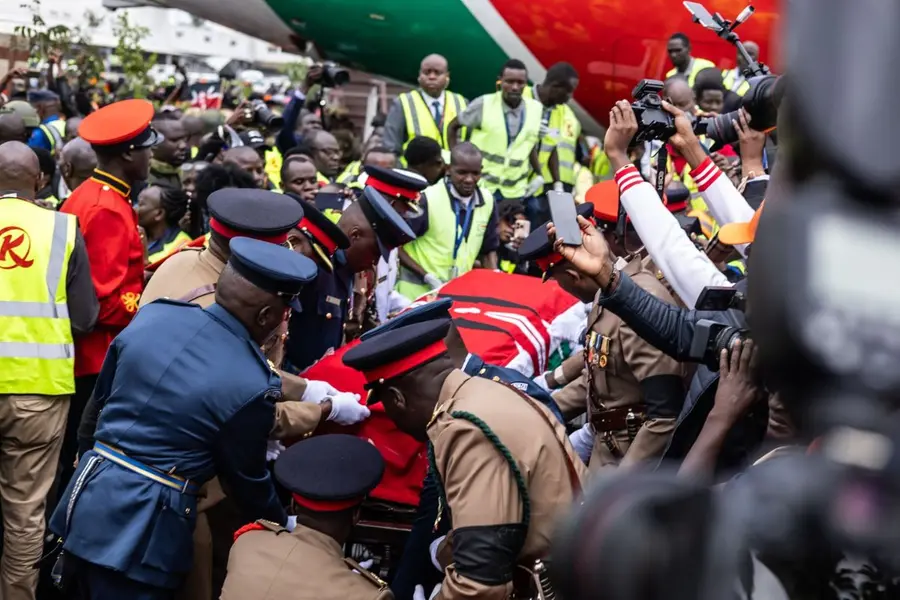
Nairobi: Thousands of Kenyans gathered Thursday at Jomo Kenyatta International Airport to receive the body of influential African politician and former Prime Minister Raila Odinga, who died Wednesday in India’s Kerala at the age of 80.
Odinga’s body arrived in a chartered airplane and was honoured with a water cannon salute before a planned public viewing later in the day. Airport operations were halted for two hours as mourners walked alongside the military vehicle carrying his body from the runway to the exit.
“We are in mourning as a country. We loved Baba so much, he was the defender of the people,” said Beatrice Adala, one of many who attended. Like many Kenyans, she referred to Odinga as “Baba,” a Kiswahili honourific usually reserved for a beloved father figure.
Odinga, celebrated for his fight for democracy, collapsed during a morning walk in Kerala, India, where resuscitation efforts at a hospital failed.
State funeral and public viewings
Odinga will be accorded a state funeral, with final rites Sunday at his rural home in Bondo, western Kenya. His family stated he wished to be buried quickly, ideally within 72 hours, a practice unusual for Kenya’s popular leaders.
Friday has been declared a public holiday, with Kenyans expected to gather at a football stadium in Nairobi for the state funeral service. Another public viewing will take place Saturday in Kisumu, near his rural home.
Mourners disrupt ceremonial reception
A ceremonial reception at the airport, intended for close family and top leaders, was disrupted as mourners demanded access to view the body. Parliament announced that the planned viewing at its precincts would be moved to a football stadium to accommodate the crowd.
Tributes from the President
Kenyan President William Ruto, who defeated Odinga in the 2022 elections but later appointed opposition members to the Cabinet under a political pact, described him as “a patriot of uncommon courage, a pan-Africanist, a unifier who sought peace and unity above power and self-gain.” Ruto declared seven days of national mourning.
Political legacy
Odinga ran for Kenya’s presidency five times over three decades, often coming close to victory. In 2007, he narrowly lost to Mwai Kibaki in a disputed election that sparked ethnic violence. He served as prime minister from 2008 to 2013 in a unity government facilitated by international mediation. In 2017, a court nullified the presidential election after his challenge, but he boycotted the subsequent vote, claiming it would not be credible without reforms.
Published: 16 Oct 2025, 04:48 pm IST
Related Topics
Disclaimer: Kindly avoid objectionable, derogatory, unlawful and lewd comments, while responding to reports. Such comments are punishable under cyber laws. Please keep away from personal attacks. The opinions expressed here are the personal opinions of readers and not that of Mathrubhumi.
