
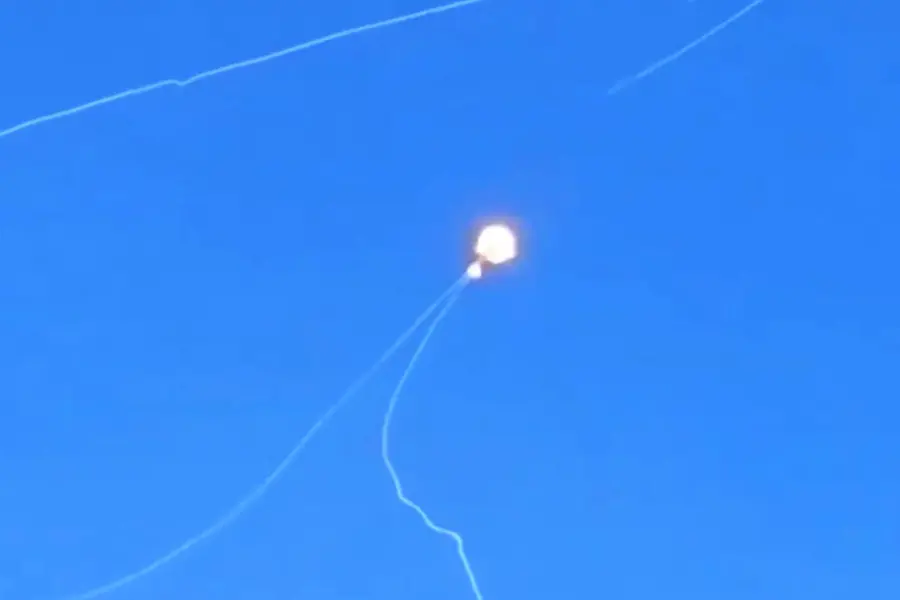
New video emerges of Israel's Iron Dome air defense system at work during the day over Tel Aviv
Israel's air defense has been firing on all cylinders ever since Iran launched retaliatory strikes on the country a week ago. Israel's renowned air defense system, Iron Dome, has been put to maximum use to counter the multiple waves of missiles and rockets fired by Iran's Islamic Revolutionary Guard Corps (IRGC).
While the Iron Dome has shielded Israel to a large extent, there have been occasions when Iranian missiles have penetrated the Iron Dome's defenses.
Amid the plethora of footages of Israel's Iron Dome interceptors doing the rounds on social media and television media, a new video has emerged that shows the air defense system at work during the day.
The video shows two Iron Dome interceptors dramatically colliding and igniting, creating a fireball, as they neutralized a submunition from a cluster warhead of an Iranian ballistic missile over Tel Aviv.
The Iron Dome air defense system has been facing renewed scrutiny despite its long-standing reputation as a highly advanced and battle-tested technology. While consistently touted by Israeli officials as "nearly impenetrable" and showcased in numerous conflicts since its 2011 operational debut, recent large-scale missile attacks have brought questions about its effectiveness, limitations under heavy saturation, and overall performance into sharper focus.
Developed specifically to counter the growing threat from short-range rockets, the Iron Dome has been a critical component of Israel's defense strategy.
What is the Iron Dome?
The Iron Dome is a mobile, short-range missile defense system designed to intercept and destroy incoming rockets, artillery shells, and drones before they can strike populated areas. It was developed collaboratively by Israeli defense contractors Rafael Advanced Defense Systems and Israel Aerospace Industries, with substantial financial and technological backing from the United States.
The system first became operational in March 2011, deployed near the southern city of Beersheba in response to increased rocket fire from Gaza.
According to the Associated Press (April 2024), the Iron Dome is specifically engineered to counter threats launched from short distances that follow relatively low-altitude trajectories.
Its primary objective is to safeguard civilian populations and vital infrastructure. Crucially, the system is designed not to intercept every incoming projectile indiscriminately, but rather to calculate trajectories and engage only those that pose a direct threat to populated areas, optimizing its efficiency.
How the system functions
The Iron Dome operates through a sophisticated three-part mechanism: detection, assessment, and interception. Each Iron Dome battery is composed of a radar unit (the EL/M-2084 radar), a control center, and up to three launchers, each capable of firing up to 20 Tamir interceptor missiles.
Upon the launch of a rocket or shell towards Israeli territory, the radar system detects it almost instantaneously. The control center then rapidly calculates the projectile's precise path and determines whether it is projected to strike a populated area or to land harmlessly in an open field.
As reported by Reuters (April 2024), if the control system identifies the incoming projectile as a threat, it authorizes the launch of a Tamir interceptor missile. The Tamir missile is equipped with its own radar and steerable fins, enabling it to adjust its course mid-air and detonate near the incoming projectile, effectively neutralizing it before impact.
This selective interception capability is a key factor in the Iron Dome's cost-effectiveness, distinguishing it from systems that attempt to shoot down every incoming object regardless of its trajectory.
It is important to note that the Iron Dome is just one layer within Israel's comprehensive, multi-layered air defense strategy. While the Iron Dome handles short-range threats, other advanced systems are in place for medium- and long-range projectiles.
The David's Sling system, also developed with US cooperation, is designed to intercept medium-range threats such as cruise missiles and longer-range rockets. At the highest tier, the Arrow-2 and Arrow-3 systems are specifically engineered to intercept ballistic missiles, with the Arrow-3 capable of engaging targets outside the Earth's atmosphere.
In the April 2024 missile exchange involving Iran and its allied groups, this integrated multi-layered defense network was rigorously tested. Reuters reported that Israeli officials credited the seamless integration of all these systems, including US-operated air defense units temporarily stationed in Israel, with preventing widespread destruction during the extensive attack.
In that scenario, the Iron Dome played its designated role of handling the immediate barrage of short-range rockets, while the Arrow and David's Sling systems engaged the more significant longer-range missiles.
Published: 21 Jun 2025, 07:45 am IST
Related Topics
Disclaimer: Kindly avoid objectionable, derogatory, unlawful and lewd comments, while responding to reports. Such comments are punishable under cyber laws. Please keep away from personal attacks. The opinions expressed here are the personal opinions of readers and not that of Mathrubhumi.
