
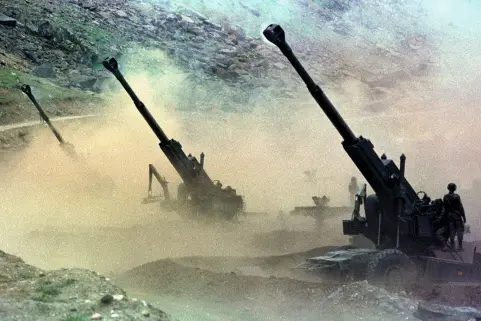
Pakistan Army Chief General Syed Asim Munir has confirmed the Pakistani military's direct involvement in the 1999 Kargil conflict with India. This marks a significant departure from the long-standing official stance.
During his Defence Day address on Friday, Munir referenced the Kargil conflict alongside Pakistan's other wars with India, honouring the "sacrifices made through martyrdom" by the Pakistani Armed Forces.
"Certainly, the Pakistani nation is both powerful and courageous, valuing freedom and knowing how to defend it. From 1948 to 1965, 1971, and the Kargil war, as well as the Siachen conflict, countless lives were sacrificed for our country's safety and security," Munir told the audience at General Headquarters (GHQ) in Rawalpindi.
Munir's remarks are being regarded as a massive admission by a sitting Army Chief regarding the military's involvement in Kargil, a topic Islamabad has avoided acknowledging for the past 25 years.
Previously, Pakistan had denied direct involvement in the 1999 conflict, attributing the actions to "freedom fighters" from Kashmir. Former Army Chief General Pervez Musharraf had consistently characterized the Kargil operation as a successful, localized initiative.
In interviews, Musharraf indicated that Prime Minister Nawaz Sharif was not consulted about the operation, and many decisions regarding the volatile Line of Control (LoC) were made without the Army Chief's approval. However, Musharraf did acknowledge the role of Pakistan's Force Command Northern Areas (FCNA) in the operation.
"Initially, there was mujahideen activity in the area. Later, FCNA decided to occupy the 150-mile stretch of the LoC. For this, there was no need for approval from higher authorities," Musharraf stated.
Mushahid Hussain Syed, who was Information Secretary under Prime Minister Sharif in 1999, revealed that the Kargil operation was officially communicated to Sharif by the then Director General Military Operations (DGMO) on May 17, 1999.
Before this, signs of the operation were evident as Indian reports began emerging.
Experts argue that the Kargil operation is seen by some as a strategic success and by others as a significant error.
Musharraf’s acknowledgment of FCNA's role aligns with Munir's recent statements, providing further validation of the military's involvement.
Moreover, the fact that many Pakistani soldiers' bodies were not returned from Kargil has led to questions from their families about the government and military's reluctance to claim responsibility.
"Those officers who visited us should have made greater efforts to recover the bodies of our loved ones," said Itrat Abbas, whose brother, Captain Farhat Haseeb, was martyred in Kargil.
Rehana Mehboob, mother of Captain Ammar Hussain, noted receiving frequent calls from her son's Army Unit during the conflict, adding that Musharraf did not publicly acknowledge the operation.
These statements from families, former government officials, and the former Army Chief contribute to the view that while Prime Minister Sharif was kept uninformed, the military leadership was fully aware of and involved in the Kargil operation.
IANS
Published: 07 Sept 2024, 05:10 pm IST
Related Topics
Disclaimer: Kindly avoid objectionable, derogatory, unlawful and lewd comments, while responding to reports. Such comments are punishable under cyber laws. Please keep away from personal attacks. The opinions expressed here are the personal opinions of readers and not that of Mathrubhumi.
