
Vote counting is underway in Nepal’s first general election since violent Gen Z-led protests toppled the KP Sharma Oli-led government last year.
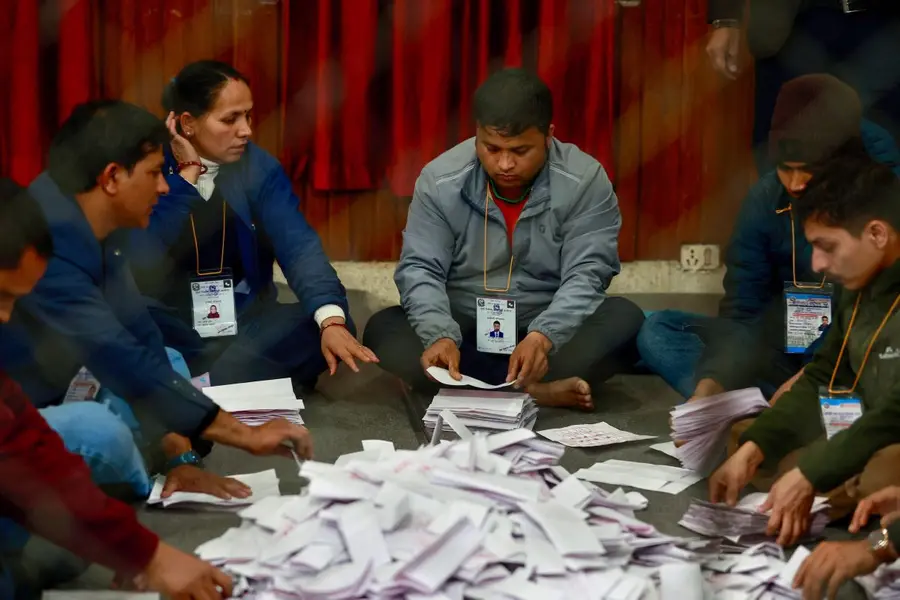
Kathmandu: Nepal began counting votes on Friday for its crucial 2026 general elections, the first nationwide polls since massive Gen Z-led protests last year forced the resignation of the KP Sharma Oli-led coalition government and plunged the country into political turmoil.
Early trends suggest a strong performance by the newly formed Rastriya Swatantra Party (RSP), signalling a potential shift in the Himalayan nation’s political landscape.
According to preliminary results, the Rastriya Swatantra Party has already secured one seat and is leading in around 36 constituencies where vote counting is underway.
Traditional political parties are trailing in early trends, with the Nepali Congress leading in five seats, the Communist Party of Nepal (Unified Marxist–Leninist) (CPN-UML) in three, and the Communist Party of Nepal (Maoist Centre) in one constituency so far.
The election, held on March 5, recorded a voter turnout of around 60 percent. While the voting process was largely peaceful, turnout was among the lowest in decades, reflecting voter frustration with long-standing political instability and dissatisfaction with traditional leadership.
The polls were conducted nearly six months after widespread protests led by young Nepalis rocked the country in September 2025. Demonstrators demanded an end to corruption, better governance, and greater economic opportunities.
The protests turned violent in several places, leaving dozens dead and eventually forcing the government to resign.
Against this backdrop, the emergence of the Rastriya Swatantra Party has become one of the biggest stories of the election. The party has attracted strong support from younger voters and urban constituencies, positioning itself as an alternative to Nepal’s traditional political establishment.
A key face of the party is Balendra “Balen” Shah, a former rapper and structural engineer who rose to national prominence after winning the Kathmandu mayoral election as an independent candidate. Shah later aligned with the RSP and is widely seen as a frontrunner in the race for prime minister if the party performs strongly.
Early trends show him leading in the Jhapa-5 constituency against veteran communist leader and former prime minister KP Sharma Oli.
Nepal’s political heavyweights are still in the fray. Former prime minister KP Sharma Oli’s CPN-UML, Sher Bahadur Deuba’s Nepali Congress, and Pushpa Kamal Dahal’s CPN (Maoist Centre) remain among the major contenders trying to regain influence in parliament.
However, analysts say the rise of younger leaders such as Gagan Thapa of the Nepali Congress reflects a broader generational shift in the country’s politics.
The election will determine the composition of the 275-member House of Representatives. Of these, 165 members are elected directly from constituencies through a first-past-the-post system, while the remaining 110 are chosen through proportional representation. Nearly 19 million voters were eligible to participate in the election.
Election officials said some winners may be declared later on Friday, but final nationwide results could take several days due to Nepal’s mountainous terrain and logistical challenges in transporting ballot boxes from remote areas.
Even after the results are declared, forming a government may take time if no party secures a clear majority. Nepal has seen frequent coalition governments over the past decades, and analysts expect intense negotiations among parties before a new prime minister is chosen.
For many voters, however, the 2026 election represents a moment of hope, an opportunity to reshape Nepal’s politics and bring new leadership to a country that has experienced repeated political instability in recent years.
Published: 06 Mar 2026, 09:48 am IST
Related Topics
Disclaimer: Kindly avoid objectionable, derogatory, unlawful and lewd comments, while responding to reports. Such comments are punishable under cyber laws. Please keep away from personal attacks. The opinions expressed here are the personal opinions of readers and not that of Mathrubhumi.
