
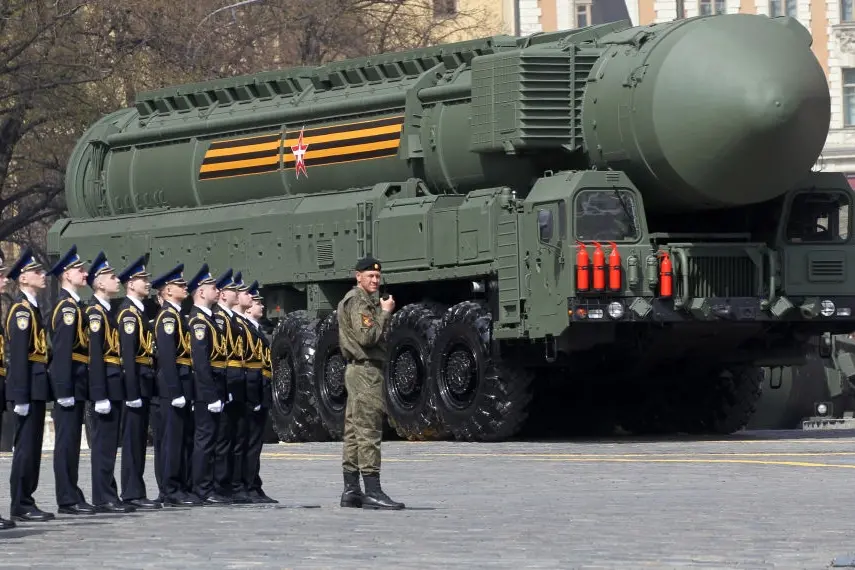
Ukraine's claim that Russia launched an intercontinental ballistic missile (ICBM) at the central city of Dnipro marks an alarming shift in the ongoing war, signalling a dramatic escalation in the use of long-range, nuclear-capable weapons. If verified, this would be the first time Russia has deployed such a weapon during the conflict, raising fears of increased global instability and potential nuclear risks.
ICBMs: A chilling reminder of Russia’s nuclear arsenal

Intercontinental Ballistic Missiles (ICBMs) are among the most powerful weapons in Russia’s military arsenal. Designed to carry nuclear warheads, these missiles can travel over vast distances, making them capable of striking virtually any target worldwide. Russia's arsenal includes a wide range of active intercontinental ballistic missiles (ICBMs) and submarine-launched ballistic missiles (SLBMs) that form the backbone of its nuclear deterrent. Key ICBMs include the RS-28 Sarmat (Satan 2), a heavy missile with a range of over 11,000 km, and the RS-24 Yars, a road-mobile MIRV-equipped missile. The R-36M2 Voyevoda (SS-18 Satan) remains one of the most powerful ICBMs, capable of carrying up to 10 warheads. Russia also maintains the UR-100N 15A30 (SS-19 Stiletto) and RT-2PM Topol (SS-25 Sickle), both with long ranges and precision targeting. The R-29RMU Sineva and R-29RMU2 Layner are SLBMs deployed on nuclear submarines, offering strategic mobility and range. Additionally, Russia’s R-29R and R-29RM variants, including SS-N-18 Stingray and SS-N-23 Skiff, provide advanced MIRV capabilities.
These weapons are critical to Russia's doctrine of nuclear deterrence, maintaining a strategic balance with other major powers, particularly the United States. The decision to launch one against Ukraine would send a powerful and chilling message about Moscow’s willingness to escalate the conflict — even without a nuclear warhead.
International alarm over escalating conflict
U.K. officials have expressed deep concern over the potential use of such weapons, calling it "reckless" and "escalatory." The British government warned that the launch of an ICBM would elevate the conflict to a dangerous new level, with the risk of triggering a broader regional or global conflict.
Similarly, the European Union labelled the move as a "clear escalation," highlighting the potential consequences for European and global security. The attack comes amidst heightened tensions, following the easing of U.S. restrictions on Ukraine's use of longer-range missiles and Russia's announcement of new doctrines that could involve nuclear responses to conventional attacks.
Global power struggles and the risk of nuclear escalation
The firing of an ICBM would exacerbate already heightened tensions between NATO and Russia. It follows a week of mounting conflicts, including the U.S. authorization for Ukraine to use longer-range American-made missiles inside Russia, and a new Russian military doctrine permitting nuclear retaliation even against non-nuclear nations. Analysts warn that such actions could provoke further instability, pushing the world closer to a dangerous precipice where nuclear weapons, once again, could play a central role in global security.
Published: 21 Nov 2024, 06:49 pm IST
Related Topics
Disclaimer: Kindly avoid objectionable, derogatory, unlawful and lewd comments, while responding to reports. Such comments are punishable under cyber laws. Please keep away from personal attacks. The opinions expressed here are the personal opinions of readers and not that of Mathrubhumi.