
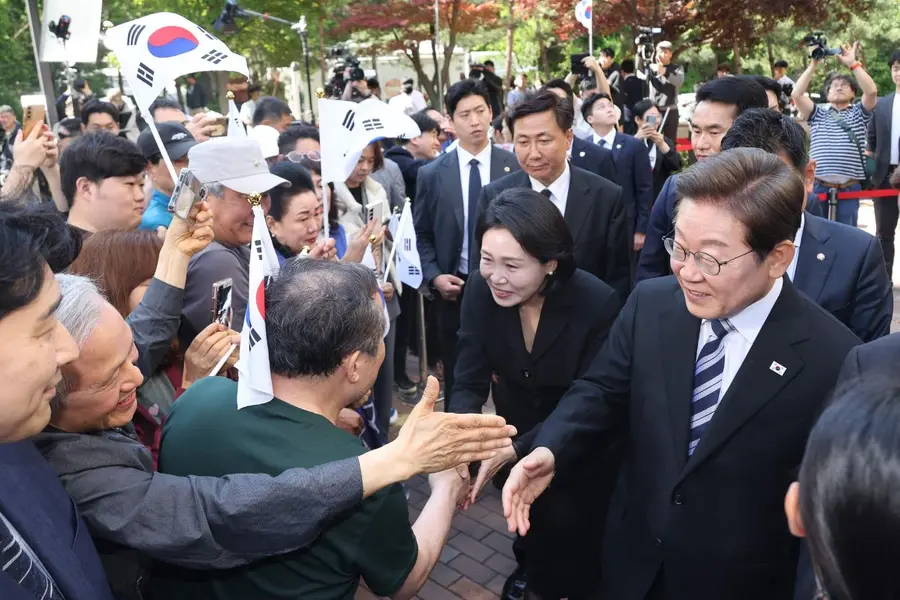
Seoul: South Korea’s centre-left leader Lee Jae-myung was declared president on Wednesday after winning a snap election, taking office immediately in the wake of a turbulent political crisis that saw his predecessor impeached for attempting to impose martial law.
Lee secured a decisive victory over conservative rival Kim Moon-soo, a candidate from the party formerly led by disgraced ex-president Yoon Suk Yeol. According to the National Election Commission, Lee won 49.4 percent of the vote, while Kim trailed with 41.2 percent — a margin widened by internal divisions among conservatives and the presence of a third-party candidate splitting the right-wing vote.
Due to the snap nature of the election, held following Yoon’s impeachment, there was no transition period. Lee’s presidency began immediately after the NEC certified the final tally early Wednesday.
“The National Election Commission hereby declares Lee Jae-myung of the Democratic Party as the elected president,” said commission chairperson Roh Tae-ak.
Kim had already conceded defeat before the final count was announced, acknowledging the outcome as inevitable.
Lee took office just hours before the United States was scheduled to impose steep 50 percent tariffs on South Korean steel and aluminium exports -- a key issue for the country’s economy. Nevertheless, financial markets responded positively to the result, with both the benchmark KOSPI index and the won rising on Wednesday.
The new president inherits a deeply polarised nation still shaken by former president Yoon’s declaration of martial law last December and the subsequent rise of far-right sentiment. Analysts say the episode has left a lasting impact on South Korea’s democratic institutions and public trust.
In his first address as president, Lee struck a conciliatory tone. Speaking to supporters in the early hours, he called on the nation to “move forward with hope and make a fresh start from this moment on”. He also pledged to “pursue dialogue, communication, and cooperation” with North Korea, with whom the South technically remains at war, stating a commitment to peaceful coexistence and mutual prosperity.
First day in office
Lee began his first day in office by holding a meeting with the military’s top commander, formally receiving operational control of the armed forces. He praised the military’s conduct during the martial law crisis, crediting them with helping to prevent “further chaos”, and called on them to maintain “firm readiness” against any North Korean threats.
He then visited the National Cemetery in Seoul to pay respects at the graves of former presidents, a symbolic gesture marking the start of his term.
Unlike traditional presidential inaugurations that feature tens of thousands of attendees and outdoor fanfare, Lee’s ceremony is expected to be a muted event at the National Assembly, where Yoon had controversially deployed troops during his failed bid to suspend civilian rule. Only a few hundred guests are anticipated to attend.
Following the ceremony, Lee will head to the presidential office to begin forming his administration. Notably, he has previously indicated he will not use the current presidential compound in Yongsan — a converted defence ministry building chosen by Yoon after abandoning the traditional Blue House.
Attention will now turn to who Lee selects for top roles including prime minister, presidential chief of staff, and head of the National Intelligence Service. The announcements will set the tone for his administration’s direction, both domestically and in terms of foreign policy.
Lee is expected to receive a series of congratulatory calls from world leaders throughout the day. US President Donald Trump is likely to be among the first to speak with him, while US Secretary of State Marco Rubio has already issued a statement praising the “ironclad” alliance between Washington and Seoul, highlighting their shared values and economic ties.
Although Lee has previously expressed a desire for greater autonomy in South Korea’s foreign policy, experts expect him to strike a careful balance. Gi-Wook Shin, a sociology professor at Stanford University, said Lee would likely seek to maintain strong ties with the United States while also engaging more actively with China and North Korea — signalling a shift from previous administrations that leaned heavily on the US alliance or focused singularly on North Korea.
Published: 04 Jun 2025, 07:47 am IST
Related Topics
Disclaimer: Kindly avoid objectionable, derogatory, unlawful and lewd comments, while responding to reports. Such comments are punishable under cyber laws. Please keep away from personal attacks. The opinions expressed here are the personal opinions of readers and not that of Mathrubhumi.
