
Japan is voting in a rare winter election under heavy snow, with Prime Minister Sanae Takaichi widely expected to secure a strong mandate amid high political stakes.
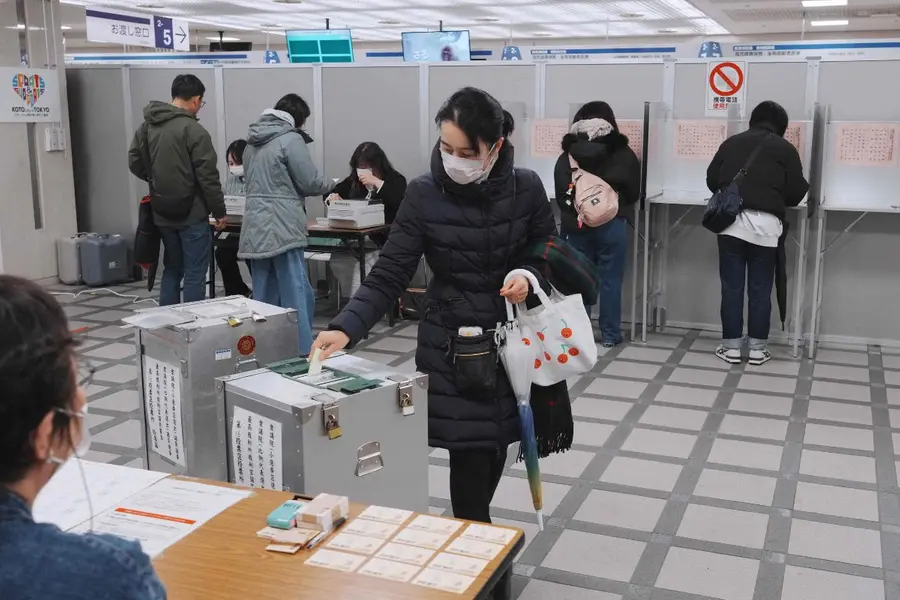
Japan is holding a pivotal general election on 8 February 2026, and Prime Minister Sanae Takaichi appears set to secure a decisive victory, according to projections and early reports from the polls opening across the country.
Voters are casting ballots in the lower house parliamentary election that could deliver a strong mandate for Takaichi’s conservative agenda, despite severe winter conditions that threaten turnout.
Also Read

Polling stations opened early Sunday morning, with Takaichi’s Liberal Democratic Party (LDP) and its partner, the Japan Innovation Party (Ishin), expected to capture a substantial share of the 465 seats in the House of Representatives.
Multiple opinion polls suggest the conservative coalition could win around 300 seats, a marked increase from the roughly 233 seats it held going into the campaign, a result that would significantly bolster Takaichi’s legislative strength.
The snap election, called after less than three months of campaigning, marks one of Japan’s rare winter votes. Heavy snow and blizzard conditions in many regions have not only complicated campaigning but could also suppress turnout, especially in rural and snowbound areas. Meteorological forecasts warned of record snowfall that may keep occasional voters at home, potentially amplifying the influence of well-organised voting blocs.
What is a rare snap vote, and why Japan rarely holds one
Japan’s rare snap vote refers to a sudden dissolution of the lower house and an election called well ahead of the normal parliamentary schedule, leaving parties little time to campaign. In Japan, snap elections are uncommon to begin with — and even rarer in mid-winter.
Prime Minister Sanae Takaichi called the election just months after taking office, turning what is usually a routine parliamentary cycle into a high-stakes, fast-paced political contest. The compressed campaign period heavily favours incumbents, as opposition parties struggle to mobilise candidates, funding and messaging in time.
What makes this snap vote especially unique for Japan is its timing and context. National elections are typically held in spring or autumn to maximise voter turnout, but this vote is taking place in February amid heavy snowfall and harsh weather, conditions that can discourage participation and distort turnout patterns.
It is also the first general election led by a female prime minister, and one in which the leader has openly tied her political future to the outcome.
Combined with a reshaped ruling coalition and major policy stakes, from defence to the economy, this rare snap winter vote has turned into a de facto referendum on leadership, making it one of the most unusual elections Japan has seen in decades.
Strong position but high stakes
Takaichi, Japan’s first female prime minister, took office in October 2025 and has staked her premiership on a clear majority in the lower house.
She has repeatedly stated she would resign if her coalition fails to secure a majority, underscoring the high personal and political stakes of Sunday’s vote.
Her leadership has been marked by a mix of conservative policies, including plans to boost defence capabilities amid regional tensions and proposals to introduce economic relief measures.
Despite her personal popularity, particularly among younger voters who have rallied behind a social media-driven phenomenon dubbed “sanakatsu”, opposition parties remain fragmented.
Analysts say this division, alongside Takaichi’s appeal and the cohesive messaging from her coalition, positions the ruling bloc well for a strong showing.
Policy agenda and campaign dynamics
Takaichi’s campaign has emphasised national security and economic revival. A core part of her platform involves bolstering Japan’s military posture in the face of increasing regional challenges.
She has also proposed tax measures aimed at easing cost-of-living pressures, including suspension of certain consumption taxes, proposals that have attracted attention in financial markets.
Analysts caution, however, that her conservative agenda and assertive leadership style could alienate moderate voters and provoke debate over Japan’s postwar pacifist policies.
At the same time, her ability to translate high approval ratings into parliamentary control remains central to her political longevity.
Weather and turnout
The severe winter weather has become a defining feature of this election, only the third general election in postwar history held in February. Snowfall has disrupted transportation, prompting some constituents to vote early or delay travel to polling stations.
Observers are watching turnout figures closely, with the potential for low participation to skew results towards organised party supporters.
What happens next
Polls will close at 20:00 local time, and broadcasters are expected to begin issuing exit poll projections soon after. Early indications point to a strong performance by Takaichi’s coalition, but final results, and the extent of the ruling bloc’s majority, will determine how sharply Japan’s policy direction may shift in the coming years.
Published: 08 Feb 2026, 08:20 am IST
Related Topics
Disclaimer: Kindly avoid objectionable, derogatory, unlawful and lewd comments, while responding to reports. Such comments are punishable under cyber laws. Please keep away from personal attacks. The opinions expressed here are the personal opinions of readers and not that of Mathrubhumi.