
Israel records highest cancellation rate as West Asia tensions disrupt 232 regional flights.
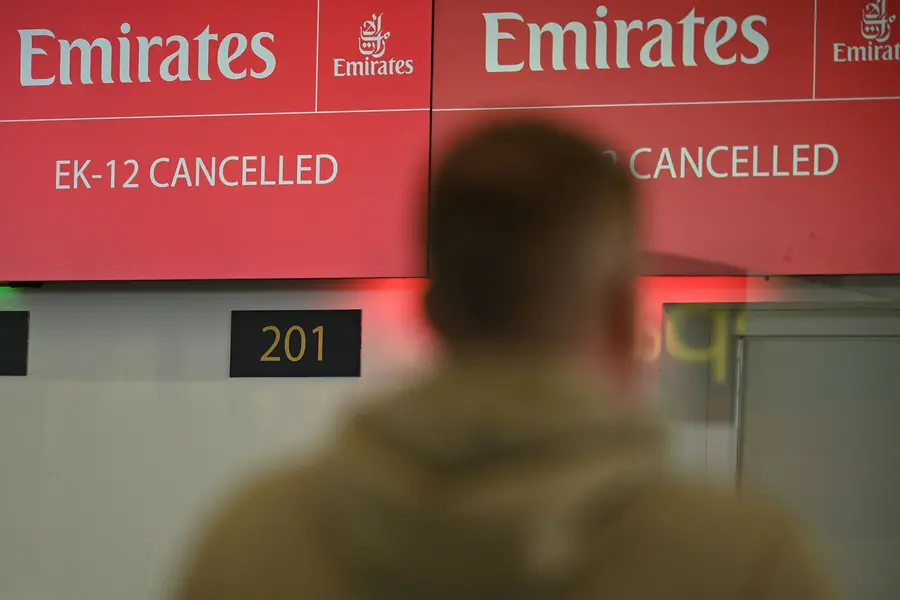
Escalating geopolitical tensions in West Asia have begun to significantly disrupt international air traffic, with aviation analytics firm Cirium reporting 232 flight cancellations across key Gulf and regional destinations. The data indicates that disruptions are likely to increase further in the coming days.
A total of 3,422 flights were scheduled to operate to affected destinations. With 232 cancellations recorded so far, the overall disruption rate stands at 6.78 percent. However, the impact varies sharply by country, reflecting differences in airspace closures, operational risk assessments, and airline responses.
Also Read: ‘We were told to evacuate after…’: Passengers recount chaos at Tel Aviv airport | WATCH
Israel has been the most severely affected market. Of 107 scheduled flights, 40 were cancelled, a steep cancellation rate of 37.38%. The near-immediate operational impact underscores how sensitive aviation flows are to airspace closures and security developments in the region.
Jordan followed with a cancellation rate of 13.33%, with 14 flights cancelled out of 105 scheduled services. Qatar reported 34 cancellations from 335 flights (10.15%), indicating moderate but growing disruption in Gulf air corridors.
The United Arab Emirates, a major global transit hub connecting Asia, Europe and North America, recorded 94 cancellations out of 1,067 scheduled flights, an 8.81% disruption rate. Given the UAE’s critical role in long-haul connectivity, even single-digit percentage disruptions can have wider ripple effects across international networks.
Also Read: US names Iran attack ‘Operation Epic Fury’ as Israel dubs it ‘Lion’s Roar’
Bahrain reported a similar disruption level at 8.82% (9 cancellations out of 102 flights), while Oman saw 5 cancellations from 122 scheduled flights (4.10 percent).
Saudi Arabia, despite having the highest number of scheduled flights at 1,277, experienced comparatively lower disruption, with 28 cancellations, a 2.19% rate. Iran reported 9 cancellations out of 307 scheduled services, translating to 2.61 percent.
The varying cancellation rates suggest that airlines are making route-by-route risk assessments rather than implementing blanket suspensions across the region. However, the broader concern lies in airspace constraints and rerouting challenges, which can increase flight times, fuel burn, crew duty hours, and operational costs.
For Indian carriers and Gulf-based airlines, West Asia remains a critical corridor, not only for point-to-point traffic but also for connecting flows to Europe and North America. Any sustained disruption could affect scheduling reliability, aircraft utilisation, and passenger confidence.
Moreover, hubs such as Dubai, Doha and Abu Dhabi serve as key transit points for Indian expatriate traffic and long-haul travellers. Even moderate cancellation rates in these markets can create cascading effects across global networks.
Also Read: Where is Ayatollah Ali Khamenei? First photo of his obliterated home emerges
Cirium has indicated that cancellations are expected to increase beyond current figures, including for flights scheduled tomorrow. Airlines are continuing to monitor the evolving security environment and adjust operations accordingly.
While safety remains the overriding priority, the situation highlights the vulnerability of global aviation networks to geopolitical instability, particularly in regions that serve as critical air traffic corridors.
Published: 28 Feb 2026, 08:25 pm IST
ABOUT THE AUTHOR

Disclaimer: Kindly avoid objectionable, derogatory, unlawful and lewd comments, while responding to reports. Such comments are punishable under cyber laws. Please keep away from personal attacks. The opinions expressed here are the personal opinions of readers and not that of Mathrubhumi.