
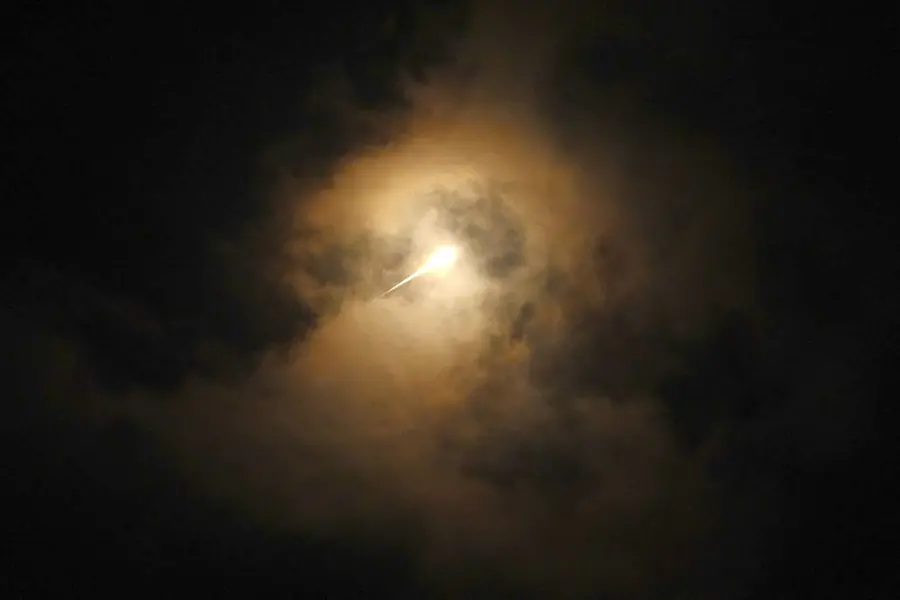
Iran fired ballistic missiles at two Israeli military bases and the headquarters of Mossad, Israel's intelligence agency. Iranian state television reported the strikes, which were dubbed 'Operation True Promise II', citing Mohammad Bagheri, Chief of the General Staff of the Iranian Armed Forces.
Key Targets: Nevatim, Netzarim, and Tel Nof
According to Bagheri, the attack targeted the Nevatim air base, Netzarim military facility, and Tel Nof intelligence unit. The Nevatim base, known for housing Israel's F-35 fighter jets, was highlighted as a significant target, as the fighter jets were reportedly involved in a late September airstrike over Beirut. The IRGC used hypersonic Fatah missiles to hit these sites, according to Iranian media.
Retaliation for Assassinations of Militant Leaders
Iran framed the missile strike as retaliation for the killings of key militant leaders. Bagheri explained that the attack responded to the deaths of Hamas leader Ismail Haniyah and IRGC commander Abbas Nilforoushan in July, as well as Hezbollah leader Sayyed Hassan Nasrallah, who was killed in an Israeli strike in Beirut on September 27.
Iran’s Statement on Civilian Targets and Regional Peace
Bagheri emphasized that the IRGC deliberately avoided civilian targets and infrastructure during the attack. Iranian President Masoud Pezeshkian defended the military operation, stating that it was in line with Iran’s legitimate rights and aimed at ensuring peace and security for the region. Pezeshkian reiterated that the missile strikes were in defense of Iran’s national interests.
Celebrations in Iran
Following the attack, people across Iranian cities took to the streets to celebrate, waving Iranian, Lebanese, and Palestinian flags. The celebrations were seen as expressions of solidarity with the IRGC for what was considered a successful targeting of Israeli military installations.
Israel’s Response: Interceptions and Warnings
Israeli authorities reported that out of approximately 180 missiles launched by Iran, most were intercepted. Prime Minister Benjamin Netanyahu condemned the attack, calling it a "big mistake" and warning that Iran would face significant consequences. Netanyahu stressed Israel’s determination to defend itself and take action against its enemies.
US Military Assistance and Reinforcement
The US quickly mobilized additional military assets to the region in support of Israel. Three squadrons of F-16, F-15E, and A-10 fighter aircraft were deployed, with one squadron already in place. President Joe Biden directed the U.S. military to assist in intercepting the missiles targeting Israel, and Defense Secretary Lloyd Austin denounced the attack as an "outrageous act of aggression."
US Navy’s Role in Missile Defense
The US Navy’s Arleigh Burke-class destroyers, USS Cole and USS Bulkeley, stationed in the Eastern Mediterranean, launched interceptors at the incoming Iranian missiles. While it remains unclear whether the interceptors successfully took down the missiles, U.S. forces played a critical role in assisting Israel’s defense during the attack.
Scale of the Attack and Pentagon’s Assessment
Pentagon officials described the Iranian missile barrage as nearly twice the scope of a similar attack in April. U.S. military officials reaffirmed their commitment to defending Israel, with Pentagon Press Secretary Major Gen. Pat Ryder stating that most of the missiles were intercepted before reaching their targets, though some caused minimal damage.
ANI
Published: 02 Oct 2024, 10:39 am IST
Related Topics
Disclaimer: Kindly avoid objectionable, derogatory, unlawful and lewd comments, while responding to reports. Such comments are punishable under cyber laws. Please keep away from personal attacks. The opinions expressed here are the personal opinions of readers and not that of Mathrubhumi.
