
For many observers, Maduro’s arrest evokes earlier US interventions, particularly the captures of Panama’s Manuel Noriega and Iraq’s Saddam Hussein.
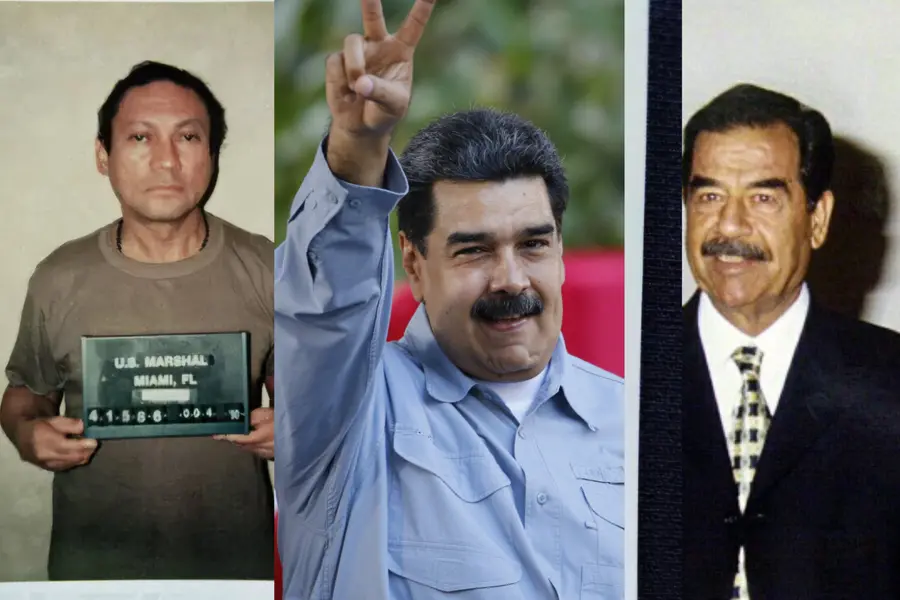
The capture of Venezuelan President Nicolás Maduro by the United States has triggered shockwaves across the globe and revived memories of earlier moments when Washington forcibly removed foreign leaders it accused of criminality or posing a security threat.
US President Donald Trump claimed that Maduro and his wife, Cilia Flores, were seized during what he described as “large-scale” military strikes on Venezuela and flown out of the country. While Washington has offered few operational details, Caracas has publicly said it has no confirmation of the president’s whereabouts.
Also Read: US signals no further action in Venezuela after Maduro capture; Russia reacts
Venezuela’s Vice President Delcy Rodríguez said the government was demanding proof that Maduro and Flores were alive, underscoring the uncertainty surrounding the dramatic claims. The episode follows weeks of escalating US military action in the Caribbean and eastern Pacific, where Washington says it targeted vessels linked to drug trafficking.
For many observers, the moment evokes earlier US interventions, particularly the captures of Panama’s Manuel Noriega and Iraq’s Saddam Hussein.
Noriega: From asset to enemy
In 1989, the United States launched a full-scale invasion of Panama to remove General Manuel Noriega, the country’s de facto ruler. Officially, Washington cited threats to US citizens, electoral fraud, corruption and drug trafficking.
Also Read: Is the ‘Cartel of the Suns’ real? The alleged network behind US strikes on Venezuela
Months earlier, Noriega had been indicted in Miami on drug-smuggling charges, a legal move that paved the way for his removal. Once considered a useful partner in US regional strategy, Noriega fell out of favour as he asserted greater independence and stoked anti-American sentiment.
The invasion, the largest US combat operation since Vietnam at the time, ended with Noriega’s capture and transfer to the United States, where he was tried and imprisoned. After years behind bars in the US and France, he was eventually returned to Panama, where he died in prison in 2017.
Saddam Hussein and the WMD claim
Perhaps the most infamous precedent remains Iraq. Saddam Hussein was captured by US forces in December 2003, nine months after the US-led invasion that was justified by claims Iraq possessed weapons of mass destruction.
Also Read: US strikes in Venezuela caught on camera: Eyewitnesses describe chaos in Caracas | WATCH
US leaders, including then-president George W. Bush, argued that Saddam’s government maintained chemical, biological and nuclear weapons programmes and supported terrorist groups. Iraq denied the accusations, and post-invasion investigations later confirmed that no WMD stockpiles existed.
Saddam, once a US ally during the Iran-Iraq war of the 1980s, was eventually found hiding near Tikrit. He was tried by an Iraqi court, sentenced to death and executed in 2006 — a conclusion that left lasting scars on US credibility and global trust in intelligence-based justifications for war.
Published: 03 Jan 2026, 08:35 pm IST
Related Topics
Disclaimer: Kindly avoid objectionable, derogatory, unlawful and lewd comments, while responding to reports. Such comments are punishable under cyber laws. Please keep away from personal attacks. The opinions expressed here are the personal opinions of readers and not that of Mathrubhumi.
