
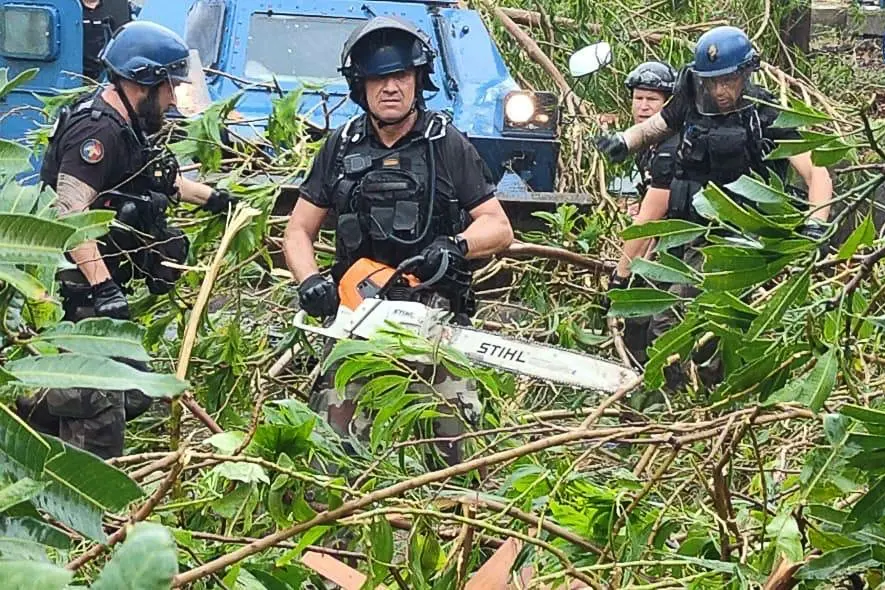
Cape Town: France is rushing aid to its overseas territory of Mayotte in the Indian Ocean after the island was struck by its worst storm in nearly a century. Cyclone Chido, which made landfall on Saturday, caused widespread devastation.
Officials fear that hundreds, possibly thousands, of people have died. As of Monday morning, the official death toll stood at 14, but the full extent of the damage is still being assessed.
Rescue efforts underway as authorities assess the damage
France has sent rescue teams, medical personnel, and supplies to Mayotte from both the mainland and the nearby French territory of Reunion. French television station TF1 reported that Interior Minister Bruno Retailleau had arrived in Mamoudzou, the capital of Mayotte, on Monday.
He told the media, “It will take days and days to establish the human toll.”
More than 800 additional personnel are expected to arrive in the coming days to assist with the recovery efforts.
Mayotte Prefect François-Xavier Bieuville confirmed the scale of the disaster, stating that the death toll could be in the hundreds or even thousands. The cyclone, which hit the densely populated island of 300,000 people, devastated Mayotte’s slums, where metal shacks and informal housing were particularly vulnerable.
“The death toll is several hundred people and could even be in the thousands,” Bieuville said in an interview with Mayotte la 1ere.
“We are struggling to get an accurate count of the dead and injured.”
Mayotte’s infrastructure severely damaged
The cyclone caused severe damage to public infrastructure, including the main airport and hospital. French authorities also reported that electricity supplies had been knocked out across much of the island. The airport’s control tower was damaged, meaning that only military aircraft can fly into Mayotte, which has complicated the rescue response.
Despite being France’s poorest department and the poorest territory in the European Union, Mayotte is a destination for economic migrants from countries like Comoros and Somalia, drawn by better living standards and access to the French welfare system.
The island's large migrant population, including many undocumented migrants, has made it difficult for authorities to fully account for all casualties. Due to Muslim traditions of burying the dead within 24 hours, many of the fatalities may never be officially recorded.
Cyclone Chido continues to affect the region
Cyclone Chido, with winds exceeding 220 kph (136 mph), was a category 4 storm, making it the second strongest on the scale. After hitting Mayotte, it continued its path across the Indian Ocean, affecting nearby islands such as Comoros and Madagascar.
Chido made landfall in Mozambique late on Sunday, where authorities and aid agencies warned that over 2 million people could be affected. Early reports from Mozambique media suggest that three people have died, but the toll is still being assessed.
The cyclone has also raised concerns in Malawi and Zimbabwe, where preparations are underway for possible evacuations due to flooding as Chido moves eastward. The cyclone has weakened as it moves over land, but the damage across the region is expected to be significant.
Cyclone season in the southwestern Indian Ocean lasts from December to March, and recent years have seen a series of powerful storms.
In 2019, Cyclone Idai killed over 1,300 people, mostly in Mozambique, Malawi, and Zimbabwe, while Cyclone Freddy caused more than 1,000 deaths in 2023 across several countries in the region.
AFP
Published: 16 Dec 2024, 06:36 pm IST
Related Topics
Disclaimer: Kindly avoid objectionable, derogatory, unlawful and lewd comments, while responding to reports. Such comments are punishable under cyber laws. Please keep away from personal attacks. The opinions expressed here are the personal opinions of readers and not that of Mathrubhumi.
