
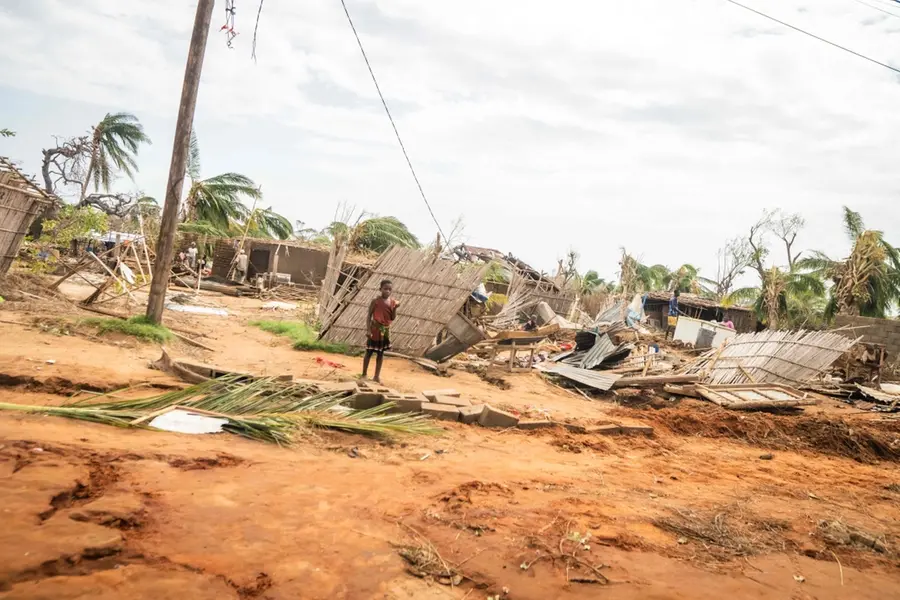
Maputo: The death toll from Cyclone Chido, a powerful tropical cyclone that struck northern Mozambique, has reached 120, with 868 people injured and over 680,000 others affected. These updated figures were provided by Mozambique's national disaster relief agency.
The northern regions of Mozambique, including Cabo Delgado, Nampula, and Niassa, have endured severe damage due to heavy rainfall, storms, and widespread flooding caused by the cyclone. According to the National Institute for Disaster Risk Management and Reduction (INGD), these provinces have been hit hard by the intense weather conditions.
Also Read

Destruction caused by Cyclone Chido
Cyclone Chido made landfall on December 15, bringing torrential rains and violent storms. The cyclone’s impact was most severe in the provinces of Cabo Delgado, Nampula, and Niassa. More than 123,000 families, roughly 622,610 people, have been affected. The storm caused the destruction of over 140,000 homes, either partially or completely.
The latest figures from the national disaster relief agency show that more than 150,000 homes were damaged, along with 250 schools, 89 public buildings, and 52 health facilities. Additionally, nearly 110,000 students have been impacted by the destruction.
In response to the widespread displacement, the Mozambican government has established two emergency shelters. Currently, these shelters are providing refuge to 1,349 people, according to reports from the Xinhua news agency.
In a social media post on Sunday, the INGD emphasised the severe impact of Cyclone Chido on the education and health sectors. "The Cyclone Chido once again highlights the vulnerability of social infrastructure to climate change and the need for resilient planning to mitigate future impacts," the post read.
Cyclone Chido’s path
Cyclone Chido first formed over the southwestern Indian Ocean on December 5. After causing significant damage in Mayotte, a French overseas territory, it made landfall in Mozambique on December 15, leaving behind widespread destruction in its wake.
Cyclone Chido originated as a tropical depression, a weather system characterized by low atmospheric pressure and a circular wind pattern produced by thunderstorms. Tropical depressions are typically marked by sustained winds of 61 km/h or less. If such a system intensifies, it can develop into a tropical storm, with wind speeds between 62 km/h and 119 km/h. When wind speeds exceed this range, the system becomes classified as a tropical cyclone.
Authorities and international humanitarian organizations are continuing to call for support to help meet the urgent needs of the communities affected by the devastation caused by Cyclone Chido.
Agency
Published: 24 Dec 2024, 07:57 am IST
Related Topics
Disclaimer: Kindly avoid objectionable, derogatory, unlawful and lewd comments, while responding to reports. Such comments are punishable under cyber laws. Please keep away from personal attacks. The opinions expressed here are the personal opinions of readers and not that of Mathrubhumi.