
A China-linked businessman has bought a Washington property just 650 feet from the White House for $8.4 million, prompting scrutiny over potential US national security risks.
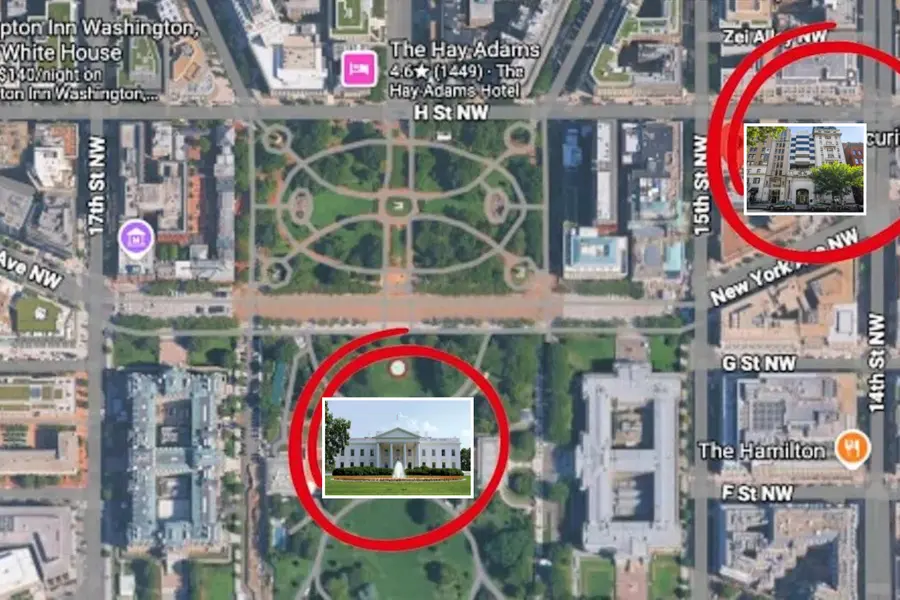
Washington DC: A historic commercial building located about 650 feet from the White House has come under scrutiny after it was purchased for $8.4 million by the Philip Qiu and Family Foundation, headed by Chinese businessman Philip Qiu, also known as Qiu Feili.
The Securities Building on 15th Street NW in Washington, DC, was sold on July 21, according to property records cited in reports. The buyer was the Philip Qiu and Family Foundation.
The purchase has attracted attention because of the property's proximity to the White House and reports about Qiu's previous work and organisational associations in China.
There is no public evidence that the property is being used for espionage or intelligence-gathering. The concerns centre on the potential security implications of foreign-linked ownership of a property located so close to sensitive US government facilities.
Who is Philip Qiu
Qiu, also known as Qiu Feili, has reportedly worked as a detective with the Shanghai Public Security Bureau's criminal investigation team, which operates under China's Ministry of Public Security.
Reports also say he received specialised combat and sniper training while studying at Shanghai Jiao Tong University.
Qiu has held senior positions in organisations associated with China's United Front system, including the Shanghai Overseas Chinese Foundation. He also co-founded the Chinese American Museum in Washington, DC.
These reported connections have drawn additional scrutiny following the purchase of the Washington property.
Why the location matters
The Securities Building is approximately 650 feet from the White House complex, placing it within an unusually sensitive area of the US capital.
Security specialists have raised the possibility that a property in such a location could theoretically provide opportunities to monitor communications or conduct other forms of surveillance.
Former CIA operations officer Bryan Dean Wright has pointed to potential risks involving electronic surveillance and signals intelligence collection.
However, such concerns remain potential risks rather than evidence of wrongdoing. There is currently no publicly established finding that Qiu or his foundation has used the building for intelligence activities.
Calls for investigation
The purchase has prompted national security advocates to call for closer examination of the transaction.
Michael Lucci, chief executive of State Armor, has argued that authorities should consider whether the property should be sold because of the potential security implications.
The Committee on Foreign Investment in the United States, or CFIUS, can review certain foreign transactions and can impose measures or, in some circumstances, require divestment. However, US rules do not automatically prohibit foreign ownership of every commercial property near government facilities.
The case has therefore renewed questions about whether Washington needs stronger restrictions on strategically located properties.
Why this matters
The controversy is less about the building itself and more about the combination of location, ownership and the buyer's reported background.
A property just 650 feet from the White House is unusually close to the centre of US political power. If its owner has documented links to foreign security or influence organisations, national security officials may consider whether additional safeguards are necessary.
At the same time, proximity and reported affiliations alone do not establish espionage. Any government action would require authorities to assess the actual ownership structure, intended use of the property and applicable US national security laws.
The bigger US-China context
The episode comes amid wider US concerns over Chinese investment, influence operations and access to strategically sensitive locations.
Washington has increasingly scrutinised Chinese-linked investments involving critical infrastructure, technology, data and sensitive locations. CFIUS has played a central role in reviewing transactions that could create national security vulnerabilities.
The Washington property case could add to calls for closer scrutiny of foreign purchases in areas surrounding the White House and other sensitive federal facilities.
What happens next
The key issue for US authorities is whether the transaction falls within the scope of existing national security review mechanisms and whether the property presents a specific, identifiable security vulnerability.
Representatives for Qiu and his affiliated organisations reportedly did not respond to requests for comment on the purchase or the concerns surrounding his organisational links.
For now, the deal remains under scrutiny, not an established espionage case.
Published: 17 Aug 2026, 11:31 am IST
ABOUT THE AUTHOR

Disclaimer: Kindly avoid objectionable, derogatory, unlawful and lewd comments, while responding to reports. Such comments are punishable under cyber laws. Please keep away from personal attacks. The opinions expressed here are the personal opinions of readers and not that of Mathrubhumi.