
Xi received a lavish state reception, announced cultural exchanges, and gifted pandas to the US, amid ongoing discussions regarding Taiwan, Iran, and global security.
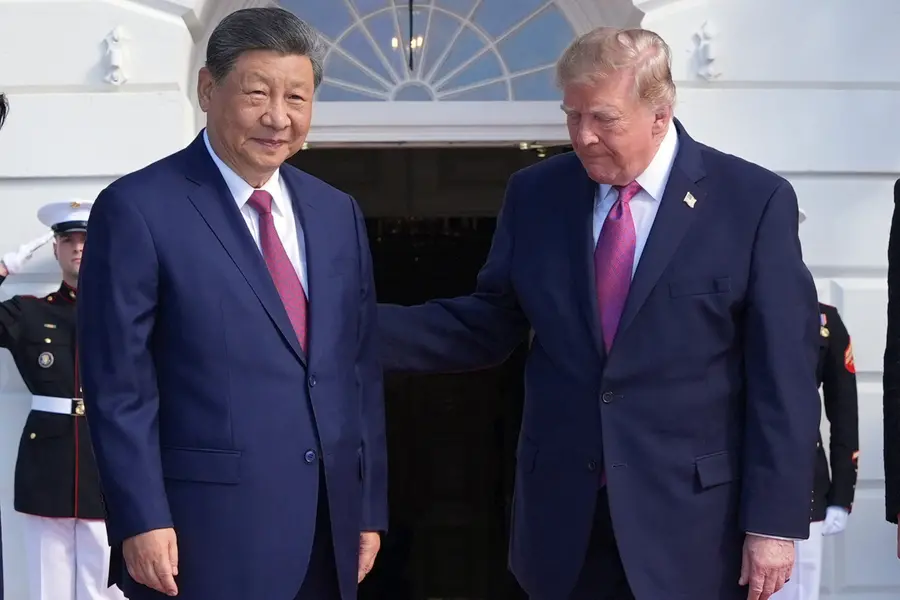
Washington: US President Donald Trump on Thursday hailed the “truly great friendship” he has established with Xi Jinping as the Chinese leader commenced his highly anticipated state visit, advocating for closer cooperation between the world's two largest economies to prevent friction as they compete.
While Trump faces numerous complex issues to resolve with the leader of America’s primary economic rival, he emphasised his long-standing relationship with Xi as the two leaders gathered alongside aides for opening remarks prior to formal discussions.
“From the time of my first election in 2016, President Xi and I have forged a friendship, a truly great friendship, actually, built on mutual respect and the vital interests of our people,” Trump said.
ALSO READ: Melania Trump and Peng Liyuan tour Asian art museum in DC
China has resisted pressure and economic threats from the Trump administration to exert its considerable influence over Iran to compel acceptance of U.S. terms to conclude the nearly seven-month conflict. Xi seeks a permanent cessation of American arms sales to Taiwan alongside a relaxation of export controls on advanced microchips. On Wednesday, the two nations agreed to a two-month extension of a one-year trade truce scheduled to expire on 10 November as negotiators work toward a more lasting accord.
Xi delivered more pointed opening comments, observing that Chinese and American interests are “deeply intertwined” and stressing that “competition should be a healthy one and should be kept within bounds."
He reiterated his caution that both nations must avoid the “Thucydides trap," the historical concept suggesting that war often results when an established power is challenged by a rising rival. Xi voiced a similar warning during Trump's visit to Beijing in May.
“It should be a race of catching up with one another, not a wrestle in which one either wins or loses,” Xi added.
The Chinese president also announced that Beijing will invite 100,000 American students to China for educational programs and exchanges over the next five years, while also dispatching two pandas to the zoo in Atlanta. Describing the animals as an “envoy of friendship," Xi noted they would arrive to meet the American public within a “few days."
Earlier Thursday, Trump stated in a social media post that artificial intelligence, which he is seeking to rebrand as “superintelligence,” would feature prominently on the agenda amid global concerns regarding job displacement and existential risks.
“I want to leave it exactly where it is,” Trump wrote. “That is China’s position also.”
Xi similarly referenced AI in his introductory remarks, stating that both nations bear a duty to ensure human oversight remains paramount in technological development.
“We have both the capability and responsibility to develop and manage AI for good and ensure that a development of AI is always under human control and serves the well-being of the people,” the Chinese leader said.
ALSO READ: Xi Jinping arrives in US for Trump talks
Finance ministers from both countries conferred earlier this week, with the U.S. putting forward a new “notification mechanism” to handle AI-related incidents between the nations.
Trump made clear his intent to host an impressive reception for Xi. The Republican president ensured the completion of a new helicopter landing pad on the White House South Lawn ahead of the visit and personally greeted Xi and his wife, Peng Liyuan, upon their arrival at Joint Base Andrews outside Washington on Wednesday evening.
The White House organised an elaborate military review for the leaders and their spouses prior to the Oval Office talks. Following the inspection, First Lady Melania Trump accompanied Peng on a tour of the Smithsonian National Museum of Asian Art.
After approximately 90 minutes of bilateral talks, the leaders gathered on the South Lawn where Trump showcased the new White House helipad and guided Xi through Marine One, the presidential helicopter. The two leaders were also observed viewing the construction site of the new ballroom from a distance. Xi departed the White House shortly thereafter, with plans to return in the evening for the formal state dinner.
“We had a great meeting,” Trump remarked briefly to reporters following the tour.
Later, the leaders will dine on sea bass at a black-tie dinner in the White House East Room, featuring red decor and a toast commemorating the late President Richard Nixon, whose 1972 journey to China led to the establishment of formal diplomatic ties in 1979 and the simultaneous severance of official relations with Taiwan.
Trump's decision to accord Xi a grand reception drew criticism from lawmakers across both parties and certain White House allies.
“Quite frankly, had the White House asked me for advice, I would have suggested the president not invite Xi Jinping to Washington for such a lavish welcome here in the United States of America based on all of the troubling issues we have with President Xi and the Chinese Communist Party,” said Sen. Roger Wicker, R-Miss.
Shortly after Xi arrived in Washington, Treasury Secretary Scott Bessent announced during a Fox News appearance that both sides had finalised terms to extend the bilateral trade truce.
Both leaders possess clear incentives to sustain the trade truce.
Trump's Republican Party faces political pressure as it seeks to retain control of Congress in November's midterm elections and can ill afford additional economic instability. Concurrently, Xi is managing an uneven domestic economic environment in China, characterised by weak domestic demand alongside strong high-tech exports.
The two sides are also anticipated to address the ongoing conflict involving Iran. Trump has maintained that China, which relies far more heavily on Gulf oil imports than the U.S., possesses significant incentive to leverage its relationship with Tehran to help bring an end to hostilities.
However, Trump's military intervention has drawn criticism from Beijing, with Chinese officials condemning U.S. and Israeli actions while Xi warned the conflict represented a troubling return to the “law of the jungle."
Chinese leadership was similarly unsettled by the military operation ordered by Trump earlier this year to remove Venezuelan President Nicolás Maduro from power and transport him to New York to face federal narcotics and drug trafficking charges.
Trump has since urged Latin American nations to curtail economic and diplomatic ties with China, framing U.S. involvement in Venezuela’s energy sector as a necessary measure to counter Chinese and Russian influence in South America.
China continues to frame the status of Taiwan as the most sensitive issue within US-China relations.
Beijing regards Taiwan as Chinese territory and maintains its commitment to unify the island with the mainland, by force if deemed necessary. The U.S. remains legally obligated to provide Taiwan with defensive military equipment to deter armed aggression.
China has repeatedly pressed Washington to permanently cease weapons sales, most notably during the meeting between Trump and Xi in Beijing in May.
Following those discussions, Trump indicated he was withholding final approval for a proposed $14 billion arms package for Taiwan, describing weapons transfers to the island as a “very good negotiating chip” in broader talks with China.
While Xi made no direct mention of Taiwan during his public remarks, he stressed that both nations “must hold the line of no conflict and no confrontation.”
“We can certainly find the right path for two great countries to get along on this planet we both call home,” Xi said.
AP
Published: 24 Sept 2026, 11:42 pm IST
ABOUT THE AUTHOR

Related Topics
Disclaimer: Kindly avoid objectionable, derogatory, unlawful and lewd comments, while responding to reports. Such comments are punishable under cyber laws. Please keep away from personal attacks. The opinions expressed here are the personal opinions of readers and not that of Mathrubhumi.