
Gaza`s hospitals are overwhelmed with malnourished children. The blockade and ongoing conflict worsen the crisis, leading to starvation.
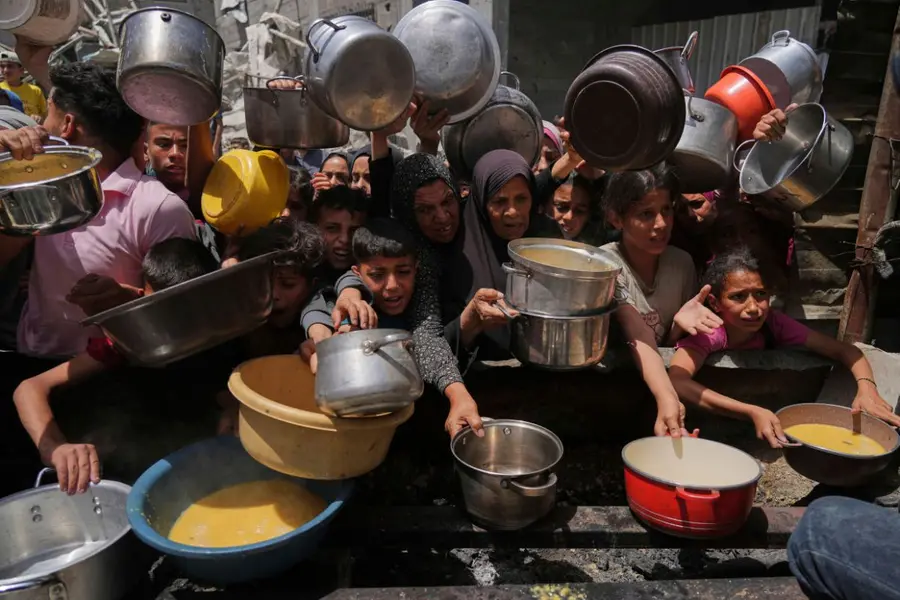
Gaza Strip: Grasping her daughter’s thin arm, Asmaa al-Arja pulls a shirt over the two-year-old’s exposed ribs and swollen belly. The child, Mayar, lies on a hospital bed, gasping and then crying uncontrollably, wrapping her arms around herself for comfort.
This is not Mayar’s first hospital stay for malnutrition, but it is her longest at 17 days. She suffers from coeliac disease, an autoimmune condition requiring a gluten-free diet. However, after 19 months of war and Israel’s blockade, there is little suitable food left in Gaza.
“She needs nappies, soya milk and special food. These are not available because of the border closures. If they are, I can’t afford them,” her mother said at Nasser Hospital in Khan Younis.
Thousands of children treated for malnutrition
Mayar is one of more than 9,000 children treated for malnutrition in Gaza this year, according to the UN children’s agency. Food security experts expect tens of thousands more cases in the coming year.
Experts warn that if Israel does not end its military campaign and fully lift the blockade, the region could fall into famine. However, the World Health Organization recently stated that people are already starving.
“Everywhere you look, people are hungry. They point their fingers to their mouths, showing that they need something to eat,” said Nestor Owomuhangi, UN Population Fund representative for the Palestinian territories. “The worst has already arrived in Gaza.”
Aid still not reaching the people
For over two months, Israel blocked all food, medicine and supplies from entering Gaza during ongoing airstrikes and ground operations. With local food production nearly wiped out, Gazans rely almost entirely on aid.
After denying a food shortage, Israel began allowing limited humanitarian trucks into Gaza under international pressure. Some trucks carried baby food.
“Children are already dying from malnutrition and there are more babies in Gaza now who will be in mortal danger if they don’t get fast access to the nutrition supplies needed to save their lives,” said Tess Ingram of the UN children’s agency.
UN agencies say the incoming aid is still far too little. Around 600 trucks per day are needed, similar to the number entering during a recent ceasefire. Complicated Israeli military procedures and the breakdown of law and order have made distributing aid extremely difficult.
This week, more than a dozen trucks reached central Gaza warehouses for the first time since the blockade was eased, a UN official said on condition of anonymity.
Concerns over new distribution plan
Israel has accused Hamas of diverting aid, without providing evidence. It plans to introduce a new aid distribution system, but UN agencies and humanitarian groups warn it will not meet the population’s needs.
They say the new system would force many to move again to be near distribution centres, violating humanitarian principles by not delivering aid to people where they live.
Hospitals at breaking point
Mayar’s coeliac disease has led to chronic diarrhoea, keeping her in and out of hospital all year. At just 7 kilograms, she weighs about half what a healthy child her age should. Health staff say baby formula and other supplies are vanishing.
“We have nothing at Nasser Hospital,” said Dr Ahmed al-Farrah. His emergency centre for malnourished children is full. Supplies are running low, people are surviving on scraps, and the situation is dire for babies and pregnant women, he added.
Starvation spreads across families
In the hospital’s feeding centre, undernourished mothers try to soothe their frail children. Some children have visible spines and swollen limbs due to lack of food.
According to the Integrated Food Security Phase Classification, up to 71,000 children could suffer from malnutrition by March. Nearly 17,000 pregnant and breastfeeding women are also expected to need urgent nutritional support.
Mai Namleh and her 18-month-old son, who live in a tent, are both malnourished. She has barely any breastmilk and gives him diluted formula to stretch it. Sometimes, she feeds him starch to silence his hunger.
An aid group gave her 30 packets of nutritional supplements, but they lasted just two days after she shared them with relatives.
A future without food
In another tent, Nouf al-Arja paid a high price for a kilogram of red lentils. Her family cooks it with lots of water to make it last. She has lost 23 kilograms and struggles to concentrate due to constant dizziness.
Her three-year-old daughter and four-month-old son are both malnourished. She is struggling to breastfeed and worries her baby will suffer the same fate.
“I keep looking for infant food... so I can feed him. There is nothing,” she said.
AP inputs
Published: 23 May 2025, 09:33 am IST
Related Topics
Disclaimer: Kindly avoid objectionable, derogatory, unlawful and lewd comments, while responding to reports. Such comments are punishable under cyber laws. Please keep away from personal attacks. The opinions expressed here are the personal opinions of readers and not that of Mathrubhumi.
